
Skip to main navigation Skip to main content
  • KAPS
  • E-Submission

APS : Advances in Pediatric Surgery

OPEN ACCESS
ABOUT
BROWSE ARTICLES
EDITORIAL POLICY
FOR CONTRIBUTORS
Original Article

Long-term Outcome of Laparoscopic Hernia Sac Transection and Intracorporeal Ligation in Children: A Single Center Cohort Study

Journal of the Korean Association of Pediatric Surgeons 2014;20(2):23-27.
Published online: December 30, 2014

1Division of Pediatric Surgery, Department of Surgery, Korea University College of Medicine, Seoul, Korea.

2Department of Pediatrics, Korea University College of Medicine, Seoul, Korea.

Correspondence: Yoon Jung Boo, Division of Pediatric Surgery, Department of Surgery, Korea University College of Medicine, 73, Inchon-ro, Seongbuk-gu, Seoul 136-705, Korea. Tel: +82-2-920-6844, Fax: +82-2-928-1631, drboo@korea.ac.kr
• Received: August 5, 2014   • Revised: August 25, 2014   • Accepted: September 6, 2014

Copyright © 2014 by the Korean Association of Pediatric Surgeons

This is an Open Access article distributed under the terms of the Creative Commons Attribution Non-Commercial License (http://creativecommons.org/licenses/by-nc/3.0/) which permits unrestricted non-commercial use, distribution, and reproduction in any medium, provided the original work is properly cited.

  • 2 Views
  • 0 Download
next
  • Purpose
    Laparoscopic hernia repair in children is still controversial. The aim of this study was to report our long-term results of the laparoscopic hernia technique, which is based on the same surgical principles as conventional open herniotomy.
  • Methods
    Five hundred fourteen pediatric patients with inguinal hernia were included in this study under informed consent. All patients underwent a laparoscopic technique of sac transection and intracorporeal ligation. The asymptomatic contralateral inguinal ring was routinely explored and repaired if a patient had patent processus vaginalis on the contralateral side. Patients were prospectively followed for 5 years. Those who were lost to follow-up were excluded from the study. Perioperative complications and recurrences were evaluated.
  • Results
    The mean follow-up period was 29 months. Mean operation time was 27.5 minutes. Forty one percent of the patients had contralateral patent processus vaginalis. Only one hernia recurred (0.19%). We had one case of contralateral metachronous hernia (0.21%) during follow-up period.
  • Conclusion
    The long-term follow-up results of our study revealed that laparoscopic hernia sac transection and ligation can be a safe and effective alternative for conventional herniorraphy.

The abstract of this article was presented at the 65th Congress of the Korean Surgical Society, Seoul, Korea, November 21-23, 2013.

No potential conflict of interest relevant to this article was reported.

  • 1. Schier F. Laparoscopic herniorrhaphy in girls. J Pediatr Surg 1998;33:1495-1497.
  • 2. Schier F, Montupet P, Esposito C. Laparoscopic inguinal herniorrhaphy in children: a three-center experience with 933 repairs. J Pediatr Surg 2002;37:395-397.
  • 3. Harrison MR, Lee H, Albanese CT, Farmer DL. Subcutaneous endoscopically assisted ligation (SEAL) of the internal ring for repair of inguinal hernias in children: a novel technique. J Pediatr Surg 2005;40:1177-1180.
  • 4. Becmeur F, Philippe P, Lemandat-Schultz A, Moog R, Grandadam S, Lieber A, et al. A continuous series of 96 laparoscopic inguinal hernia repairs in children by a new technique. Surg Endosc 2004;18:1738-1741.
  • 5. Tsai YC, Wu CC, Ho CH, Tai HC, Wu CC, Yang SS. Minilaparoscopic herniorrhaphy in pediatric inguinal hernia: a durable alternative treatment tostandard herniotomy. J Pediatr Surg 2011;46:708-712.
  • 6. Lau ST, Lee YH, Caty MG. Current management of hernias and hydroceles. Semin Pediatr Surg 2007;16:50-57.
  • 7. Tsai YC, Wu CC, Yang SS. Open versus minilaparoscopic herniorrhaphy for children: a prospective comparative trial with midterm follow-up evaluation. Surg Endosc 2010;24:21-24.
  • 8. International Pediatric Endosurgery Group. IPEG guidelines for inguinal hernia and hydrocele. J Laparoendosc Adv Surg Tech A 2010;20:x-xiv.
  • 9. Treef W, Schier F. Characteristics of laparoscopic inguinal hernia recurrences. Pediatr Surg Int 2009;25:149-152.
  • 10. Schier F. Laparoscopic inguinal hernia repair-a prospective personal series of 542 children. J Pediatr Surg 2006;41:1081-1084.
  • 11. Gorsler CM, Schier F. Laparoscopic herniorrhaphy in children. Surg Endosc 2003;17:571-573.
  • 12. Tsai YC, Wu CC, Yang SS. Minilaparoscopic herniorrhaphy with hernia sac transection in children and young adults: a preliminary report. Surg Endosc 2007;21:1623-1625.
  • 13. Kim HG, Boo YJ. A preliminary report of laparoscopic hernia repair in children. J Korean Assoc Pediatr Surg 2011;17:58-64.
  • 14. Schier F. Laparoscopic hernia repair: an option in babies weighing 5 kg or less. Pediatr Surg Int 2006;22:1033.
  • 15. Marte A, Sabatino MD, Borrelli M, Parmeggiani P. Decreased recurrence rate in the laparoscopic herniorraphy in children: comparison between two techniques. J Laparoendosc Adv Surg Tech A 2009;19:259-262.
  • 16. Dutta S, Albanese C. Transcutaneous laparoscopic hernia repair in children: a prospective review of 275 hernia repairs with minimum 2-year follow-up. Surg Endosc 2009;23:103-107.
  • 17. Endo M, Watanabe T, Nakano M, Yoshida F, Ukiyama E. Laparoscopic completely extraperitoneal repair of inguinal hernia in children: a single-institute experience with 1,257 repairs compared with cut-down herniorrhaphy. Surg Endosc 2009;23:1706-1712.
  • 18. Tam YH, Lee KH, Sihoe JD, Chan KW, Wong PY, Cheung ST, et al. Laparoscopic hernia repair in children by the hook method: a single-center series of 433 consecutive patients. J Pediatr Surg 2009;44:1502-1505.
  • 19. Becmeur F, Dimitriu C, Lacreuse I, Boeyeldieu L, Moog R, Kauffmann I, et al. Laparoscopic treatment of congenital inguinal hernias in children (212 patients). Arch Pediatr 2007;14:985-988.
  • 20. Giseke S, Glass M, Tapadar P, Matthyssens L, Philippe P. A true laparoscopic herniotomy in children: evaluation of long-term outcome. J Laparoendosc Adv Surg Tech A 2010;20:191-194.
  • 21. Tabrizian F, Raisolsadat SM, Houshmand B, Yaghubi MA. Assessment of the necessity of sac high ligation in inguinal hernia open surgery among children. J Pediatr Surg 2013;48:547-549.
  • 22. Pant N, Aggarwal SK, Ratan SK. Laparoscopic repair of hernia in children: comparison between ligation and nonligation of sac. J Indian Assoc Pediatr Surg 2014;19:76-79.
  • 23. Riquelme M, Aranda A, Riquelme-Q M. Laparoscopic pediatric inguinal hernia repair: no ligation, just resection. J Laparoendosc Adv Surg Tech A 2010;20:77-80.
  • 24. Blackburn SC, Adams SD, Mahomed AA. Risk of hernia occurrence where division of an indirect inguinal sac without ligation is undertaken. J Laparoendosc Adv Surg Tech A 2012;22:713-714.
  • 25. Ein SH, Njere I, Ein A. Six thousand three hundred sixty-one pediatric inguinal hernias: a 35-year review. J Pediatr Surg 2006;41:980-986.
  • 26. Ron O, Eaton S, Pierro A. Systematic review of the risk of developing a metachronous contralateral inguinal hernia in children. Br J Surg 2007;94:804-811.
  • 27. Park T, Jung E, Park WH, Choi SO. Clinical analysis of metachronous inguinal hernia in children. J Korean Surg Soc 2011;80:142-146.
  • 28. Tam YH, Wong YS, Pang KK, Tsui SY, Mou JW, Houben CH, et al. Unexpected metachronous hernia development in children following laparoscopic unilateral hernia repair with negative evaluation for contralateral patent processus vaginalis. J Laparoendosc Adv Surg Tech A 2013;23:287-290.
  • 29. Saad S, Mansson J, Saad A, Goldfarb MA. Ten-year review of groin laparoscopy in 1001 pediatric patients with clinical unilateral inguinal hernia: an improved technique with transhernia multiple-channel scope. J Pediatr Surg 2011;46:1011-1014.
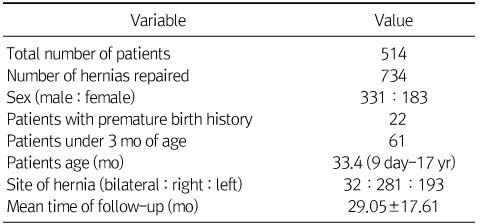
Table 1
Patients' Demographics and Preoperative Characteristics

Values are presented as n, ratio, mean (range), or mean±SD.

jkaps-20-23-i001.jpg
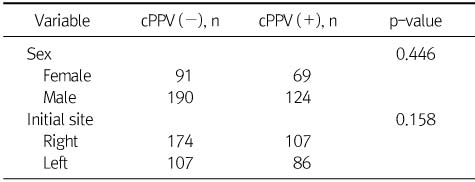
Table 2
Number of Contralateral Patent Processus Vaginalis (cPPV)
jkaps-20-23-i002.jpg

Download Citation

Download a citation file in RIS format that can be imported by all major citation management software, including EndNote, ProCite, RefWorks, and Reference Manager.

Format:

Include:

Long-term Outcome of Laparoscopic Hernia Sac Transection and Intracorporeal Ligation in Children: A Single Center Cohort Study
J Korean Assoc Pediatr Surg. 2014;20(2):23-27.   Published online December 30, 2014
Download Citation

Download a citation file in RIS format that can be imported by all major citation management software, including EndNote, ProCite, RefWorks, and Reference Manager.

Format:
Include:
Long-term Outcome of Laparoscopic Hernia Sac Transection and Intracorporeal Ligation in Children: A Single Center Cohort Study
J Korean Assoc Pediatr Surg. 2014;20(2):23-27.   Published online December 30, 2014
Close
Long-term Outcome of Laparoscopic Hernia Sac Transection and Intracorporeal Ligation in Children: A Single Center Cohort Study

Patients' Demographics and Preoperative Characteristics

Values are presented as n, ratio, mean (range), or mean±SD.

Number of Contralateral Patent Processus Vaginalis (cPPV)

Table 1 Patients' Demographics and Preoperative Characteristics

Values are presented as n, ratio, mean (range), or mean±SD.

Table 2 Number of Contralateral Patent Processus Vaginalis (cPPV)