
Skip to main navigation Skip to main content
  • KAPS
  • E-Submission

APS : Advances in Pediatric Surgery

OPEN ACCESS
ABOUT
BROWSE ARTICLES
EDITORIAL POLICY
FOR CONTRIBUTORS
Original Article

Thyroid Cancer in Pediatric Age: A Single Institution Experience

Journal of the Korean Association of Pediatric Surgeons 2017;23(2):42-47.
Published online: December 20, 2017

1Department of Pediatric Surgery, Seoul National University Children's Hospital, Seoul, Korea.

2Department of Pediatric Surgery, Seoul National University College of Medicine, Seoul, Korea.

3Department of Surgery, Chung-Ang University College of Medicine, Seoul, Korea.

Correspondence: Hyun-Young Kim, Department of Pediatric Surgery, Seoul National University College of Medicine, 103 Daehak-ro, Jongno-gu, Seoul 03080, Korea. Tel: +82-2-2072-2478, Fax: +82-2-747-5130, spkhy02@snu.ac.kr
• Received: July 17, 2017   • Revised: September 5, 2017   • Accepted: September 23, 2017

Copyright © 2017 Korean Association of Pediatric Surgeons

This is an Open Access article distributed under the terms of the Creative Commons Attribution Non-Commercial License (https://creativecommons.org/licenses/by-nc/4.0) which permits unrestricted non-commercial use, distribution, and reproduction in any medium, provided the original work is properly cited.
  • 0 Views
  • 0 Download
prev next
  • Purpose
    Thyroid cancer is a rare disease in pediatric population, but its incidence rate is increasing. The aim of this report is to present a single institution experience of pediatric thyroid cancer and to identify clinical features, predisposing factors, and postoperative course of pediatric thyroid cancer.
  • Methods
    We retrospectively reviewed 35 pediatric patients who underwent operation due to thyroid cancer at Seoul National University Children's Hospital between May 1997 and January 2017. The median follow-up period was 70 months (range, 5–238 months).
  • Results
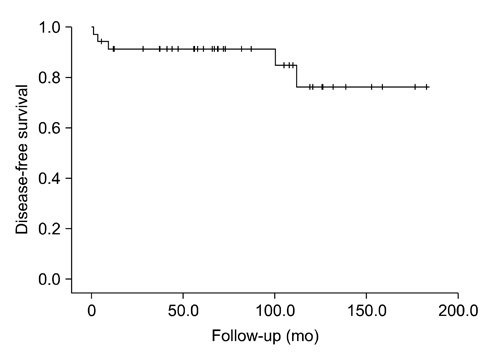
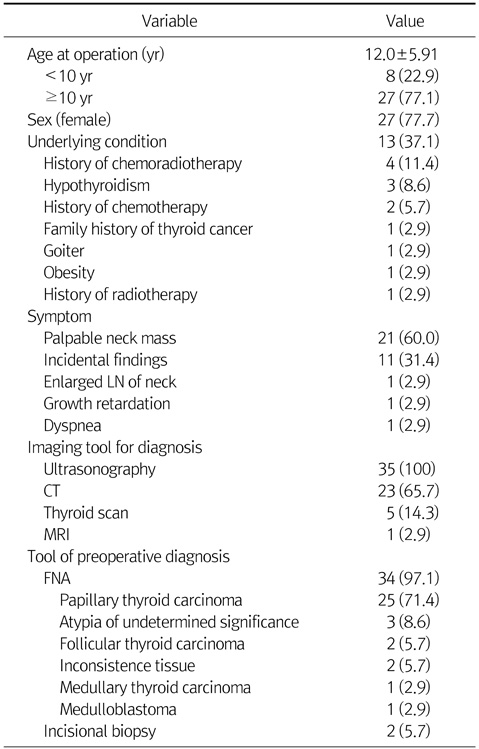
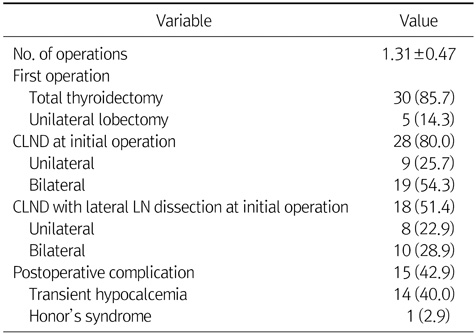
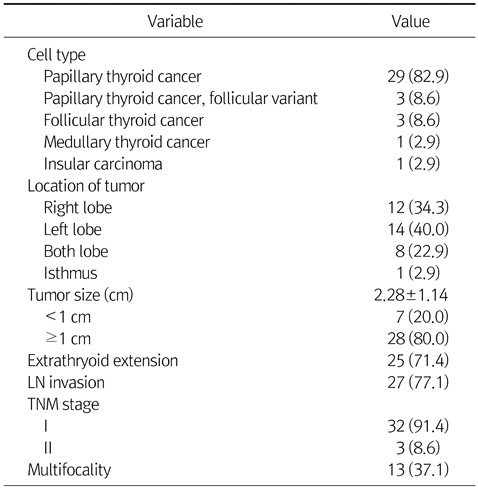
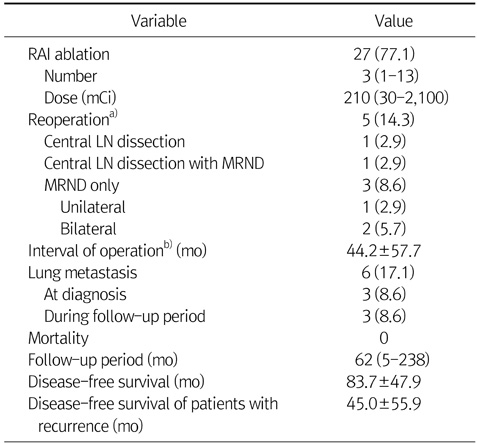
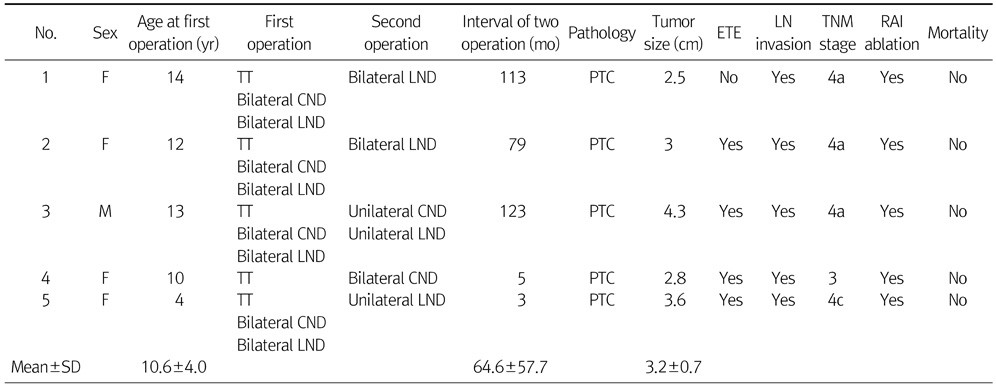
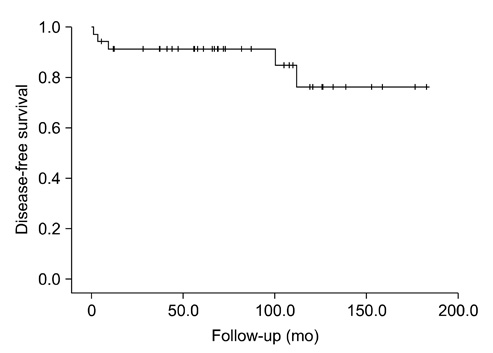
    The mean age at operation was 12.0±5.91 years and 27 patients were female. The underlying conditions in patients included history of chemoradiotherapy for previous other malignancies (n=4), hypothyroidism (n=3), history of chemotherapy (n=2), family history of thyroid cancer (n=1) and history of radiation therapy (n=1). The initial symptoms were palpable neck mass (n=21) and incidental findings (n=11). Total thyroidectomy (n=30) or unilateral lobectomy (n=5) were performed. There were 15 postoperative complications including transient hypocalcemia in 14 patients and Horner's syndrome in 1 patient. The most common pathologic cell type was papillary thyroid cancer (n=29). Extrathyroid extension and lymph node invasion were found in 25 patients and 27 patients, respectively. Thirteen patients showed multifocality. During follow-up period, 5 patients underwent additional operation because of tumor recurrence in lymph nodes. Lung metastasis was detected in 3 patients at the time of diagnosis and in 3 patients during follow-up period. The mortality rate was zero and mean disease-free survival was 83.7±47.9 months.
  • Conclusion
    Pediatric thyroid cancer has lower mortality rate and recurrence rate as seen in this study despite the advanced stage at diagnosis. A thorough follow-up of patients with an underlying condition such as history of chemoradiotherapy and understanding new pediatric guideline can be helpful to maximize patients' survival and prognosis.

No potential conflict of interest relevant to this article was reported.

  • 1. Siegel R, Ma J, Zou Z, Jemal A. Cancer statistics, 2014. CA Cancer J Clin 2014;64:9-29.
  • 2. Siegel DA, King J, Tai E, Buchanan N, Ajani UA, Li J. Cancer incidence rates and trends among children and adolescents in the United States, 2001-2009. Pediatrics 2014;134:e945-e955.
  • 3. Steliarova-Foucher E, Stiller CA, Pukkala E, Lacour B, Plesko I, Parkin DM. Thyroid cancer incidence and survival among European children and adolescents (1978-1997): report from the automated childhood cancer information system project. Eur J Cancer 2006;42:2150-2169.
  • 4. Cho YY, Jang HW, Joung JY, Park SM, Jeong DJ, Kim SW, et al. Trends in thyroid cancer incidence in Korean children (1999-2012) based on palpation and nonpalpation detection methods. Eur Thyroid J 2015;4:252-259.
  • 5. Oh CM, Won YJ, Jung KW, Kong HJ, Cho H, Lee JK, et al. Cancer statistics in Korea: incidence, mortality, survival, and prevalence in 2013. Cancer Res Treat 2016;48:436-450.
  • 6. McNally RJ, Blakey K, James PW, Gomez Pozo B, Basta NO, Hale J. Increasing incidence of thyroid cancer in Great Britain, 1976-2005: age-period-cohort analysis. Eur J Epidemiol 2012;27:615-622.
  • 7. Moon EK, Park HJ, Oh CM, Jung KW, Shin HY, Park BK, et al. Cancer incidence and survival among adolescents and young adults in Korea. PLoS One 2014;9:e96088.
  • 8. Czene K, Lichtenstein P, Hemminki K. Environmental and heritable causes of cancer among 9.6 million individuals in the Swedish family-cancer database. Int J Cancer 2002;99:260-266.
  • 9. Park YJ, Ahn HY, Choi HS, Kim KW, Park DJ, Cho BY. The long-term outcomes of the second generation of familial nonmedullary thyroid carcinoma are more aggressive than sporadic cases. Thyroid 2012;22:356-362.
  • 10. Williams ED, Doniach I, Bjarnason O, Michie W. Thyroid cancer in an iodide rich area: a histopathological study. Cancer 1977;39:215-222.
  • 11. Romei C, Fugazzola L, Puxeddu E, Frasca F, Viola D, Muzza M, et al. Modifications in the papillary thyroid cancer gene profile over the last 15 years. J Clin Endocrinol Metab 2012;97:E1758-E1765.
  • 12. Kazakov VS, Demidchik EP, Astakhova LN. Thyroid cancer after Chernobyl. Nature 1992;359:21.
  • 13. Furukawa K, Preston D, Funamoto S, Yonehara S, Ito M, Tokuoka S, et al. Long-term trend of thyroid cancer risk among Japanese atomic-bomb survivors: 60 years after exposure. Int J Cancer 2013;132:1222-1226.
  • 14. White MG, Cipriani NA, Abdulrasool L, Kaplan S, Aschebrook-Kilfoy B, Angelos P, et al. Radiation-induced differentiated thyroid cancer is associated with improved overall survival but not thyroid cancer-specific mortality or disease-free survival. Thyroid 2016;26:1053-1060.
  • 15. Sinnott B, Ron E, Schneider AB. Exposing the thyroid to radiation: a review of its current extent, risks, and implications. Endocr Rev 2010;31:756-773.
  • 16. Mazonakis M, Tzedakis A, Damilakis J, Gourtsoyiannis N. Thyroid dose from common head and neck CT examinations in children: is there an excess risk for thyroid cancer induction? Eur Radiol 2007;17:1352-1357.
  • 17. Francis GL, Waguespack SG, Bauer AJ, Angelos P, Benvenga S, Cerutti JM, et al. Management guidelines for children with thyroid nodules and differentiated thyroid cancer. Thyroid 2015;25:716-759.
  • 18. Welch Dinauer CA, Tuttle RM, Robie DK, McClellan DR, Svec RL, Adair C, et al. Clinical features associated with metastasis and recurrence of differentiated thyroid cancer in children, adolescents and young adults. Clin Endocrinol (Oxf) 1998;49:619-628.
  • 19. Gupta A, Ly S, Castroneves LA, Frates MC, Benson CB, Feldman HA, et al. A standardized assessment of thyroid nodules in children confirms higher cancer prevalence than in adults. J Clin Endocrinol Metab 2013;98:3238-3245.
  • 20. Chow SM, Law SC, Mendenhall WM, Au SK, Yau S, Mang O, et al. Differentiated thyroid carcinoma in childhood and adolescence-clinical course and role of radioiodine. Pediatr Blood Cancer 2004;42:176-183.
  • 21. Harness JK, Thompson NW, McLeod MK, Pasieka JL, Fukuuchi A. Differentiated thyroid carcinoma in children and adolescents. World J Surg 1992;16:547-553 discussion 553-4.
  • 22. LaFranchi SH. Inaugural management guidelines for children with thyroid nodules and differentiated thyroid cancer: children are not small adults. Thyroid 2015;25:713-715.
  • 23. Handkiewicz-Junak D, Wloch J, Roskosz J, Krajewska J, Kropinska A, Pomorski L, et al. Total thyroidectomy and adjuvant radioiodine treatment independently decrease locoregional recurrence risk in childhood and adolescent differentiated thyroid cancer. J Nucl Med 2007;48:879-888.
Fig. 1

Disease-free survival.

jkaps-23-42-g001.jpg
Table 1

Clinical Characteristics of Patients (n=35)

Values are presented as mean±SD or n (%).

LN, lymph node; FNA, fine needle aspiration.

jkaps-23-42-i001.jpg
Table 2

Operation (n=35)

Values are presented as mean±SD or n (%).

CLND, central lymph node dissection; LN, lymph node.

jkaps-23-42-i002.jpg
Table 3

Pathology Results (n=35)

Values are presented as n (%) or mean±SD.

LN, lymph node.

jkaps-23-42-i003.jpg
Table 4

Postoperative Course (n=35)

Values are presented as n (%), median (range), or mean±SD.

RAI, radioactive iodine; LN, lymph node; MRND, modified radical neck dissection.

a)Fivepatients underwent lymph node dissection due to recurrence.

b)Period between first operation and reoperation.

jkaps-23-42-i004.jpg
Table 5

Reoperation Cases

F, female; M, male; TT, total thyroidectomy; CND, central node dissection; LND, lateral node dissection; PTC, papillary thyroid cancer; ETE, extrathyroid extension; LN, lymph node; RAI, radioactive iodine.

jkaps-23-42-i005.jpg

Download Citation

Download a citation file in RIS format that can be imported by all major citation management software, including EndNote, ProCite, RefWorks, and Reference Manager.

Format:

Include:

Thyroid Cancer in Pediatric Age: A Single Institution Experience
J Korean Assoc Pediatr Surg. 2017;23(2):42-47.   Published online December 20, 2017
Download Citation

Download a citation file in RIS format that can be imported by all major citation management software, including EndNote, ProCite, RefWorks, and Reference Manager.

Format:
Include:
Thyroid Cancer in Pediatric Age: A Single Institution Experience
J Korean Assoc Pediatr Surg. 2017;23(2):42-47.   Published online December 20, 2017
Close

Figure

  • 0
Thyroid Cancer in Pediatric Age: A Single Institution Experience
Image
Fig. 1 Disease-free survival.
Thyroid Cancer in Pediatric Age: A Single Institution Experience

Clinical Characteristics of Patients (n=35)

Values are presented as mean±SD or n (%).

LN, lymph node; FNA, fine needle aspiration.

Operation (n=35)

Values are presented as mean±SD or n (%).

CLND, central lymph node dissection; LN, lymph node.

Pathology Results (n=35)

Values are presented as n (%) or mean±SD.

LN, lymph node.

Postoperative Course (n=35)

Values are presented as n (%), median (range), or mean±SD.

RAI, radioactive iodine; LN, lymph node; MRND, modified radical neck dissection.

a)Fivepatients underwent lymph node dissection due to recurrence.

b)Period between first operation and reoperation.

Reoperation Cases

F, female; M, male; TT, total thyroidectomy; CND, central node dissection; LND, lateral node dissection; PTC, papillary thyroid cancer; ETE, extrathyroid extension; LN, lymph node; RAI, radioactive iodine.

Table 1 Clinical Characteristics of Patients (n=35)

Values are presented as mean±SD or n (%).

LN, lymph node; FNA, fine needle aspiration.

Table 2 Operation (n=35)

Values are presented as mean±SD or n (%).

CLND, central lymph node dissection; LN, lymph node.

Table 3 Pathology Results (n=35)

Values are presented as n (%) or mean±SD.

LN, lymph node.

Table 4 Postoperative Course (n=35)

Values are presented as n (%), median (range), or mean±SD.

RAI, radioactive iodine; LN, lymph node; MRND, modified radical neck dissection.

a)Fivepatients underwent lymph node dissection due to recurrence.

b)Period between first operation and reoperation.

Table 5 Reoperation Cases

F, female; M, male; TT, total thyroidectomy; CND, central node dissection; LND, lateral node dissection; PTC, papillary thyroid cancer; ETE, extrathyroid extension; LN, lymph node; RAI, radioactive iodine.