Skip to main navigation Skip to main content
  • KAPS
  • E-Submission

APS : Advances in Pediatric Surgery

OPEN ACCESS
ABOUT
BROWSE ARTICLES
EDITORIAL POLICY
FOR CONTRIBUTORS
Original Article

Prevalence and Significance of Immature Ganglion Cell in Hirschsprung's Disease

Hee-Beom Yang, M.D.1, Hyun-Young Kim, M.D.1, Soo-Hong Kim, M.D.2, Sung-Eun Jung, M.D.1, Kwi-Won Park, M.D.1
Journal of the Korean Association of Pediatric Surgeons 2013;19(2):122-129.
Published online: December 24, 2013

1Department of Pediatric Surgery, Seoul National University Children's Hospital, Seoul, Korea.

2Department of Pediatric Surgery, Pusan National University Children's Hospital, Yangsan, Korea.

Correspondence: Hyun-Young Kim, M.D., Department of Pediatric Surgery, Seoul National University Children's Hospital, 101 Daehang-ro, Yeongeon-dong, Jongro-gu, Seoul 110-744, Korea. Tel: 02)2072-2478, Fax: 02)747-5134, spkhy02@snu.ac.kr
• Received: October 4, 2013   • Accepted: November 13, 2013

Copyright © 2013 Korean Association of Pediatric Surgeons

  • 0 Views
  • 0 Download
prev next
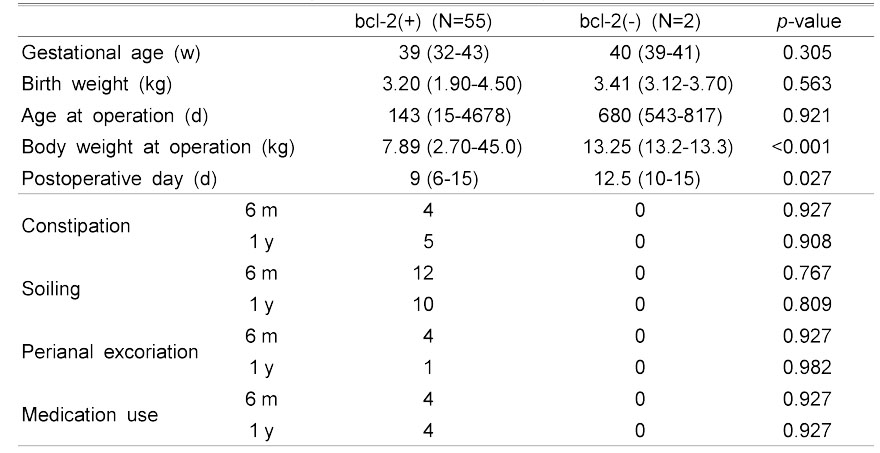
  • Immature ganglion cell (IGC) is known for its relationship with intestinal motility and its impact on postoperative functional outcomes of Hirschsprung's disease (HD). There are few studies on the relationship between intestinal dysmotility and IGC in HD patients. 67 patients pathologically diagnosed with HD and who received definitive operation in Seoul National University Children's Hospital from 2010 to 2011 were included. 10 patients were excluded due to inadequate immunohistochemical staining results. The proximal end of resected ganglionic segment was evaluated with immunohistochemistry examination with MAP-2, a marker of ganglionic cells and bcl-2, a marker of IGCs The median age at operation was 155 (15-4678) day-old. 55 (96.5%) patients positive for bcl-2, were regarded as having IGC, and 2 (3.5%) patients positive for MAP-2 but negative for bcl-2, were regarded as having only mature ganglion cells. In the bcl-2 positive group, there were 7 patients (12.7%) with constipation, 15 patients (27.3%) with soiling, 3 patients (5.5%) with perianal excoriation and 6 patients (10.9%) with medication use. In bcl-2 negative group, intestinal dysmotility was not seen. There was no statistical significance in the two groups. Considering that HD is diagnosed at a young age, the rate of IGC present is very high and it might be inappropriate to relate IGC to functional outcome at young ages.
  • 1. Lyford G, Foxx-Orenstein A. Chronic intestinal pseudoobstruction. Curr Treat Options Gastroenterol 2004;7:317-325.
  • 2. Toyosaka A, Okamoto E, Okasora T, Nose K, Tomimoto Y. Clinical, laboratory and prognostic features of congenital large intestinal motor dysfunction (pseudo-Hirschsprung's disease). Clin Auton Res 1993;3:243-248.
  • 3. Langer JC. Hirschsprung disease. Curr Opin Pediatr 2013;25:368-374.
  • 4. Miyahara K, Kato Y, Seki T, Arakawa A, Lane GJ, Yamataka A. Neuronal immaturity in normoganglionic colon from cases of Hirschsprung disease, anorectal malformation, and idiopathic constipation. J Pediatr Surg 2009;44:2364-2368.
  • 5. Burtelow MA, Longacre TA. Utility of microtubule associated protein-2 (MAP-2) immunohistochemistry for identification of ganglion cells in paraffin-embedded rectal suction biopsies. Am J Surg Pathol 2009;33:1025-1030.
  • 6. Park SH, Min H, Chi JG, Park KW, Yang HR, Seo JK. Immunohistochemical studies of pediatric intestinal pseudo-obstruction: bcl2, a valuable biomarker to detect immature enteric ganglion cells. Am J Surg Pathol 2005;29:1017-1024.
  • 7. Kim DY, Lee SC, Park KW, Kim WK. Cathepsin D Expression in Intestinal Ganglion Cells of Neonate. J Korean Assoc Pediatr Surg 1999;5:39-44.
  • 8. Feichter S, Meier-Ruge WA, Bruder E. The histopathology of gastrointestinal motility disorders in children. Semin Pediatr Surg 2009;18:206-211.
  • 9. Ieiri S, Nakatsuji T, Akiyoshi J, Higashi M, Hashizume M, Suita S, Taguchi T. Long-term outcomes and the quality of life of Hirschsprung disease in adolescents who have reached 18 years or older--a 47-year single-institute experience. J Pediatr Surg 2010;45:2398-2402.
  • 10. Menezes M, Pini Prato A, Jasonni V, Puri P. Long-term clinical outcome in patients with total colonic aganglionosis: a 31-year review. J Pediatr Surg 2008;43:1696-1699.
  • 11. Park K, Choe YM, Kim JY, Choi SK, Heo YS, Lee KY, Kim SJ, Cho YU, Ahn SI, Hong KC, Shin SH, Kim KR, Seo JM. Clinical experience with Hirschsprung's disease. J Korean Assoc Pediatr Surg 2010;16:162-169.
  • 12. Stensrud KJ, Emblem R, Bjørnland K. Functional outcome after operation for Hirschsprung disease--transanal vs transabdominal approach. J Pediatr Surg 2010;45:1640-1644.
  • 13. Sun X, Wang R, Zhang L, Li D, Li Y. Efficacy of pelvic floor muscle training for the treatment of fecal incontinence after Soave procedure for Hirschsprung disease. Eur J Pediatr Surg 2012;22:300-304.
  • 14. Levitt MA, Dickie B, Pena A. The Hirschsprungs patient who is soiling after what was considered a 'successful' pull-through. Semin Pediatr Surg 2012;21:344-353.
  • 15. Friedmacher F, Puri P. Residual aganglionosis after pull-through operation for Hirschsprung's disease: a systematic review and meta-analysis. Pediatr Surg Int 2011;27:1053-1057.
  • 16. Bettolli M, De Carli C, Jolin-Dahel K, Bailey K, Khan HF, Sweeney B, Krantis A, Staines WA, Rubin S. Colonic dysmotility in postsurgical patients with Hirschsprung's disease. Potential significance of abnormalities in the interstitial cells of Cajal and the enteric nervous system. J Pediatr Surg 2008;43:1433-1438.
  • 17. Kapur RP. Practical pathology and genetics of Hirschsprung's disease. Semin Pediatr Surg 2009;18:212-223.
  • 18. Lawal TA, Chatoorgoon K, Collins MH, Coe A, Peña A, Levitt MA. Redo pull-through in Hirschsprung's [corrected] disease for obstructive symptoms due to residual aganglionosis and transition zone bowel. J Pediatr Surg 2011;46:342-347.
  • 19. Venugopal S, Mancer K, Shandling B. The validity of rectal biopsy in relation to morphology and distribution of ganglion cells. J Pediatr Surg 1981;16:433-437.
  • 20. Smith B. Pre- and postnatal development of the ganglion cells of the rectum and its surgical implications. J Pediatr Surg 1968;3:386-391.
  • 21. Song Y, Li JC, Li MJ. Bcl-2 expression in enteric neurons of Hirschsprungs disease and its significance. Shi Yan Sheng Wu Xue Bao 2002;35:155-158.
  • 22. Wester T, Olsson Y, Olsen L. Expression of bcl-2 in enteric neurons in normal human bowel and Hirschsprung's disease. Arch Pathol Lab Med 1999;123:1264-1268.
  • 23. Puri P. Variant Hirschsprung's disease. J Pediatr Surg 1997;32:149-157.
  • 24. Ure BM, Holschneider AM, Schulten D, Meier-Ruge W. Clinical impact of intestinal neuronal malformations: a prospective study in 141 patients. Pediatr Surg Int 1997;12:377-382.
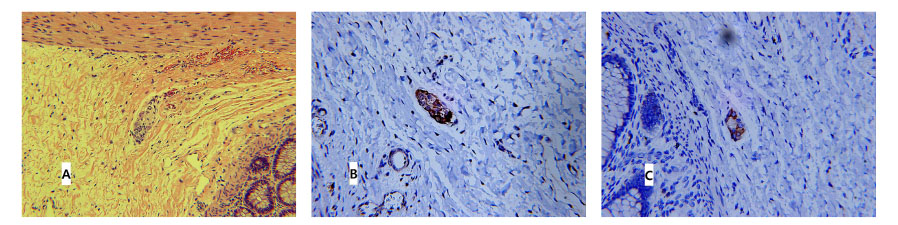
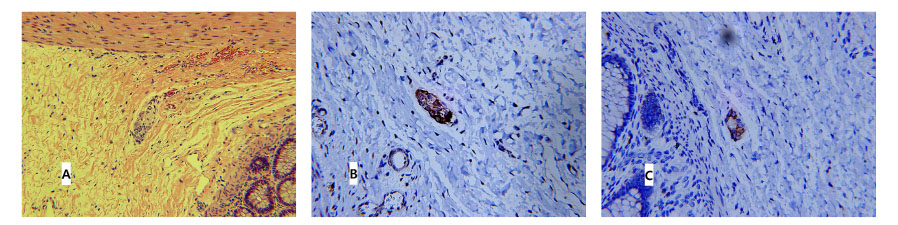
Fig. 1
H&E and Immunohistochemical Staining of Ganglion Cell. A: Ganglion Cell in H&E, B: Mature Ganglion Cell in MAP-2, C: Immature Ganglion Cell in bcl-2
jkaps-19-122-g001.jpg
Table 1
Comparisons according to Immunohistochemistry
jkaps-19-122-i001.jpg

Download Citation

Download a citation file in RIS format that can be imported by all major citation management software, including EndNote, ProCite, RefWorks, and Reference Manager.

Format:

Include:

Prevalence and Significance of Immature Ganglion Cell in Hirschsprung's Disease
J Korean Assoc Pediatr Surg. 2013;19(2):122-129.   Published online December 24, 2013
Download Citation

Download a citation file in RIS format that can be imported by all major citation management software, including EndNote, ProCite, RefWorks, and Reference Manager.

Format:
Include:
Prevalence and Significance of Immature Ganglion Cell in Hirschsprung's Disease
J Korean Assoc Pediatr Surg. 2013;19(2):122-129.   Published online December 24, 2013
Close

Figure

  • 0
Prevalence and Significance of Immature Ganglion Cell in Hirschsprung's Disease
Image
Fig. 1 H&E and Immunohistochemical Staining of Ganglion Cell. A: Ganglion Cell in H&E, B: Mature Ganglion Cell in MAP-2, C: Immature Ganglion Cell in bcl-2
Prevalence and Significance of Immature Ganglion Cell in Hirschsprung's Disease

Comparisons according to Immunohistochemistry

Table 1 Comparisons according to Immunohistochemistry