Skip to main navigation Skip to main content
  • KAPS
  • E-Submission

APS : Advances in Pediatric Surgery

OPEN ACCESS
ABOUT
BROWSE ARTICLES
EDITORIAL POLICY
FOR CONTRIBUTORS
Original Article

Risk Factors Associated with the Need for Operative Treatment of Intussusception in Children

Journal of the Korean Association of Pediatric Surgeons 2014;20(1):17-22.
Published online: June 30, 2014

Department of Surgery, Kyungpook National University School of Medicine, Daegu, Korea.

Correspondence: Jinyoung Park, Department of Surgery, Kyungpook National University Hospital, 130, Dongdeok-ro, Chung-gu, Daegu 700-721, Korea. Tel: 053-420-5612, Fax: 053-421-0510, kpnugs@knu.ac.kr
• Received: May 25, 2014   • Accepted: June 8, 2014

Copyright © 2014 by the Korean Association of Pediatric Surgeons

This is an Open Access article distributed under the terms of the Creative Commons Attribution Non-Commercial License (http://creativecommons.org/licenses/by-nc/3.0/) which permits unrestricted non-commercial use, distribution, and reproduction in any medium, provided the original work is properly cited.
  • 1 Views
  • 0 Download
prev
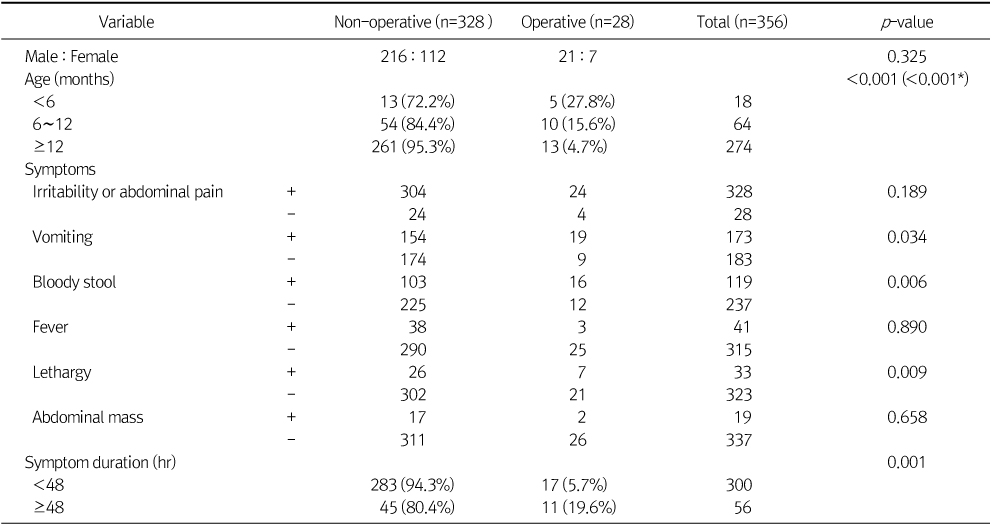
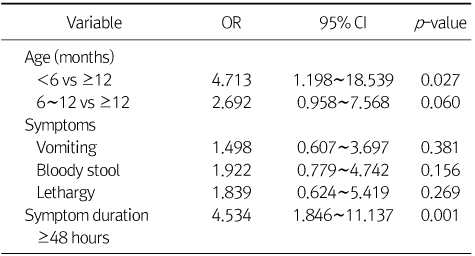
  • The aim of this study was to identify the risk factor related to the need for operative treatment and avoid unnecessary non-operative management for intussusception in children. We retrospectively reviewed medical records of patient treated for intussusception at our institution between January 2006 and January 2013. Clinical features such as gender, age, seasonal variation, symptoms and signs, treatment results were analyzed. Univariate and multivariate analyses including a chi-square test for categorical variables and logistic regression analysis were performed. During the study period, 356 patients were treated for intussusception. 328 (92.1%) was treated successfully by the non-operative pneumoreduction, and 28 (7.9%) required operative management. On univariate analysis, risk factors which were related to the need for operative treatment were age, vomiting, bloody stool, lethargy, and symptoms duration. A logistic regression analysis in order to assess for independent predictors of operative treatment was performed. Age (<6 vs ≥12 months) (OR 4.713, 95% CI 1.198~18.539, p=0.027) and symptoms duration longer than 48 hours (OR 4.534, 95% CI 1.846~11.137, p=0.001) were significantly associated with a requirement for operative treatment. We conclude that younger age and a longer duration of symptoms (≥ 48 hours) are the independent risk factor related to the need for operative treatment for intussusception. Early surgical intervention or transfer to a hospital with pediatric surgical capabilities should be considered for patients with these findings.
  • 1. Kim WS, Jeong JH, Lee JH, Park JK, Moon HJ, Shin HJ, Lee JI. Clinical manifestations of childhood intussusception with ubiquitous ultrasonography: comparison with small bowel and ileocecal type. J Korean Assoc Pediatr Surg 2011;17:23-34.
  • 2. Ko KM, Song YW, Je BK, Han JJ, Woo CW, Choi BM, Lee JW. Risk factors for the failure of non-operative reduction of intussusceptions. Korean J Pediatr Gastroenterol Nutr 2008;11:110-115.
  • 3. Park BC, Kim SY, Jung SJ. A comparative analysis of clinical features and treatment outcomes of intussusception according to age distribution. Korean J Pediatr Gastroenterol Nutr 2005;8:150-156.
  • 4. Ko JW, Kwon DS, Kim BS, Moon DJ. Analysis of the possibility of operative treatment in pediatric intussusception and its scoring. J Korean Surg Soc 2004;67:402-406.
  • 5. Chang J, Choi KJ. Change of the clinical aspects and management of childhood intussusception. J Korean Surg Soc 2008;74:65-70.
  • 6. Lee KS, Park YJ. Clinical analysis of recurrent intussusception and the pathologic lead point in a single center. Korean J Pediatr Gastroenterol Nutr 2009;12:163-170.
  • 7. Lee KJ, Chung JH, Hong MK, Won YS, An CH, Song YT. Lead-points in childhood intussusception. J Korean Assoc Pediatr Surg 2001;7:126-129.
  • 8. Jang SM, Kang SH, Lee JH, Huh YS. Pathologic lead points in childhood intussusception. J Korean Assoc Pediatr Surg 2000;6:50-55.
  • 9. Kim EJ, Lee MH, Lee HY, Kim JS, Seo JH, Lim JY, Choi MB, Park CH, Woo HO, Youn HS. Clinical analysis of intussusception delayed in the final diagnosis. Korean J Pediatr Gastroenterol Nutr 2004;7:16-23.
  • 10. Kim YM, Chung TW, Yoon W, Chang NK, Heo SH, Shin SS, Lim HS, Jeong YY, Kang HK. Efficacy of US-guided hydrostatic reduction in children with intussusception. J Korean Soc Ultrasound Med 2007;26:113-118.
  • 11. Kim HR, Hong TH, Lee YS, Kim JJ, Lee KH, Oh SJ, Park SM, Kim YH. The role of laparoscopy for intussusceptions. J Korean Surg Soc 2008;74:126-128.
  • 12. Son IT, Jung K, Park T, Kim HY, Park KW, Jung SE. Clinical features and factors affecting success rate of air reduction for pediatric intussusception. J Korean Assoc Pediatr Surg 2010;16:108-116.
  • 13. Fallon SC, Lopez ME, Zhang W, Brandt ML, Wesson DE, Lee TC, Rodriguez JR. Risk factors for surgery in pediatric intussusception in the era of pneumatic reduction. J Pediatr Surg 2013;48:1032-1036.
  • 14. Daneman A, Navarro O. Intussusception. Part 2: an update on the evolution of management. Pediatr Radiol 2004;34:97-108.
  • 15. Jeong IU, Park JW, Cho SY, Lee SJ, Park BS, Lee TH. A comparative study of non-operative management in childhood intussusception. J Korean Surg Soc 2000;58:426-432.
  • 16. Jen HC, Shew SB. The impact of hospital type and experience on the operative utilization in pediatric intussusception: a nationwide study. J Pediatr Surg 2009;44:241-246.
  • 17. Bratton SL, Haberkern CM, Waldhausen JH, Sawin RS, Allison JW. Intussusception: hospital size and risk of surgery. Pediatrics 2001;107:299-303.
  • 18. Tareen F, Ryan S, Avanzini S, Pena V, Mc Laughlin D, Puri P. Does the length of the history influence the outcome of pneumatic reduction of intussusception in children? Pediatr Surg Int 2011;27:587-589.
  • 19. Ramachandran P, Gupta A, Vincent P, Sridharan S. Air enema for intussusception: is predicting the outcome important? Pediatr Surg Int 2008;24:311-313.
  • 20. Fragoso AC, Campos M, Tavares C, Costa-Pereira A, Estevão-Costa J. Pneumatic reduction of childhood intussusception. Is prediction of failure important? J Pediatr Surg 2007;42:1504-1508.
  • 21. Lehnert T, Sorge I, Till H, Rolle U. Intussusception in children--clinical presentation, diagnosis and management. Int J Colorectal Dis 2009;24:1187-1192.
  • 22. Katz M, Phelan E, Carlin JB, Beasley SW. Gas enema for the reduction of intussusception: relationship between clinical signs and symptoms and outcome. AJR Am J Roentgenol 1993;160:363-366.
  • 23. Fike FB, Mortellaro VE, Holcomb GW 3rd, St Peter SD. Predictors of failed enema reduction in childhood intussusception. J Pediatr Surg 2012;47:925-927.
  • 24. Saxena AK, Höllwarth ME. Factors influencing management and comparison of outcomes in paediatric intussusceptions. Acta Paediatr 2007;96:1199-1202.
  • 25. Fraser JD, Aguayo P, Ho B, Sharp SW, Ostlie DJ, Holcomb GW 3rd, St Peter SD. Laparoscopic management of intussusception in pediatric patients. J Laparoendosc Adv Surg Tech A 2009;19:563-565.
  • 26. Jung SE, Park KW, Lee SC, Kim WK. A surgical treatment of in tussusception in infancy and childhood. J Korean Surg Soc 1991;40:529-535.
  • 27. Choi KJ. Analysis of clinical factors and operative findings in childhood intussusception. J Korean Assoc Pediatr Surg 1996;2:81-87.
  • 28. Reijnen JA, Festen C, van Roosmalen RP. Intussusception: factors related to treatment. Arch Dis Child 1990;65:871-873.
  • 29. Hsu WL, Lee HC, Yeung CY, Chan WT, Jiang CB, Sheu JC, Wang NL, Shih SL. Recurrent intussusception: when should surgical intervention be performed? Pediatr Neonatol 2012;53:300-303.
  • 30. Niramis R, Watanatittan S, Kruatrachue A, Anuntkosol M, Buranakitjaroen V, Rattanasuwan T, Wongtapradit L, Tongsin A. Management of recurrent intussusception: nonoperative or operative reduction? J Pediatr Surg 2010;45:2175-2180.
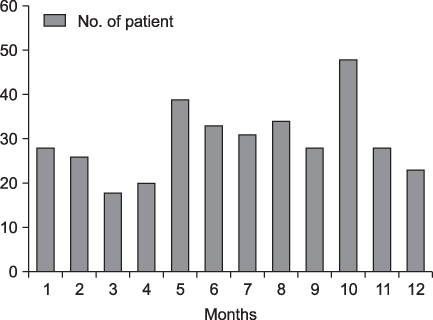
Fig. 1
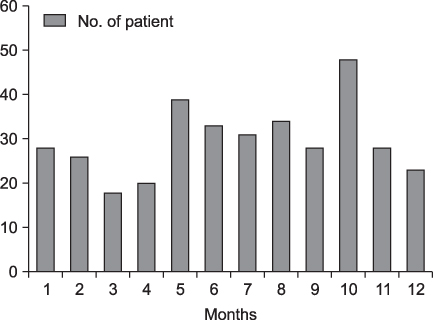
Monthly distribution of intussusception.
jkaps-20-17-g001.jpg
Table 1
Univariate Comparison between the Non-operative and Operative Group

*Cochran-Armitage test for linear trend.

jkaps-20-17-i001.jpg
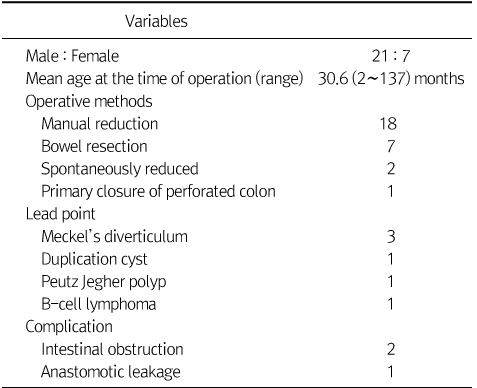
Table 2
Demographics and Outcomes of Operative Group
jkaps-20-17-i002.jpg
Table 3
Logistic Regression Analysis for Risk Factors of Operative Treatment
jkaps-20-17-i003.jpg

Download Citation

Download a citation file in RIS format that can be imported by all major citation management software, including EndNote, ProCite, RefWorks, and Reference Manager.

Format:

Include:

Risk Factors Associated with the Need for Operative Treatment of Intussusception in Children
J Korean Assoc Pediatr Surg. 2014;20(1):17-22.   Published online June 30, 2014
Download Citation

Download a citation file in RIS format that can be imported by all major citation management software, including EndNote, ProCite, RefWorks, and Reference Manager.

Format:
Include:
Risk Factors Associated with the Need for Operative Treatment of Intussusception in Children
J Korean Assoc Pediatr Surg. 2014;20(1):17-22.   Published online June 30, 2014
Close

Figure

  • 0
Risk Factors Associated with the Need for Operative Treatment of Intussusception in Children
Image
Fig. 1 Monthly distribution of intussusception.
Risk Factors Associated with the Need for Operative Treatment of Intussusception in Children

Univariate Comparison between the Non-operative and Operative Group

*Cochran-Armitage test for linear trend.

Demographics and Outcomes of Operative Group

Logistic Regression Analysis for Risk Factors of Operative Treatment

Table 1 Univariate Comparison between the Non-operative and Operative Group

*Cochran-Armitage test for linear trend.

Table 2 Demographics and Outcomes of Operative Group
Table 3 Logistic Regression Analysis for Risk Factors of Operative Treatment