Skip to main navigation Skip to main content
  • KAPS
  • E-Submission

APS : Advances in Pediatric Surgery

OPEN ACCESS
ABOUT
BROWSE ARTICLES
EDITORIAL POLICY
FOR CONTRIBUTORS
Original Article

A Comparison between Ilioinguinal and Iliohypogastric Nerve Block and Infiltration of Local Anesthetics for Postoperative Pain after Inguinal Herniorrhaphy in Children

Journal of the Korean Association of Pediatric Surgeons 2014;20(1):7-11.
Published online: June 30, 2014

Department of Surgery, Yeungman University Collage of Medicine, Daegu, Korea.

Correspondence: Nam-Hyuk Lee, Department of Surgery, Yeungnam University College of Medicine, 170, Hyeonchung-ro, Nam-gu, Daegu 705-703, Korea. Tel: 053-620-3584, Fax: 053-624-1213, nhlee@med.yu.ac.kr
• Received: March 15, 2014   • Accepted: June 1, 2014

Copyright © 2014 by the Korean Association of Pediatric Surgeons

This is an Open Access article distributed under the terms of the Creative Commons Attribution Non-Commercial License (http://creativecommons.org/licenses/by-nc/3.0/) which permits unrestricted non-commercial use, distribution, and reproduction in any medium, provided the original work is properly cited.

  • 1 Views
  • 0 Download
prev next
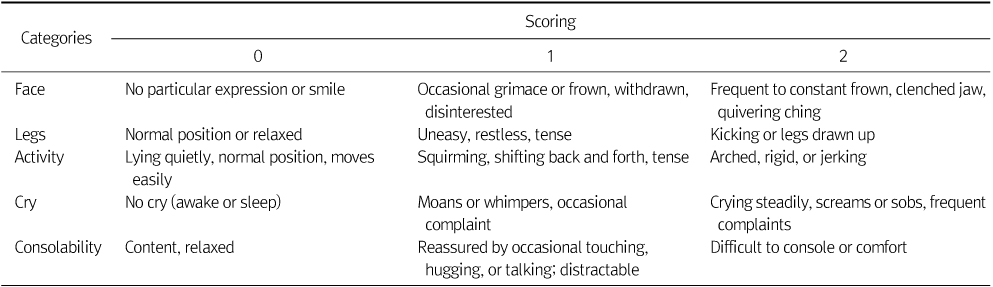
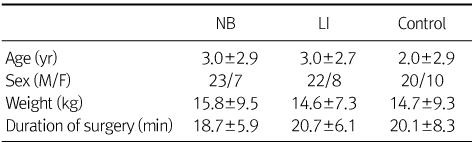
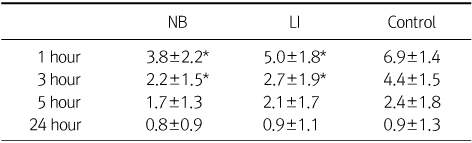
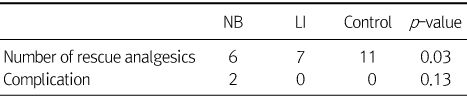
  • The present study compared the postoperative analgesic effects of ilioinguinal and iliohypogastric nerve block with infiltration of local anesthetics (bupivacaine) into the wound in children after inguinal hernia repair. Ninety children below 7 years old who were scheduled elective inguinal hernia repair were randomly allocated into one of three groups. The patients in nerve block (NB) group, ilioinguinal and iliohypogastric nerve block was done with 0.5 mL/kg of 0.25% bupivacaine. The patients in infiltration of local anesthetics (LI) group, 0.5 mL/kg of 0.25% bupivacaine was infiltrated into the wound after surgery. The patients in control group were allocated as a Control group. Postoperative pain was assessed at 1, 3, 5, and 24 hours after operation with FLACC scale and additional analgesic consumption were counted. The three groups were not significantly different in age, sex, body weight, and duration of operation. Pain scores at 1 hour and 3 hours after operation were significantly higher in Control group than in NB group and LI group (p<0.01), whereas there were no difference between NB group and LI group. The rescue analgesics administration was significantly higher in Control group (n=11) than in NB group (n=6) and LI group (n=7) (p<0.05). There were 2 cases of transient femoral nerve palsy in NB group. Both of ilioinguinal and iliohypogastric nerve block and infiltration of local anesthetics into the wound provided effective postoperative analgesia in early postoperative period following inguinal hernia repair in children. But no difference between the two methods. Technically, infiltration of local anesthetics into the wound was easier and safer than ilioinguinal and iliohypogastric nerve block.
  • 1. Hirschl RB, Coran AG. Special considerations in pediatric anesthesia, chap 10. In O'Neill JA Jr, Grosfeld JL, Fonkkalsrud EW, Coran AG, Caldamone AA, eds, ddPrinciples of Pediatric Surgery. ed 2. St. Louis, MO: Mosby; 2003, pp 125-140.
  • 2. Sakellaris G, Petrakis I, Makatounaki K, Arbiros I, Karkavitsas N, Charissis G. Effects of ropivacaine infiltration on cortisol and prolactin responses to postoperative pain after inguinal hernioraphy in children. J Pediatr Surg 2004;39:1400-1403.
  • 3. Usmani H, Pal Singh S, Quadir A, Chana RS. A comparison between EMLA cream application versus lidocaine infiltration for postoperative analgesia after inguinal herniotomy in children. Reg Anesth Pain Med 2009;34:106-109.
  • 4. Fell D, Derrington MC, Taylor E, Wandless JG. Paediatric postoperative analgesia. A comparison between caudal block and wound infiltration of local anaesthetic. Anaesthesia 1988;43:107-110.
  • 5. Okur H, Küçükaydin M, Muhtaroğlu S, Kazez A. Effects of bupivacaine infiltration on beta-endorphin and cortisol release and postoperative pain following inguinal herniorrhaphy in children. Pediatr Surg Int 1996;11:41-44.
  • 6. Anatol TI, Pitt-Miller P, Holder Y. Trial of three methods of intraoperative bupivacaine analgesia for pain after paediatric groin surgery. Can J Anaesth 1997;44:1053-1059.
  • 7. van Schoor AN, Boon JM, Bosenberg AT, Abrahams PH, Meiring JH. Anatomical considerations of the pediatric ilioinguinal/iliohypogastric nerve block. Paediatr Anaesth 2005;15:371-377.
  • 8. Landsman IS, Hay SR, Karsanac CJ, Franklin A. Pediatric anesthesia, chap 13. In Coran AG, Adzick NS, Krummel T, Laberge JM, Shamberger R, Caldmone A, eds, ddPediatric Surgery. ed 7. Philadelphia, PA: Mosby Inc.; 2012, pp 201-226.
  • 9. Beyer JE, Wells N. The assessment of pain in children. Pediatr Clin North Am 1989;36:837-854.
  • 10. Merkel SI, Voepel-Lewis T, Shayevitz JR, Malviya S. The FLACC: a behavioral scale for scoring postoperative pain in young children. Pediatr Nurs 1997;23:293-297.
  • 11. Bao Y, Fang J, Peng L, Yi Y, Liu K, Li W, Luo H. Comparison of preincisional and postincisional parecoxib administration on postoperative pain control and cytokine response after total hip replacement. J Int Med Res 2012;40:1804-1811.
  • 12. Ong CK, Lirk P, Seymour RA, Jenkins BJ. The efficacy of preemptive analgesia for acute postoperative pain management: a meta-analysis. Anesth Analg 2005;100:757-773.
  • 13. Sajedi P, Yaraghi A, Zadeh MT. Comparison of pre- vs. post-incisional caudal bupivacaine for postoperative analgesia in unilateral pediatric herniorrhaphy: A double-blind randomized clinical trial. Saudi J Anaesth 2011;5:157-161.
  • 14. Cnar SO, Kum U, Cevizci N, Kayaoglu S, Oba S. Effects of levobupivacaine infiltration on postoperative analgesia and stress response in children following inguinal hernia repair. Eur J Anaesthesiol 2009;26:430-434.
  • 15. Matsota P, Papageorgiou-Brousta M, Kostopanagiotou G. Wound infiltration with levobupivacaine: an alternative method of postoperative pain relief after inguinal hernia repair in children. Eur J Pediatr Surg 2007;17:270-274.
  • 16. Weintraud M, Lundblad M, Kettner SC, Willschke H, Kapral S, Lönnqvist PA, Koppatz K, Turnheim K, Bsenberg A, Marhofer P. Ultrasound versus landmark-based technique for ilioinguinal-iliohypogastric nerve blockade in children: the implications on plasma levels of ropivacaine. Anesth Analg 2009;108:1488-1492.
  • 17. Weintraud M, Marhofer P, Bösenberg A, Kapral S, Willschke H, Felfernig M, Kettner S. Ilioinguinal/iliohypogastric blocks in children: where do we administer the local anesthetic without direct visualization? Anesth Analg 2008;106:89-93.
  • 18. Amory C, Mariscal A, Guyot E, Chauvet P, Leon A, Poli-Merol ML. Is ilioinguinal/iliohypogastric nerve block always totally safe in children? Paediatr Anaesth 2003;13:164-166.
  • 19. Erez I, Buchumensky V, Shenkman Z, Lazar L, Freud E. Quadriceps paresis in pediatric groin surgery. Pediatr Surg Int 2002;18:157-158.
  • 20. Lim SL, Ng Sb A, Tan GM. Ilioinguinal and iliohypogastric nerve block revisited: single shot versus double shot technique for hernia repair in children. Paediatr Anaesth 2002;12:255-260.
  • 21. Rosario DJ, Jacob S, Luntley J, Skinner PP, Raftery AT. Mechanism of femoral nerve palsy complicating percutaneous ilioinguinal field block. Br J Anaesth 1997;78:314-316.
  • 22. Selway RP. Transient femoral nerve block following groin surgery in children. Pediatr Surg Int 1994;9:191-192.
  • 23. Willschke H, Marhofer P, Bösenberg A, Johnston S, Wanzel O, Cox SG, Sitzwohl C, Kapral S. Ultrasonography for ilioinguinal/iliohypogastric nerve blocks in children. Br J Anaesth 2005;95:226-230.
  • 24. Casey WF, Rice LJ, Hannallah RS, Broadman L, Norden JM, Guzzetta P. A comparison between bupivacaine instillation versus ilioinguinal/iliohypogastric nerve block for postoperative analgesia following inguinal herniorrhaphy in children. Anesthesiology 1990;72:637-639.
  • 25. Reid MF, Harris R, Phillips PD, Barker I, Pereira NH, Bennett NR. Day-case herniotomy in children. A comparison of ilio-inguinal nerve block and wound infiltration for postoperative analgesia. Anaesthesia 1987;42:658-661.
Table 1
FLACC Pain Assessment Tool
jkaps-20-7-i001.jpg
Table 2
Patients and Clinical Data
jkaps-20-7-i002.jpg
Table 3
Postoperative Pain Scores

*p<0.05 vs control group.

jkaps-20-7-i003.jpg
Table 4
Requirement of Rescue Analgesics and Complications
jkaps-20-7-i004.jpg

Download Citation

Download a citation file in RIS format that can be imported by all major citation management software, including EndNote, ProCite, RefWorks, and Reference Manager.

Format:

Include:

A Comparison between Ilioinguinal and Iliohypogastric Nerve Block and Infiltration of Local Anesthetics for Postoperative Pain after Inguinal Herniorrhaphy in Children
J Korean Assoc Pediatr Surg. 2014;20(1):7-11.   Published online June 30, 2014
Download Citation

Download a citation file in RIS format that can be imported by all major citation management software, including EndNote, ProCite, RefWorks, and Reference Manager.

Format:
Include:
A Comparison between Ilioinguinal and Iliohypogastric Nerve Block and Infiltration of Local Anesthetics for Postoperative Pain after Inguinal Herniorrhaphy in Children
J Korean Assoc Pediatr Surg. 2014;20(1):7-11.   Published online June 30, 2014
Close
A Comparison between Ilioinguinal and Iliohypogastric Nerve Block and Infiltration of Local Anesthetics for Postoperative Pain after Inguinal Herniorrhaphy in Children

FLACC Pain Assessment Tool

Patients and Clinical Data

Postoperative Pain Scores

*p<0.05 vs control group.

Requirement of Rescue Analgesics and Complications

Table 1 FLACC Pain Assessment Tool
Table 2 Patients and Clinical Data
Table 3 Postoperative Pain Scores

*p<0.05 vs control group.

Table 4 Requirement of Rescue Analgesics and Complications