
Skip to main navigation Skip to main content
  • KAPS
  • E-Submission

APS : Advances in Pediatric Surgery

OPEN ACCESS
ABOUT
BROWSE ARTICLES
EDITORIAL POLICY
FOR CONTRIBUTORS
Original Article

Pediatric Liver Transplantation

Journal of the Korean Association of Pediatric Surgeons 2013;19(1):14-21.
Published online: June 28, 2013

Division of Pediatric Surgery, Deptartment of Surgery, Samsung Medical Center, Sungkyunkwan University School of Medicine, Seoul, Korea.

Correspondence: Suk-Koo Lee, M.D., Division of Pediatric Surgery, Department of Surgery, Samsung Medical Center, Sungkyunkwan University School of Medicine, 50 Irwon-dong, Gangnam-gu, Seoul 135-710, Korea. Tel: 02)3410-3464, Fax: 02)3410-0040, sukkoo.lee@samsung.com

Copyright © 2013 Korean Association of Pediatric Surgeons
  • 1 Views
  • 1 Download
prev next
  • Pediatric liver transplantation has evolved into a definite and effective therapeutic modality for various liver diseases in the pediatric patient. During the last 25 years, liver transplant outcomes in Korea have reached international standards and Korea has become the leader in living-donor liver transplantation. This review will present the cumulative outcomes of pediatric liver transplantation performed in Korea and will focus on other issues of interest involving pediatric liver transplant recipients, especially in the field of immunosuppression and post-transplant lymphoproliferative disease.
  • 1. Starzl TE, Koep LJ, Schroter GP, Halgrimson CG, Porter KA, Weil R 3rd. Liver replacement for pediatric patients. Pediatrics 1979;63:825-829.
  • 2. Kim MJ, Choe YH. Indication of pediatric liver transplantation. J Korean Soc Transplant 2011;25:151-154.
  • 3. Ryckman FC, Alonso MH, Bucuvalas JC, Balistreri WF. Biliary atresia-surgical management and treatment options as they relate to outcome. Liver Transpl Surg 1998;4:5 Suppl 1. S24-S33.
  • 4. Arnon R, Kerkar N, Davis MK, Anand R, Yin W, Gonzalez-Peralta RP. Liver transplantation in children with metabolic diseases: the studies of pediatric liver transplantation experience. Pediatr Transplant 2010;14:796-805.
  • 5. Kim ST, Park YH, Lee KU, Yoon YK, Kim SW, Yang HK, Kim WK, Park KW. An experience of liver transplantation in Korea. J Korean Soc Transplant 1988;2:27-36.
  • 6. Kim JM, Kim KM, Yi NJ, Choe YH, Kim MS, Suh KS, Kim SI, Lee SK, Lee SG. Pediatric liver transplantation outcomes in Korea. J Korean Med Sci 2013;28:42-47.
  • 7. Busuttil RW, Klintmalm GB. General criteria for pediatric transplantation. Transplantation of the liver. second edition. Philadelphia, PA: Elsevier Saunders; 2005, pp 288-291 chap 21.
  • 8. Kim JM, Lee SK, Kwon CH, Joh JW, Choe YH, Park CK. Hepatocellular carcinoma in an infant with biliary atresia younger than 1 year. J Pediatr Surg 2012;47:819-821.
  • 9. Choi Y, Lee KW, Hong G, Kim H, Park MS, Suh S, Yoo T, Lee HW, Yi NJ, Suh KS. Status and Current Problems in the Allocation System for Pediatric Liver Transplantation in Korea. J Korean Soc Transplant 2012;26:196-201.
  • 10. United Nework for Organ Sharing (UNOS). Organ Distribution: Allocation of Livers [Internet]. Richmond, VI: UNOS; 2011. Available from: http://optn.transplant.hrsa.gov
  • 11. Nalesnik MA. The diverse pathology of post-transplant lymphoproliferative disorders: the importance of a standardized approach. Transpl Infect Dis 2001;3:88-96.
  • 12. Preiksaitis JK, Keay S. Diagnosis and management of posttransplant lymphoproliferative disorder in solid-organ transplant recipients. Clin Infect Dis 2001;33:Suppl 1. S38-S46.
  • 13. Preiksaitis JK, Cockfield SM. In Bowden RA, Ljungman P, Paya CV, eds, ddEpstein-Barr virus and lymphoproliferative disease after hemopoietic stem cell or solid organ transplantation. Transplant Infections. 2nd edn. Lippincott: Williams, and Wilkins; 2003, pp 326-349.
  • 14. Green M, Reyes J, Webber S, Rowe D. The role of antiviral and immunoglobulin therapy in the prevention of Epstein-Barr virus infection and post-transplant lymphoproliferative disease following solid organ transplantation. Transpl Infect Dis 2001;3:97-103.
  • 15. Epstein-Barr virus and lymphoproliferative disorders after transplantation. Am J Transplant 2004;4:Suppl.10. 59-65.
  • 16. Choe YH, Lee SK, Seo JM, Joh JW, Kim SJ, Lee KW, Park JH, Ko YH, Kwon KY. Posttransplant lymphoproliferative disorder in pediatric liver transplantation: Samsung Medical Center experience. Korean J Pediatr Gastroenterol Nutr 2003;6:39-46.
  • 17. Heo JS, Park JW, Lee KW, Lee SK, Joh JW, Kim SJ, Lee HH, Lee DS, Choi SH, Seo JM, Choe YH. Posttrans-plantation lymphoproliferative disorder in pediatric liver transplantation. Transplant Proc 2004;36:2307-2308.
  • 18. Lee JH, Ko JS, Seo JK, Yi NJ, Suh KS, Lee KU, Kang GH. Posttransplant lymphoproliferative disorder after liver transplantation in pediatric patients: Report from a single-center over 21 years. Korean J Pediatr Gastroenterol Nutr 2009;12:199-206.
  • 19. Lerut J, Sanchez-Fueyo A. An appraisal of tolerance in liver transplantation. Am J Transplant 2006;6:1774-1780.
  • 20. Takatsuki M, Uemoto S, Inomata Y, Egawa H, Kiuchi T, Fujita S. Weaning of immunosuppression in living donor liver transplant recipients. Transplantation 2001;72:449-454.
  • 21. Feng S, Ekong UD, Lobritto SJ, Demetris AJ, Roberts JP. Complete immunosuppression withdrawal and subsequent allograft function among pediatric recipients of parental living donor liver transplants. JAMA 2012;307:283-293.
  • 22. Lee JH, Lee SK, Lee HJ, Seo JM, Joh JW, Kim SJ, Kwon CH, Choe YH. Withdrawal of immunosuppression in pediatric liver transplant recipients in korea. Yonsei Med J 2009;50:784-788.
  • 23. Sebagh M, Rifai K, Féray C, Yilmaz F, Falissard B, Roche B. All liver recipients benefit from the protocol 10-year liver biopsies. Hepatology 2003;37:1293-1301.
  • 24. Koshiba T, Li Y, Takemura M, Wu Y, Sakaquchi S, Minato N. Clinical, immunological, and pathological aspects of operational tolerance after pediatric living-donor liver transplantation. Transpl Immunol 2007;17:94-97.
  • 25. Ohe H, Li Y, Nafady-Hego H, Kayo W, Sakaguchi S, Wood K, Calne R, Uemoto S, Koshiba T. Minimal but essential doses of immunosuppression: a more realistic approach to improve long-term outcomes for pediatric living-donor liver transplantation. Transplantation 2011;91:808-810.
  • 26. Holt RI, Baker AJ, Jones JS, Miell JP. The insulin-like growth factor and binding protein axis in children with end-stage liver disease before and after orthotopic liver transplantation. Pediatr Transplant 1998;2:76-84.
  • 27. Bartosh SM, Thomas SE, Sutton MM, Brady LM, Whitington PF. Linear growth after pediatric liver transplantation. J Pediatr 1999;135:624-631.
  • 28. Park SJ, Rim SH, Kim KM, Lee JH, Choi BH, Lee SY, Chang SH, Lee YH, Lee SG. Long-term growth of pediatric patients following living-donor liver transplantation. J Korean Med Sci 2005;20:835-840.
  • 29. Renz JF, de Roos M, Rosenthal P, Mudge C, Bacchetti P, Watson J, Roberts JP, Ascher NL, Emond JC. Posttrans-plantation growth in pediatric liver recipients. Liver Transpl 2001;7:1040-1055.
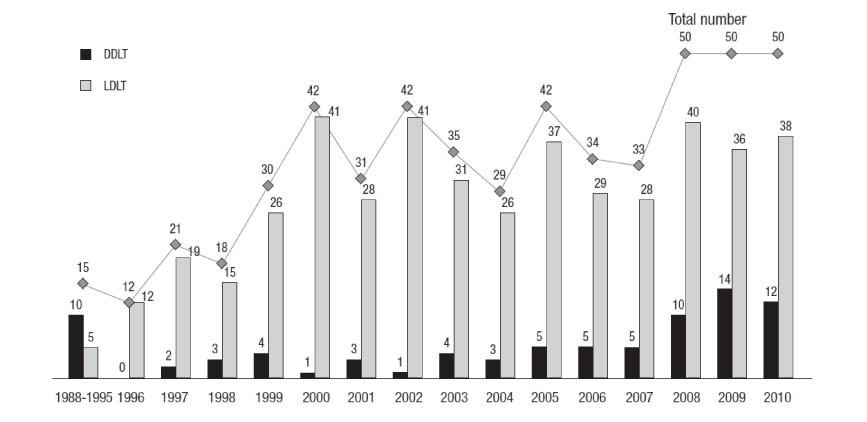
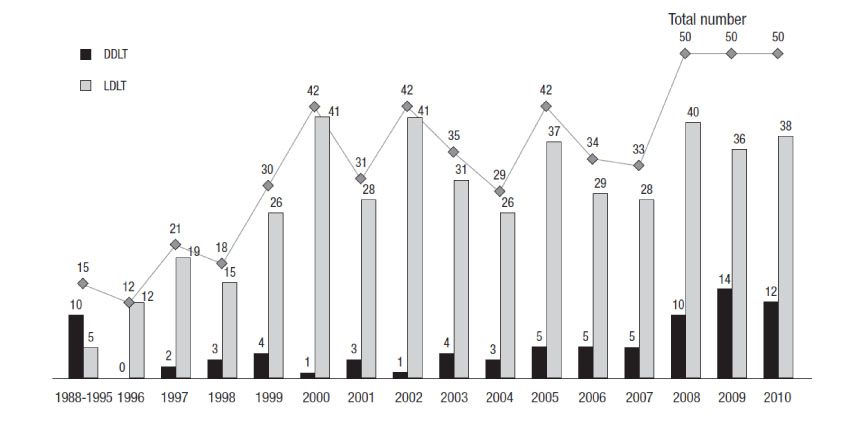
Fig. 1
Cases of pediatric liver transplantation in Korea6
jkaps-19-14-g001.jpg
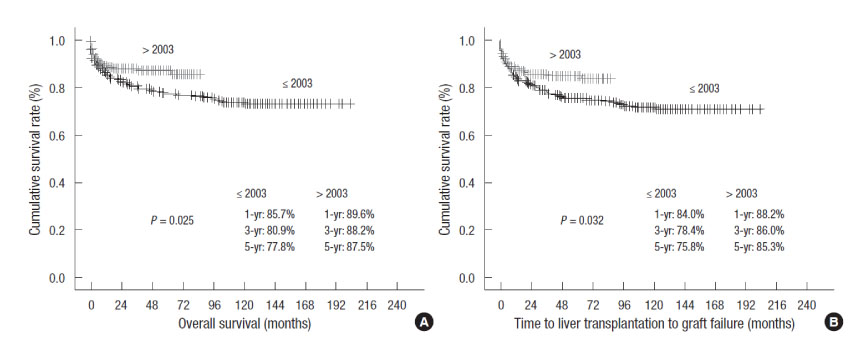
Fig. 2
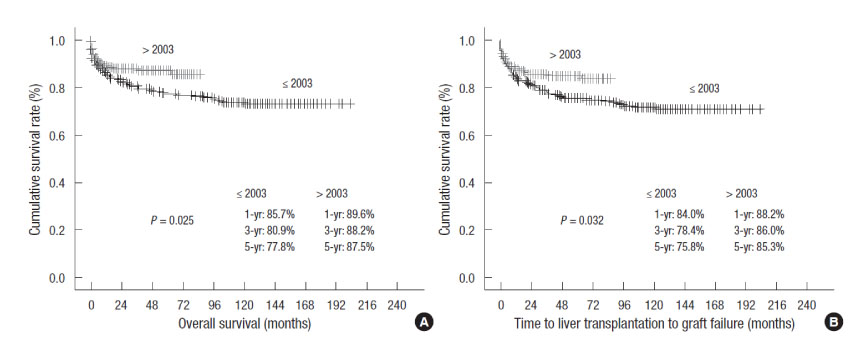
Survival of patients (A) and grafts (B) in pediatric liver transplantation6
jkaps-19-14-g002.jpg
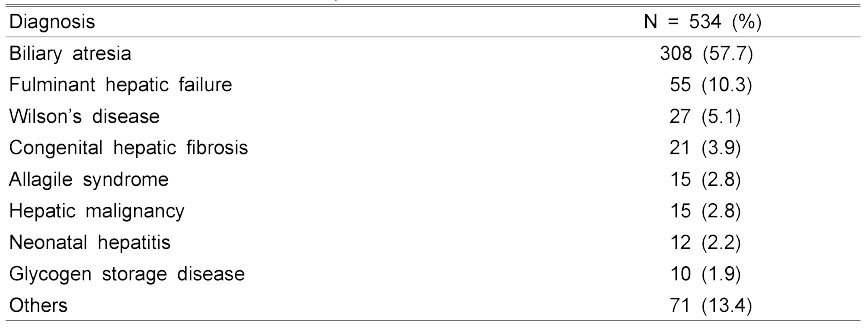
Table 1
Indications for Liver Transplantation in 534 Pediatric Patients in Korea6
jkaps-19-14-i001.jpg

Download Citation

Download a citation file in RIS format that can be imported by all major citation management software, including EndNote, ProCite, RefWorks, and Reference Manager.

Format:

Include:

Pediatric Liver Transplantation
J Korean Assoc Pediatr Surg. 2013;19(1):14-21.   Published online June 28, 2013
Download Citation

Download a citation file in RIS format that can be imported by all major citation management software, including EndNote, ProCite, RefWorks, and Reference Manager.

Format:
Include:
Pediatric Liver Transplantation
J Korean Assoc Pediatr Surg. 2013;19(1):14-21.   Published online June 28, 2013
Close

Figure

  • 0
  • 1
Pediatric Liver Transplantation
Image Image
Fig. 1 Cases of pediatric liver transplantation in Korea6
Fig. 2 Survival of patients (A) and grafts (B) in pediatric liver transplantation6
Pediatric Liver Transplantation

Indications for Liver Transplantation in 534 Pediatric Patients in Korea6

Table 1 Indications for Liver Transplantation in 534 Pediatric Patients in Korea6