
Skip to main navigation Skip to main content
  • KAPS
  • E-Submission

APS : Advances in Pediatric Surgery

OPEN ACCESS
ABOUT
BROWSE ARTICLES
EDITORIAL POLICY
FOR CONTRIBUTORS
Original Article

Cause of Abdominal Ultrasound Diagnostic Errors in Children with Acute Appendicitis

Journal of the Korean Association of Pediatric Surgeons 2016;22(2):33-37.
Published online: December 22, 2016

Department of Surgery, Yeouido St. Mary's Hospital, School of Medicine, The Catholic University of Korea, Seoul, Korea.

Correspondence: Jae Hee Chung, Department of Surgery, Yeouido St. Mary's Hospital, School of Medicine, The Catholic University of Korea, 10 63-ro, Yeongdeungpo-gu, Seoul 07345, Korea. Tel: +82-2-3779-1040, Fax: +82-2-786-0802, jhjung@catholic.ac.kr
• Received: June 13, 2016   • Revised: September 12, 2016   • Accepted: October 11, 2016

Copyright © 2016 by the Korean Association of Pediatric Surgeons

This is an Open Access article distributed under the terms of the Creative Commons Attribution Non-Commercial License (https://creativecommons.org/licenses/by-nc/4.0) which permits unrestricted non-commercial use, distribution, and reproduction in any medium, provided the original work is properly cited.

  • 0 Views
  • 0 Download
prev next
  • Purpose
    The use of CT as a diagnostic tool in pediatric acute appendicitis is increasing because of its high sensitivity and specificity. However, due to both the serious concerns about radiation of CT and the convenience and reasonable cost of ultrasound (US) examination, US has value on the initial diagnosis of acute appendicitis despite of the lower sensitivity in children. The purpose of this study was to examine the factors that affect the rate of false negative diagnosis of the ultrasound from the patients who received laparoscopic appendectomy.
  • Methods
    The pediatric appendectomy cases from 2002 to 2013 in Yeouido St. Mary's Hospital have been reviewed through the medical records. We included patients who underwent an initial screening by ultrasound examination.
  • Results
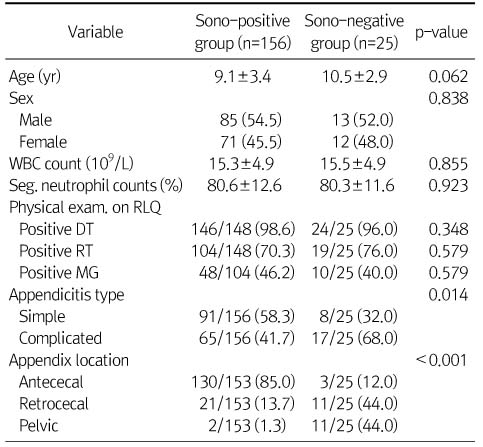
    Among 181 patients, 156 patients were the sono-positive group and 25 patients were sono-negative group. There is no significant difference in ages, genders, physical examination findings and white blood cell count between the two groups. But, the degree of inflammation of appendicitis (simple, 58.3% vs. 32.0%; complicated, 41.7% vs. 68.0%) and the appendix position (antececal, 85.0% vs. 12.0%; retrocecal, 13.7% vs. 44.0%; pelvic, 1.3% vs. 44.0%) were significantly different between the two groups (sono-positive group vs. sono-negative group; p<0.05).
  • Conclusion
    The position of the appendix may act as a factor that causes an error in the diagnostic ultrasound, especially, in the retrocecal type and the pelvic type with the higher risk of necrosis or perforation.

No potential conflict of interest relevant to this article was reported.

  • 1. Mostbeck G, Adam EJ, Nielsen MB, Claudon M, Clevert D, Nicolau C, et al. How to diagnose acute appendicitis: ultrasound first. Insights Imaging 2016;7:255-263.
  • 2. van den Bogaard VA, Euser SM, van der Ploeg T, de Korte N, Sanders DG, de Winter D, et al. Diagnosing perforated appendicitis in pediatric patients: a new model. J Pediatr Surg 2016;51:444-448.
  • 3. Galai T, Beloosesky OZ, Scolnik D, Rimon A, Glatstein M. Misdiagnosis of acute appendicitis in children attending the emergency department: the experience of a large, tertiary care pediatric hospital. Eur J Pediatr Surg 2016;01. 08. [Epub].
  • 4. Reynolds SL. Missed appendicitis in a pediatric emergency department. Pediatr Emerg Care 1993;9:1-3.
  • 5. Rothrock SG, Skeoch G, Rush JJ, Johnson NE. Clinical features of misdiagnosed appendicitis in children. Ann Emerg Med 1991;20:45-50.
  • 6. Puylaert JB. Acute appendicitis: US evaluation using graded compression. Radiology 1986;158:355-360.
  • 7. Craig S, Dalton S. Diagnosing appendicitis: what works, what does not and where to from here? J Pediatr Child Health 2016;52:168-173.
  • 8. Duke E, Kalb B, Arif-Tiwari H, Daye ZJ, Gilbertson-Dahdal D, Keim SM, et al. A systematic review and meta-analysis of diagnostic performance of MRI for evaluation of acute appendicitis. AJR Am J Roentgenol 2016;206:508-517.
  • 9. Cohen B, Bowling J, Midulla P, Shlasko E, Lester N, Rosenberg H, et al. The non-diagnostic ultrasound in appendicitis: is a non-visualized appendix the same as a negative study? J Pediatr Surg 2015;50:923-927.
  • 10. Samuel M. Pediatric appendicitis score. J Pediatr Surg 2002;37:877-881.
  • 11. Chung JB, Jeon SY, Song YT. A clinical score and ultrasonography for the diagnosis of childhood acute appendicits. J Korean Assoc Pediatr Surg 2004;10:117-122.
  • 12. Brenner D, Elliston C, Hall E, Berdon W. Estimated risks of radiation-induced fatal cancer from pediatric CT. Am J Roentgenol 2001;176:289-296.
  • 13. Pearce MS, Salotti JA, Little MP, McHugh K, Lee C, Kim KP, et al. Radiation exposure from CT scans in childhood and subsequent risk of leukaemia and brain tumours: a retrospective cohort study. Lancet 2012;380:499-505.
  • 14. Partain KN, Patel A, Travers C, McCracken CE, Loewen J, Braithwaite K, et al. Secondary signs may improve the diagnostic accuracy of equivocal ultrasounds for suspected appendicitis in children. J Pediatr Surg 2016;51:1655-1660.
  • 15. Butler M, Servaes S, Srinivasan A, Edgar JC, Del Pozo G, Darge K. US depiction of the appendix: role of abdominal wall thickness and appendiceal location. Emerg Radiol 2011;18:525-531.
  • 16. Herscu G, Kong A, Russell D, Tran CL, Varela JE, Cohen A, et al. Retrocecal appendix location and perforation at presentation. Am Surg 2006;72:890-893.
  • 17. Yap TL, Chen Y, Low WW, Ong CC, Nah SA, Jacobsen AS, et al. A new 2-step risk-stratification clinical score for suspected appendicitis in children. J Pediatr Surg 2015;50:2051-2055.
Table 1

Characteristics of Patients Who Received Appendectomy with Acute Appendicitis (n=181)

Values are presented as mean±SD or n (%).

Seg., segmented; exam., examination; RLQ, right lower quadrant; DT, direct tenderness; RT, rebound tenderness; MG, muscle guarding.

jkaps-22-33-i001.jpg
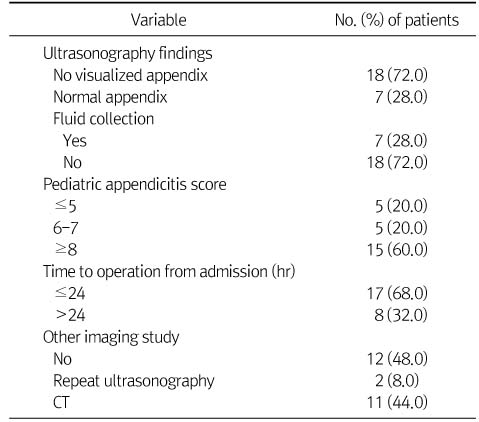
Table 2

Characteristics of Patients with Negative Ultrasonographic Finding (n=25)

jkaps-22-33-i002.jpg

Download Citation

Download a citation file in RIS format that can be imported by all major citation management software, including EndNote, ProCite, RefWorks, and Reference Manager.

Format:

Include:

Cause of Abdominal Ultrasound Diagnostic Errors in Children with Acute Appendicitis
J Korean Assoc Pediatr Surg. 2016;22(2):33-37.   Published online December 22, 2016
Download Citation

Download a citation file in RIS format that can be imported by all major citation management software, including EndNote, ProCite, RefWorks, and Reference Manager.

Format:
Include:
Cause of Abdominal Ultrasound Diagnostic Errors in Children with Acute Appendicitis
J Korean Assoc Pediatr Surg. 2016;22(2):33-37.   Published online December 22, 2016
Close
Cause of Abdominal Ultrasound Diagnostic Errors in Children with Acute Appendicitis

Characteristics of Patients Who Received Appendectomy with Acute Appendicitis (n=181)

Values are presented as mean±SD or n (%).

Seg., segmented; exam., examination; RLQ, right lower quadrant; DT, direct tenderness; RT, rebound tenderness; MG, muscle guarding.

Characteristics of Patients with Negative Ultrasonographic Finding (n=25)

Table 1 Characteristics of Patients Who Received Appendectomy with Acute Appendicitis (n=181)

Values are presented as mean±SD or n (%).

Seg., segmented; exam., examination; RLQ, right lower quadrant; DT, direct tenderness; RT, rebound tenderness; MG, muscle guarding.

Table 2 Characteristics of Patients with Negative Ultrasonographic Finding (n=25)