
Skip to main navigation Skip to main content
  • KAPS
  • E-Submission

APS : Advances in Pediatric Surgery

OPEN ACCESS
ABOUT
BROWSE ARTICLES
EDITORIAL POLICY
FOR CONTRIBUTORS
Original Article

Is Preoperative Ultrasonography Necessary in Pediatric Inguinal Hernia?

Journal of the Korean Association of Pediatric Surgeons 2018;24(1):5-9.
Published online: June 30, 2018

1Department of Pediatric Surgery, Seoul National University Children's Hospital, Seoul, Korea.

2Department of Pediatric Surgery, Seoul National University College of Medicine, Seoul, Korea.

Correspondence: Hyun-Young Kim. Department of Pediatric Surgery, Seoul National University College of Medicine, 103 Daehak-ro, Jongno-gu, Seoul 03080, Korea. Tel: +82-2-2072-2478, Fax: +82-2-747-5130, spkhy02@snu.ac.kr
• Received: November 11, 2017   • Revised: March 21, 2018   • Accepted: March 29, 2018

Copyright © 2018 Korean Association of Pediatric Surgeons

This is an Open Access article distributed under the terms of the Creative Commons Attribution Non-Commercial License (https://creativecommons.org/licenses/by-nc/4.0) which permits unrestricted non-commercial use, distribution, and reproduction in any medium, provided the original work is properly cited.
  • 0 Views
  • 0 Download
prev next
  • Purpose
    Preoperative ultrasonography (USG) in pediatric inguinal hernia has controversy. In this study, we analyzed the cases of pediatric inguinal hernia with/without preoperative USG and discussed whether USG is necessary.
  • Methods
    We reviewed medical records of 1,441 patients who underwent inguinal hernia repair in Seoul National University Children's Hospital between January 2011 and August 2016 retrospectively.
  • Results
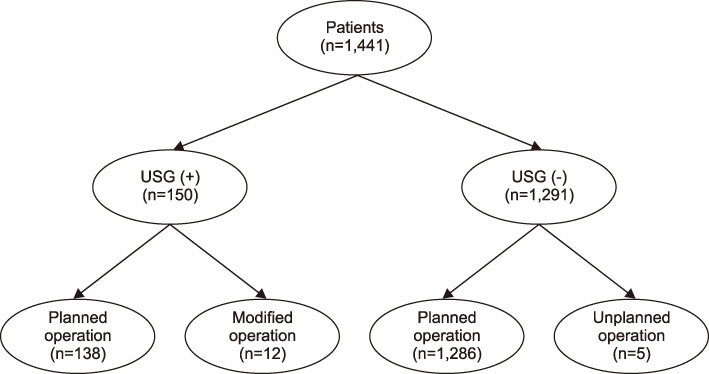
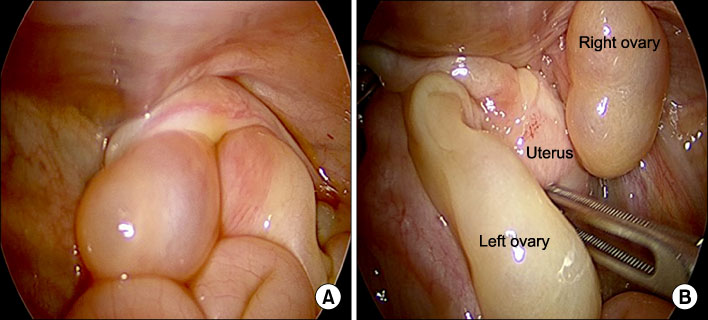
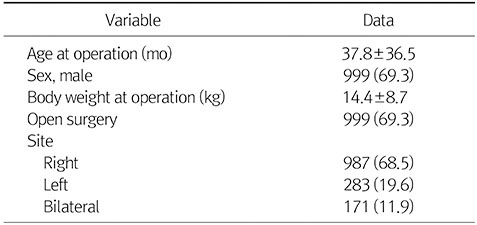
    Male were 69.3% and age at operation was 37.8±36.5 months old. There were 150 patients (10.4%) performed USG preoperatively. The department ordered to perform USG included department of surgery (n=71), emergency medicine (n=42), pediatrics (n=26), urology (n=10) and outside hospital (n=1). The reasons of performing USG included evaluation for hernia laterality (n=82), incarceration (n=28), testis (n=15), request of parents (n=14), scrotal mass (n=6) and incidentally found during evaluation for another disease (n=5). Excepting 5 cases of incidental finding, of 145 cases with USG, 12 (8.3%) cases changed the surgical plan; change to bilateral repair from unilateral repair (n=5), emergency operation due to incarceration (n=4) which include 1 salpingo-oophorectomy, 1 open abdomen surgery and 2 hernia repair after reduction of ovary, change to co-operation of orchiopexy (n=2) and change to laparoscopic surgery from open surgery due to herniation of both ovaries into one inguinal canal (n=1). In group without USG (n=1,291), 5 patients (0.4%) had unexpected problems during operation; 2 co-operation of orchiopexy because of transverse testicular ectopia (n=1) and right undescended testis (n=1), 2 hypertrophy of major labia and 1 retroperitoneal lymphangioma at inguinal area misdiagnosed as inguinal hernia.
  • Conclusion
    It was difficult to interpret the meaning of preoperative USG because not all patients had performed it. In this study, 10.4% of patients performed USG and 8.3% of them changed surgical plan. About 0.4% of patients without preoperative USG would have benefited from it for surgery if they had performed it. Since the percentage is too low, it is unreasonable to conclude that USG has diagnostic utility in inguinal hernia in this study.

No potential conflict of interest relevant to this article was reported.

  • 1. Chung SY. Indirect inguinal hernia in pediatric patients. J Korean Assoc Pediatr Surg 2010;16:101-107.
  • 2. Meena D, Jhuria R, Saxena S, Saini U. Inguinoscrotal hernia in infants: three case reports in ultrasound diagnosis. Indian J Radiol Imaging 2017;27:78-81.
  • 3. Lee JE, Choi KJ. A clinical study of pediatric inguinal hernia before and after using ultrasonography for diagnosis. J Korean Assoc Pediatr Surg 2004;10:131-135.
  • 4. Zaidi SH, Rahman JU, Siddiqui TS, Rehman HU, Ahmed N, Fraz MO. Exploration of the contralateral groin in paediatric inguinal hernia or hydrocele based on ultrasound findings: is it justified? J Ayub Med Coll Abbottabad 2017;29:26-29.
  • 5. Kwon O, Jung J, Park J, Chang S. Ultrasonographic evaluation in patients with inguinal hernia. J Korean Assoc Pediatr Surg 2002;8:16-22.
  • 6. Sameshima YT, Yamanari MG, Silva MA, Neto MJ, Funari MB. The challenging sonographic inguinal canal evaluation in neonates and children: an update of differential diagnoses. Pediatr Radiol 2017;47:461-472.
  • 7. Hasanuzzaman SM, Chowdhury LH, Sarker RN, Bari MS, Talukder SA, Islam MK. Ultrasonographic evaluation of contralateral exploration of patent processus vaginalis in unilateral inguinal hernia. Mymensingh Med J 2011;20:192-196.
  • 8. Hata S, Takahashi Y, Nakamura T, Suzuki R, Kitada M, Shimano T. Preoperative sonographic evaluation is a useful method of detecting contralateral patent processus vaginalis in pediatric patients with unilateral inguinal hernia. J Pediatr Surg 2004;39:1396-1399.
  • 9. Kim SM, Kim DY, Kim SY, Kim SC, Kim WK, Kim JE, et al. Trend (in 2005) of repair of inguinal hernia in children in Korea: a national survey by the Korean Association of Pediatric Surgeons in 2005. J Korean Assoc Pediatr Surg 2006;12:155-166.
Fig. 1

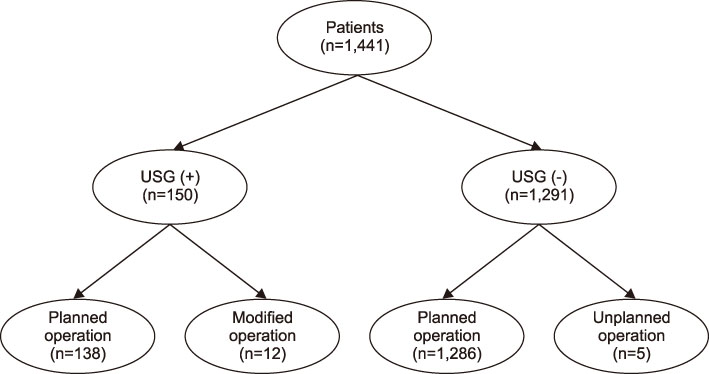
Patients with and without preoperative ultrasonography (USG).

jkaps-24-5-g001.jpg
Fig. 2

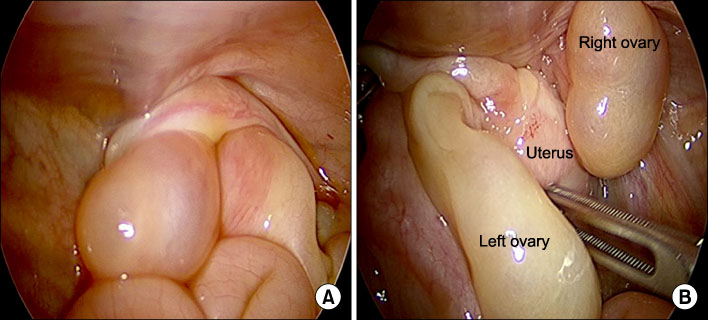
Herniation of both ovaries into unilateral inguinal canal. (A) Before reduction. (B) After reduction.

jkaps-24-5-g002.jpg
Fig. 3

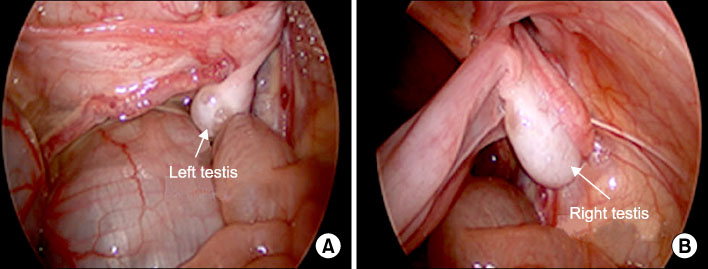
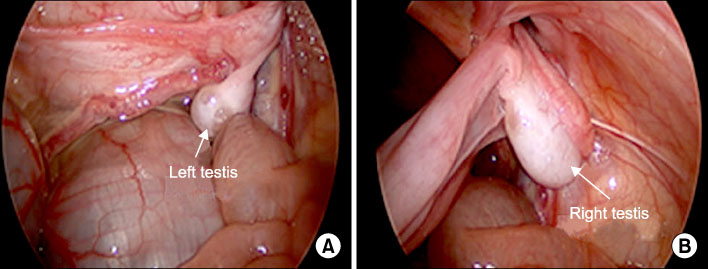
Transverse testicular ectopia with persistent Mullerian duct syndrome. (A) Left testis at right inguinal internal ring. (B) Reduction of right testis.

jkaps-24-5-g003.jpg
Fig. 4

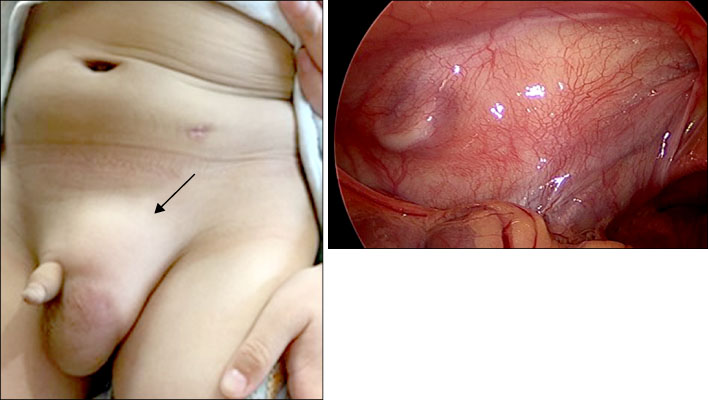
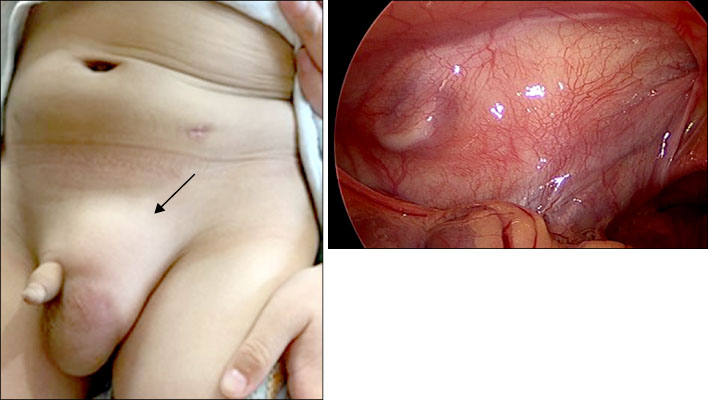
Retroperitoneal lymphangioma which was misdiagnosed as inguinal hernia (arrow).

jkaps-24-5-g004.jpg
Table 1

Demographics (n=1,441)

Values are presented as mean±SD or n (%).

jkaps-24-5-i001.jpg
Table 2

Patients with Ultrasonography (n=150)

Values are presented as n (%).
jkaps-24-5-i002.jpg

Download Citation

Download a citation file in RIS format that can be imported by all major citation management software, including EndNote, ProCite, RefWorks, and Reference Manager.

Format:

Include:

Is Preoperative Ultrasonography Necessary in Pediatric Inguinal Hernia?
J Korean Assoc Pediatr Surg. 2018;24(1):5-9.   Published online June 30, 2018
Download Citation

Download a citation file in RIS format that can be imported by all major citation management software, including EndNote, ProCite, RefWorks, and Reference Manager.

Format:
Include:
Is Preoperative Ultrasonography Necessary in Pediatric Inguinal Hernia?
J Korean Assoc Pediatr Surg. 2018;24(1):5-9.   Published online June 30, 2018
Close

Figure

  • 0
  • 1
  • 2
  • 3
Is Preoperative Ultrasonography Necessary in Pediatric Inguinal Hernia?
Image Image Image Image
Fig. 1 Patients with and without preoperative ultrasonography (USG).
Fig. 2 Herniation of both ovaries into unilateral inguinal canal. (A) Before reduction. (B) After reduction.
Fig. 3 Transverse testicular ectopia with persistent Mullerian duct syndrome. (A) Left testis at right inguinal internal ring. (B) Reduction of right testis.
Fig. 4 Retroperitoneal lymphangioma which was misdiagnosed as inguinal hernia (arrow).
Is Preoperative Ultrasonography Necessary in Pediatric Inguinal Hernia?

Demographics (n=1,441)

Values are presented as mean±SD or n (%).

Patients with Ultrasonography (n=150)

Values are presented as n (%).
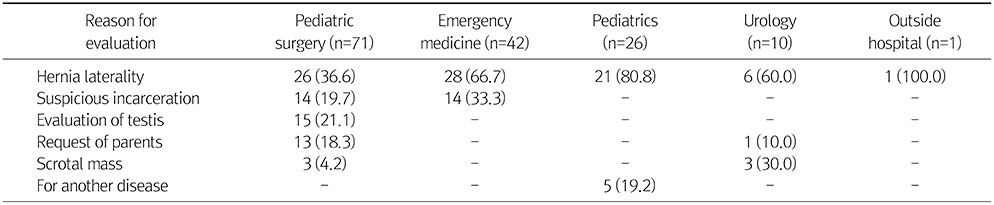
Table 1 Demographics (n=1,441)

Values are presented as mean±SD or n (%).

Table 2 Patients with Ultrasonography (n=150)

Values are presented as n (%).