
Skip to main navigation Skip to main content
  • KAPS
  • E-Submission

APS : Advances in Pediatric Surgery

OPEN ACCESS
ABOUT
BROWSE ARTICLES
EDITORIAL POLICY
FOR CONTRIBUTORS
Original Article

Surgical Treatment of Pancreatic Trauma in Children

Journal of the Korean Association of Pediatric Surgeons 2013;19(2):98-107.
Published online: December 24, 2013

Department of Pediatric Surgery, Seoul National University Children's Hospital, Seoul, Korea.

Correspondence: Hyun-Young Kim, M.D., Department of Pediatric Surgery, Seoul National University Children's Hospital, 101 Daehang-ro, Yeongeon-dong, Jongro-gu, Seoul 110-744, Korea. Tel: 02)2072-2478, Fax: 02)747-5130, spkhy02@snu.ac.kr
• Received: September 16, 2013   • Accepted: November 30, 2013

Copyright © 2013 Korean Association of Pediatric Surgeons

  • 1 Views
  • 0 Download
prev next
  • Debates exist about the appropriate treatment for pancreatic trauma in children. We intended to examine the safety of the operation of pancreatic trauma in children. This is a retrospective study of 13 patients, younger than 15, who underwent surgery for pancreatic trauma, between 1993 and 2011 in Seoul National University Children's Hospital. Medical records were reviewed for mechanism of trauma, clinical characteristics, radiological findings, operation and outcomes. Organ injury scaling from the AAST (American Association for Surgery of Trauma) was used. All injuries were caused by blunt trauma. Patients with grade III, IV, and those who were difficult to distinguish grade II from IV, underwent surgery due to severe peritonitis. Three patients with grade II were operated for reasons of mesenteric bleeding, tumor rupture of the pancreas, and progression of peritonitis. Distal pancreatectomy was performed in 10 patients and subtotal pancreatectomy and pylorus preserving pancreaticoduodenectomy in 1 patient each. The remaining one underwent surgical debridement because of severe adhesions. The location of injury, before and after operation, coincided in 83.3%. The degree of injury, before and after the operation, was identical in all the patients except for those who were difficult to tell apart grade II from grade IV, and those cannot be graded due to severe adhesion. Postoperative complications occurred in 23.1%, which improved with conservative treatment. Patients were discharged at mean postoperative 12(range 8~42) days. Even though patients with complications took longer in time from diagnosis to operation, time of trauma to operation and hospital stay, this difference was not significant. In conclusion, When pancreatic duct injury is present, or patient shows deterioration of clinical manifestation without evidence of definite duct injury, or trauma is accompanied by other organ injury or tumor rupture, operative management is advisable, and we believe it is a safe and feasible method of treatment.
  • 1. Jurkovich GJ, Carrico CJ. Pancreatic trauma. Surg Clin North Am 1990;70:575-593.
  • 2. Akhrass R, Yaffe MB, Brandt CP, Reigle M, Fallon WF, Malangoni MA. Pancreatic trauma : a ten-year multi-institutional experience. Am Surg 1997;63:598-604.
  • 3. Meier DE, Coln CD, Hicks BA, Guzzetta PC. Early operation in children with pancreas transection. J pediatr Surg 2001;36:341-344.
  • 4. Canty TG Sr, Weinman D. Management of major pancreatic duct injuries in children. J Trauma 2001;50:1001-1007.
  • 5. Shilyansky J, Sena LM, Kreller M, Chait P, Babyn PS, Filler RM, Pearl RH. Nonoperative management of pancreatic injuries in children. J Pediatr Surg 1998;33:343-349.
  • 6. Loungnarath R, Blanchard H, Saint-Vil D. Blunt injuries of the pancreas in children. Ann Chir 2001;126:992-995.
  • 7. Kim JY, Kim SC, Choi YB. Clinical analysis of the traumatic pancreatic injury. J Trauma Inj 2000;13:10-20.
  • 8. Davis JJ, Cohn I Jr, Nance FC. Diagnosis and management of blunt abdominal trauma. Ann Surg 1976;183:672-678.
  • 9. Salonen IS, Aarnio P. Treatment of acute pancreatic injuries in childhood. Ann Chir Gynaecol 1985;74:167-171.
  • 10. Lin BC, Chen RJ, Fang JF, Hsu YP, Kao YC, Kao JL. Management of blunt major pancreatic injury. J Trauma 2004;56:774-778.
  • 11. Wolf A, Bernhardt J, Patrzyk M, Heidecke CD. The value of endoscopic diagnosis and the treatment of pancreas injuries following blunt abdominal trauma. Surg endosc 2005;19:665-669.
  • 12. Tyburski JG, Dente CJ, Wilson RF, Shanti C, Steffes CP, Carlin A. Infectious complications following duodenal and/or pancreatic trauma. Am Surg 2001;67:227-230.
  • 13. Levy JL Jr, Linder LH. Major abdominal trauma in children. Am J Surg 1970;120:55-58.
  • 14. Chang J, Choi KJ. Analysis of the management of children with abdominal solid organ injuries. J Korean Surg Soc 2009;76:252-258.
  • 15. Horst HM, Bivins BA. Pancreatic transection. A concept of evolving injury. Arch Surg 1989;124:1093-1095.
  • 16. Matsuno WC, Huang CJ, Garcia NM, Roy LC, Davis J. Amylase and lipase measurements in paediatric patients with traumatic pancreatic injuries. Injury 2009;40:66-71.
  • 17. Herman R, Guire KE, Burd RS, Mooney DP, Ehlrich PF. Utility of amylaseand lipase as predictors of grade of injury or outcomes in pediatric patients with pancreatic trauma. J Pediatr Surg 2011;46:923-926.
  • 18. London NJ, Leese T, Lavelle JM, Miles K, West KP, Watkin DF, Fossard DP. Rapid-bolus contrast-enhanced dynamic computed tomography in acute pancreatitis: a prospective study. Br J Surg 1991;78:1452-1456.
  • 19. Yang L, Zhang XM, Xu XX, Tang W, Xiao B, Zeng NL. MR imaging for blunt pancreatic injury. Eur J Radiol 2010;75:e97-e101.
  • 20. de Blaauw I, Winkelhorst JT, Rieu PN, van der Staak FH, Wijnen MH, Severijnen RS, van Vugt AB, Wijnen RM. Pancreatic injury in children: good outcome of nonoperative treatment. J Pediatr Surg 2008;43:1640-1643.
  • 21. Wales PW, Shuckett B, Kim PC. Long-term outcome after nonoperative management of complete traumatic pancreatic transection in children. J Pediatr Surg 2001;36:823-827.
  • 22. Snajdauf J, Rygl M, Kalousova J, Kucera A, Petru O, Pycha K, Mixa V, Keil R, Hribal Z. Surgical management of major pancreatic injury in children. Eur J Pediatr Surg 2007;17:317-321.
  • 23. Cuenca AG, Islam S. Pediatric Pancreatic Trauma: Trending Toward Nonoperative Management? Am surg 2012;78:1204-1210.
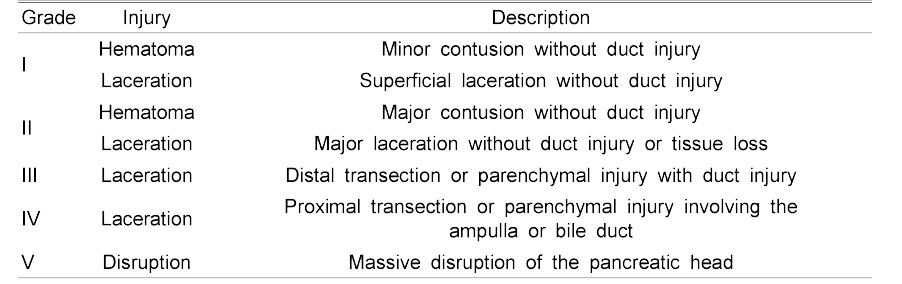
Table 1
AAST (American Association for the Surgery of Trauma) Classification
jkaps-19-98-i001.jpg
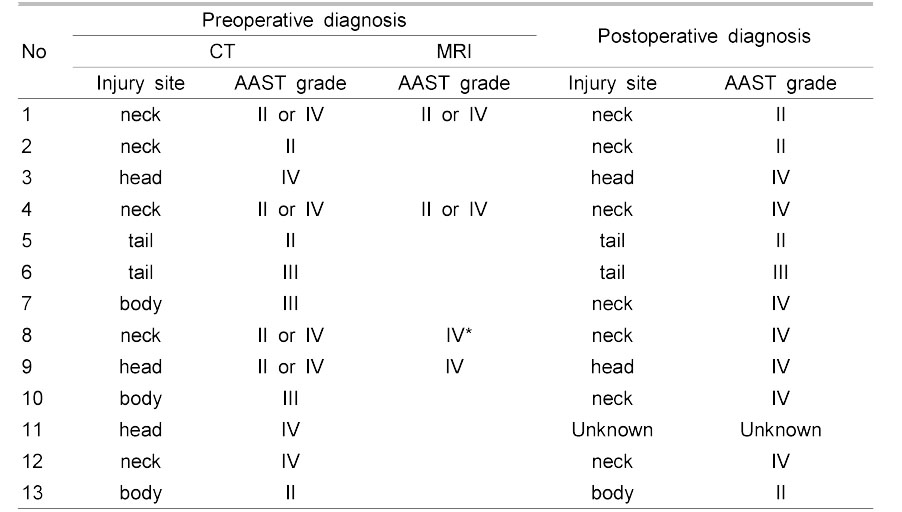
Table 2
Preoperative Clinical Findings and APACHE Score

Abbreviations: WBC; white blood cell, Hb; hemoglobin, CRP; C-reactive protein, BP; blood pressure, PR; pulse rate, RR; respiratory rate, BT; body temperature, APACHE; Acute Physiology and Chronic Health Evaluation
jkaps-19-98-i002.jpg
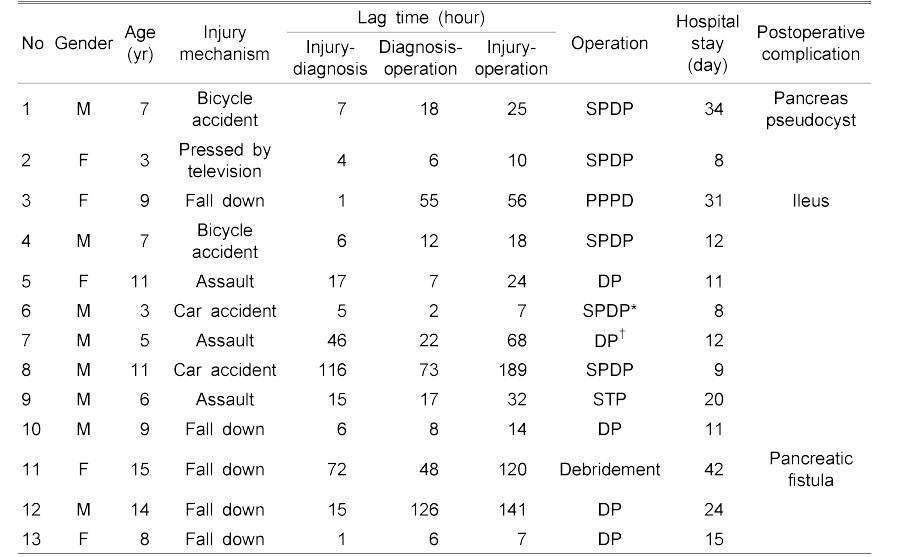
Table 3
Comparison between Preoperative Radiologic Findings and Postoperative Findings

Abbreviations: CT; computed tomography, MRI; magnetic resonance imaging, AAST; American Association for the Surgery of Trauma

*Additional examination (ERCP)

jkaps-19-98-i003.jpg
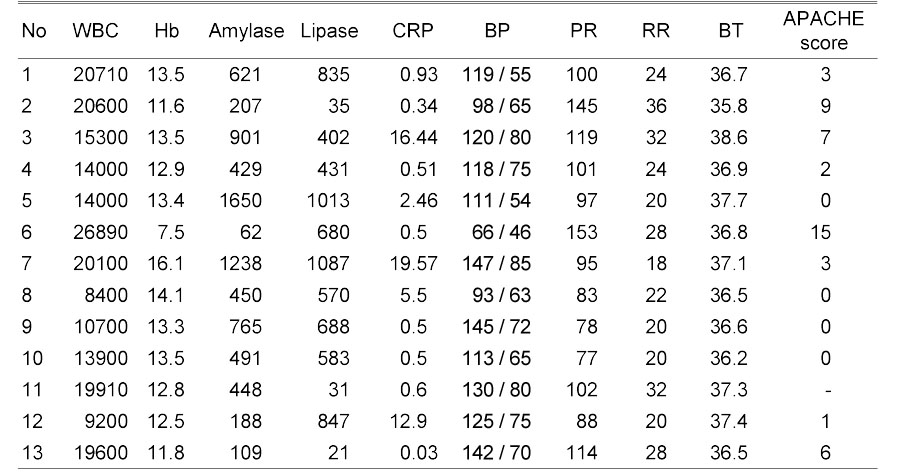
Table 4
Patients Characteristics and Clinical Course

Abbreviations: SPDP; spleen preserving distal pancreatectomy, PPPD; pylorus preserving pancreaticoduodenectomy, DP; distal pancreatectomy, STP; subtotal pancreatectomy

*Combiled operation: S2 segmentectomy, Combined operation: right hemicolectomy

jkaps-19-98-i004.jpg

Download Citation

Download a citation file in RIS format that can be imported by all major citation management software, including EndNote, ProCite, RefWorks, and Reference Manager.

Format:

Include:

Surgical Treatment of Pancreatic Trauma in Children
J Korean Assoc Pediatr Surg. 2013;19(2):98-107.   Published online December 24, 2013
Download Citation

Download a citation file in RIS format that can be imported by all major citation management software, including EndNote, ProCite, RefWorks, and Reference Manager.

Format:
Include:
Surgical Treatment of Pancreatic Trauma in Children
J Korean Assoc Pediatr Surg. 2013;19(2):98-107.   Published online December 24, 2013
Close
Surgical Treatment of Pancreatic Trauma in Children

AAST (American Association for the Surgery of Trauma) Classification

Preoperative Clinical Findings and APACHE Score

Abbreviations: WBC; white blood cell, Hb; hemoglobin, CRP; C-reactive protein, BP; blood pressure, PR; pulse rate, RR; respiratory rate, BT; body temperature, APACHE; Acute Physiology and Chronic Health Evaluation

Comparison between Preoperative Radiologic Findings and Postoperative Findings

Abbreviations: CT; computed tomography, MRI; magnetic resonance imaging, AAST; American Association for the Surgery of Trauma

*Additional examination (ERCP)

Patients Characteristics and Clinical Course

Abbreviations: SPDP; spleen preserving distal pancreatectomy, PPPD; pylorus preserving pancreaticoduodenectomy, DP; distal pancreatectomy, STP; subtotal pancreatectomy

*Combiled operation: S2 segmentectomy, Combined operation: right hemicolectomy

Table 1 AAST (American Association for the Surgery of Trauma) Classification
Table 2 Preoperative Clinical Findings and APACHE Score

Abbreviations: WBC; white blood cell, Hb; hemoglobin, CRP; C-reactive protein, BP; blood pressure, PR; pulse rate, RR; respiratory rate, BT; body temperature, APACHE; Acute Physiology and Chronic Health Evaluation

Table 3 Comparison between Preoperative Radiologic Findings and Postoperative Findings

Abbreviations: CT; computed tomography, MRI; magnetic resonance imaging, AAST; American Association for the Surgery of Trauma

*Additional examination (ERCP)

Table 4 Patients Characteristics and Clinical Course

Abbreviations: SPDP; spleen preserving distal pancreatectomy, PPPD; pylorus preserving pancreaticoduodenectomy, DP; distal pancreatectomy, STP; subtotal pancreatectomy

*Combiled operation: S2 segmentectomy, Combined operation: right hemicolectomy