Skip to main navigation Skip to main content
  • KAPS
  • E-Submission

APS : Advances in Pediatric Surgery

OPEN ACCESS
ABOUT
BROWSE ARTICLES
EDITORIAL POLICY
FOR CONTRIBUTORS
Original Article

Comparison of Pyloromyotomy with Supraumbilical Incision and Laparoscopic Pyloromyotomy for Hypertrophic Pyloric Stenosis Performed by a Single Surgeon

Journal of the Korean Association of Pediatric Surgeons 2014;20(2):43-47.
Published online: December 30, 2014

Department of Pediatric Surgery, Asan Medical Center, University of Ulsan College of Medicine, Seoul, Korea.

Correspondence: Dae Yeon Kim, Department of Pediatric Surgery, Asan Medical Center Children's Hospital, 88, Olympic-ro 43-gil, Songpa-gu, Seoul 138-736, Korea. Tel: +82-2-3010-3961, Fax: +82-2-474-9027, kimdy@amc.seoul.kr
• Received: August 20, 2014   • Revised: October 25, 2014   • Accepted: October 26, 2014

Copyright © 2014 by the Korean Association of Pediatric Surgeons

This is an Open Access article distributed under the terms of the Creative Commons Attribution Non-Commercial License (http://creativecommons.org/licenses/by-nc/3.0/) which permits unrestricted non-commercial use, distribution, and reproduction in any medium, provided the original work is properly cited.
  • 0 Views
  • 0 Download
prev next
  • Purpose
    Hypertrophic pyloric stenosis (HPS) is known to be one of the most common cause of surgery for infants and pyloromyotomy was considered to the standard treatment. There has been an ongoing debate about whether laparoscopic pyloromyotomy (LP) or open pyloromyotomy (OP) is the best option for treating HPS. The aim of this study is to evaluate safety and effectiveness of LP by comparing the clinical results of both surgical strategies performed by single surgeon.
  • Methods
    Between January 2000 and December 2013, 60 patients who underwent pyloromyotomy at Asan Medical Center performed by a surgeon were followed: open-supraumbilical incision (n=36) and LP (n=24). The parameters included sex, age and body weight at operation. Clinical outcomes included operation time, time to full feeding, postoperative hospital stay, and postoperative complications.
  • Results
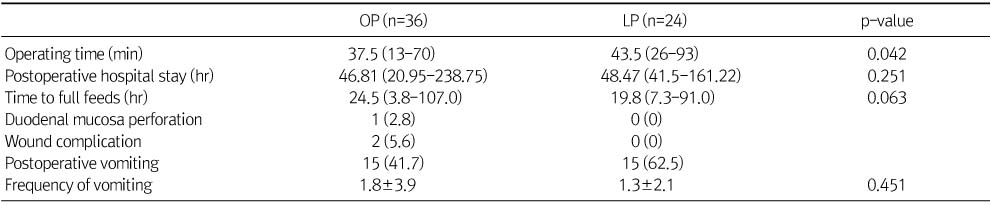
    There were no significant differences in characteristics, postoperative hospital stay between the two groups. Time to full feeding was shorter in LP (OP 24.5 hours vs. LP 19.8 hours; p=0.063). In contrast, the mean operation time was longer in LP (OP 37.5 minutes vs. LP 43.5 minutes; p=0.072). Complications such as perforation of mucosal layer (OP 1 vs. LP 0) and wound problems (OP 2 vs. LP 0) were found to be not worse in laparoscopic group as compared with open group.
  • Conclusion
    There has no difference both laparoscopic and open-supraumbilical incision in terms of postoperative hospital stay, time to full feeds and frequency of complications.

No potential conflict of interest relevant to this article was reported.

  • 1. Everett KV, Capon F, Georgoula C, Chioza BA, Reece A, Jaswon M, et al. Linkage of monogenic infantile hypertrophic pyloric stenosis to chromosome 16q24. Eur J Hum Genet 2008;16:1151-1154.
  • 2. Ohshiro K, Puri P. Pathogenesis of infantile hypertrophic pyloric stenosis: recent progress. Pediatr Surg Int 1998;13:243-252.
  • 3. Woo JH, Choi KJ. The clinical features and management of IHPS: a comparison between 1980's and 2000's. J Korean Surg Soc 2010;78:184-191.
  • 4. Schwartz MZ. Hypertrophic pyloric stenosis. In Grosfeld JL, Fonkalsrud EW, Coran AG, O'Neill JA, eds, ddPediatric surgery. 6th ed. Philadelphia: Mosby; 2006, pp 1215-1224.
  • 5. Oomen MW, Hoekstra LT, Bakx R, Ubbink DT, Heij HA. Open versus laparoscopic pyloromyotomy for hypertrophic pyloric stenosis: a systematic review and meta-analysis focusing on major complications. Surg Endosc 2012;26:2104-2110.
  • 6. Tan KC, Bianchi A. Circumumbilical incision for pyloromyotomy. Br J Surg 1986;73:399.
  • 7. Alain JL, Grousseau D, Terrier G. Extramucosal pyloromyotomy by laparoscopy. Surg Endosc 1991;5:174-175.
  • 8. Kim SM, Jung SM, Seo JM, Lee SK. Comparison of outcomes between open and laparoscopic pyloromyotomy. J Korean Assoc Pediatr Surg 2011;17:139-144.
  • 9. Hirschsprung H. Falle von angeborener pylorus stenose. J Kinderheilk 1888;27:61-62.
  • 10. Fujimoto T, Lane GJ, Segawa O, Esaki S, Miyano T. Laparoscopic extramucosal pyloromyotomy versus open pyloromyotomy for infantile hypertrophic pyloric stenosis: which is better? J Pediatr Surg 1999;34:370-372.
  • 11. St Peter SD, Holcomb GW 3rd, Calkins CM, Murphy JP, Andrews WS, Sharp RJ, et al. Open versus laparoscopic pyloromyotomy for pyloric stenosis: a prospective, randomized trial. Ann Surg 2006;244:363-370.
  • 12. Jung H, Jang JH, Jo AH, Kim SH, Jung SE, Park KW, et al. Laparoscopic versus open pyloromyotomy for hypertrophic pyloric stenosis. J Minim Invasive Surg 2013;16:11-14.
  • 13. Yagmurlu A, Barnhart DC, Vernon A, Georgeson KE, Harmon CM. Comparison of the incidence of complications in open and laparoscopic pyloromyotomy: a concurrent single institution series. J Pediatr Surg 2004;39:292-296.
  • 14. Adibe OO, Nichol PF, Flake AW, Mattei P. Comparison of outcomes after laparoscopic and open pyloromyotomy at a high-volume pediatric teaching hospital. J Pediatr Surg 2006;41:1676-1678.
  • 15. Ostlie DJ, Woodall CE, Wade KR, Snyder CL, Gittes GK, Sharp RJ, et al. An effective pyloromyotomy length in infants undergoing laparoscopic pyloromyotomy. Surgery 2004;136:827-832.
  • 16. Campbell BT, McVay MR, Lerer TJ, Lowe NJ, Smith SD, Kokoska ER. Ghosts in the machine: a multi-institutional comparison of laparoscopic and open pyloromyotomy. J Pediatr Surg 2007;42:2026-2029.
  • 17. Campbell BT, McLean K, Barnhart DC, Drongowski RA, Hirschl RB. A comparison of laparoscopic and open pyloromyotomy at a teaching hospital. J Pediatr Surg 2002;37:1068-1071.
  • 18. Sitsen E, Bax NM, van der Zee DC. Is laparoscopic pyloromyotomy superior to open surgery? Surg Endosc 1998;12:813-815.
  • 19. Spitz L. Vomiting after pyloromyotomy for infantile hypertrophic pyloric stenosis. Arch Dis Child 1979;54:886-889.
  • 20. Schärli AF, Leditschke JF. Gastric motility after pyloromyotomy in infants. A reappraisal of postoperative feeding. Surgery 1968;64:1133-1137.
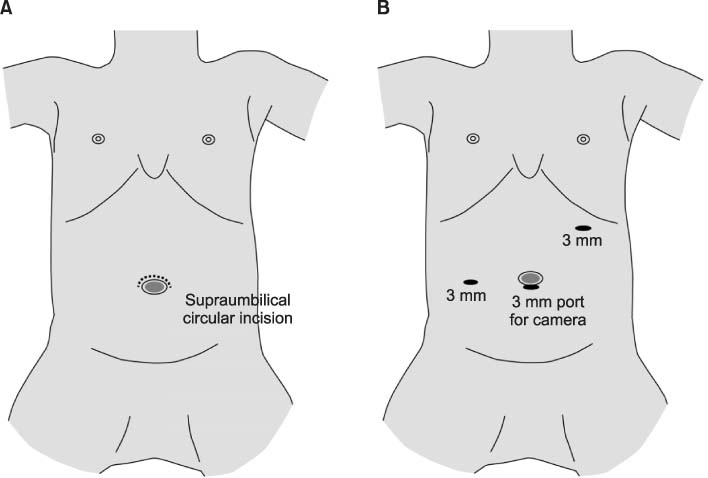
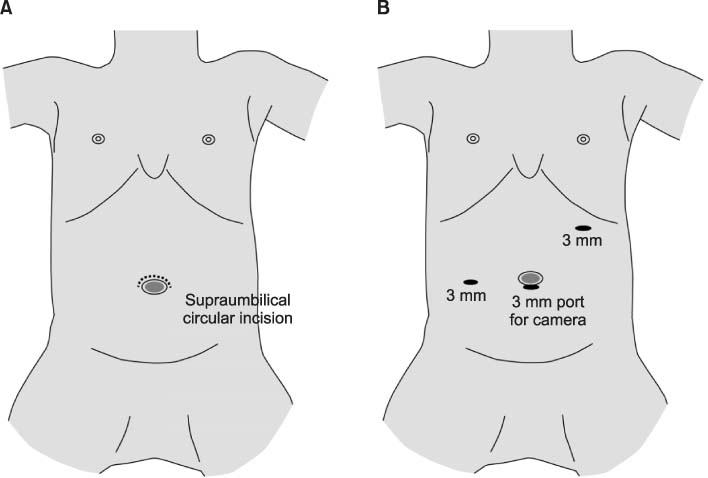
Fig. 1
Incision of supraumbilical open pyloromyotomy (supraumbilical incision) (A) and laparoscopic pyloromyotomy (B).
jkaps-20-43-g001.jpg
Table 1
Demographic Data of of HPS Patients

Values are presented as ratio or median (range).

HPS, hypertrophic pyloric stenosis; OP, open pyloromyotomy (supraumbilical incision); LP, laparoscopic pyloromyotomy.

jkaps-20-43-i001.jpg
Table 2
Clinical Outcomes Treated by OP or LP of Hypertrophic Pyloric Stenosis

Values are presented as median (range), n (%), or mean±SD.

OP, open pyloromyotomy (supraumbilical incision); LP, laparoscopic pyloromyotomy.

jkaps-20-43-i002.jpg

Download Citation

Download a citation file in RIS format that can be imported by all major citation management software, including EndNote, ProCite, RefWorks, and Reference Manager.

Format:

Include:

Comparison of Pyloromyotomy with Supraumbilical Incision and Laparoscopic Pyloromyotomy for Hypertrophic Pyloric Stenosis Performed by a Single Surgeon
J Korean Assoc Pediatr Surg. 2014;20(2):43-47.   Published online December 30, 2014
Download Citation

Download a citation file in RIS format that can be imported by all major citation management software, including EndNote, ProCite, RefWorks, and Reference Manager.

Format:
Include:
Comparison of Pyloromyotomy with Supraumbilical Incision and Laparoscopic Pyloromyotomy for Hypertrophic Pyloric Stenosis Performed by a Single Surgeon
J Korean Assoc Pediatr Surg. 2014;20(2):43-47.   Published online December 30, 2014
Close

Figure

  • 0
Comparison of Pyloromyotomy with Supraumbilical Incision and Laparoscopic Pyloromyotomy for Hypertrophic Pyloric Stenosis Performed by a Single Surgeon
Image
Fig. 1 Incision of supraumbilical open pyloromyotomy (supraumbilical incision) (A) and laparoscopic pyloromyotomy (B).
Comparison of Pyloromyotomy with Supraumbilical Incision and Laparoscopic Pyloromyotomy for Hypertrophic Pyloric Stenosis Performed by a Single Surgeon

Demographic Data of of HPS Patients

Values are presented as ratio or median (range).

HPS, hypertrophic pyloric stenosis; OP, open pyloromyotomy (supraumbilical incision); LP, laparoscopic pyloromyotomy.

Clinical Outcomes Treated by OP or LP of Hypertrophic Pyloric Stenosis

Values are presented as median (range), n (%), or mean±SD.

OP, open pyloromyotomy (supraumbilical incision); LP, laparoscopic pyloromyotomy.

Table 1 Demographic Data of of HPS Patients

Values are presented as ratio or median (range).

HPS, hypertrophic pyloric stenosis; OP, open pyloromyotomy (supraumbilical incision); LP, laparoscopic pyloromyotomy.

Table 2 Clinical Outcomes Treated by OP or LP of Hypertrophic Pyloric Stenosis

Values are presented as median (range), n (%), or mean±SD.

OP, open pyloromyotomy (supraumbilical incision); LP, laparoscopic pyloromyotomy.