Skip to main navigation Skip to main content
  • KAPS
  • E-Submission

APS : Advances in Pediatric Surgery

OPEN ACCESS
ABOUT
BROWSE ARTICLES
EDITORIAL POLICY
FOR CONTRIBUTORS
Original Article

Clinical Feature of Neonatal Neuroblastoma: Comparison of Outcome between Diagnosed Prenatally and at Postpartum Group

Journal of the Korean Association of Pediatric Surgeons 2014;20(2):53-57.
Published online: December 30, 2014

1Department of Pediatric Surgery, Seoul National University Children's Hospital, Seoul, Korea.

2Department of Pediatrics, Cancer Research Institute, Seoul National University College of Medicine, Seoul, Korea.

3Department of Pathology, Seoul National University Children's Hospital, Seoul, Korea.

4Department of Pediatric Surgery, Pusan National University Children's Hospital, Yangsan, Korea.

Correspondence: Hyun-Young Kim. Department of Pediatric Surgery, Seoul National University Children's Hospital, 101, Daehak-ro, Jongno-gu, Seoul 110-744, Korea. Tel: +82-2-2072-2478, Fax: +82-2-747-5130, spkhy02@snu.ac.kr
• Received: October 16, 2014   • Revised: November 3, 2014   • Accepted: November 4, 2014

Copyright © 2014 by the Korean Association of Pediatric Surgeons

This is an Open Access article distributed under the terms of the Creative Commons Attribution Non-Commercial License (http://creativecommons.org/licenses/by-nc/3.0/) which permits unrestricted non-commercial use, distribution, and reproduction in any medium, provided the original work is properly cited.

  • 1 Views
  • 0 Download
prev next
  • Purpose
    Neonatal neuroblastoma (NBL) is the most common malignant tumor in neonates, but there have been few studies about it. The purpose of this study was to investigate the clinical features of NBL and to compare prenatal and postnatal diagnosed groups.
  • Methods
    Nineteen patients who were diagnosed with NBL prenatally or within 28 days after birth from February 1986 to February 2013 in Seoul National University Hospital were enrolled in the study. The patients were categorized according to the International Neuroblastoma Staging System (INSS) and Children's Oncology Group (COG). Retrospective medical-record reviews were performed on these patients. The operative date, complication, pathological stage, and overall survival of the prenatally diagnosed group and the postpartum diagnosed group were compared.
  • Results
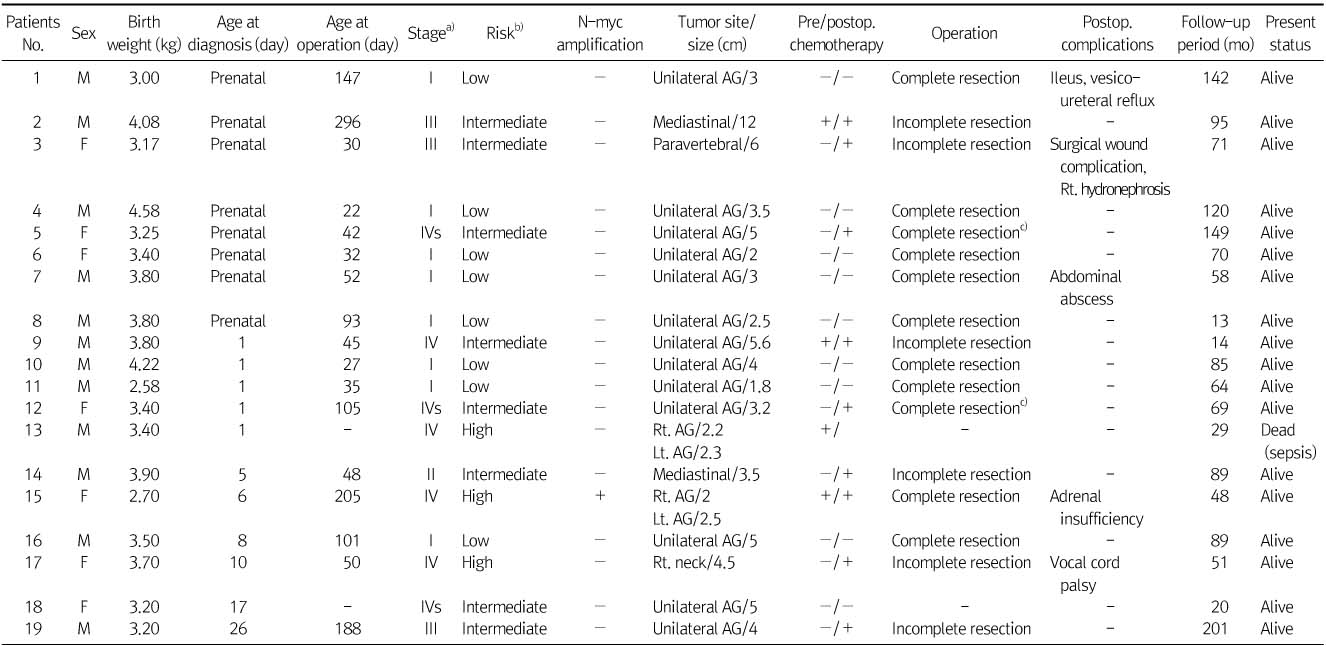
    Tumor was detected via prenatal ultrasonography in 8 patients (42.1%), and 11 patients (57.9%) were diagnosed within 28 days after birth. Based on INSS, the patients were divided into the stage I (n=8), stage II (n=1), stage III (n=3), stage IV (n=4), and stage IVs (n=3) groups, respectively. Based on COG, on the other hand, the patients were divided into the low-risk (n=8), intermediate-risk (n=8), and high-risk (n=3) groups. The postoperative complication rate was 29%. One patient died from complications from chemotherapy. The other 18 patients' mean follow-up period was 77.7 months. The differences between the postoperative complication rate, proportion of early-stage tumor, and overall survival of the prenatal and postnatal groups were not statistically significant (p=0.446, p=0.607, p=0.414).
  • Conclusion
    NBL showed favorable outcomes but relatively higher postoperative complications. There seem to be no significant statistical differences in the postoperative complications, proportion of early-stage tumor, and overall survival between the prenatally diagnosed group and the postpartum diagnosed group.

No potential conflict of interest relevant to this article was reported.

  • 1. Mullassery D, Dominici C, Jesudason EC, McDowell HP, Losty PD. Neuroblastoma: contemporary management. Arch Dis Child Educ Pract Ed 2009;94:177-185.
  • 2. Schwab M, Alitalo K, Klempnauer KH, Varmus HE, Bishop JM, Gilbert F, et al. Amplified DNA with limited homology to myc cellular oncogene is shared by human neuroblastoma cell lines and a neuroblastoma tumour. Nature 1983;305:245-248.
  • 3. Coldman AJ, Fryer CJ, Elwood JM, Sonley MJ. Neuroblastoma: influence of age at diagnosis, stage, tumor site, and sex on prognosis. Cancer 1980;46:1896-1901.
  • 4. Schmidt ML, Lukens JN, Seeger RC, Brodeur GM, Shimada H, Gerbing RB, et al. Biologic factors determine prognosis in infants with stage IV neuroblastoma: a prospective Children's Cancer Group study. J Clin Oncol 2000;18:1260-1268.
  • 5. Evans AE, D'Angio GJ, Propert K, Anderson J, Hann HW. Prognostic factor in neuroblastoma. Cancer 1987;59:1853-1859.
  • 6. Joshi VV, Cantor AB, Brodeur GM, Look AT, Shuster JJ, Altshuler G, et al. Correlation between morphologic and other prognostic markers of neuroblastoma. A study of histologic grade, DNA index, N-myc gene copy number, and lactic dehydrogenase in patients in the Pediatric Oncology Group. Cancer 1993;71:3173-3181.
  • 7. London WB, Castleberry RP, Matthay KK, Look AT, Seeger RC, Shimada H, et al. Evidence for an age cutoff greater than 365 days for neuroblastoma risk group stratification in the Children's Oncology Group. J Clin Oncol 2005;23:6459-6465.
  • 8. Dhir S, Wheeler K. Neonatal neuroblastoma. Early Hum Dev 2010;86:601-605.
  • 9. Fisher JP, Tweddle DA. Neonatal neuroblastoma. Semin Fetal Neonatal Med 2012;17:207-215.
  • 10. Fénart D, Deville A, Donzeau M, Bruneton JN. Retroperitoneal neuroblastoma diagnosed in utero. Apropos of 1 case. J Radiol 1983;64:359-361.
  • 11. Moppett J, Haddadin I, Foot AB. Neonatal neuroblastoma. Arch Dis Child Fetal Neonatal Ed 1999;81:F134-F137.
  • 12. Granata C, Fagnani AM, Gambini C, Boglino C, Bagnulo S, Cecchetto G, et al. Features and outcome of neuroblastoma detected before birth. J Pediatr Surg 2000;35:88-91.
  • 13. Gigliotti AR, Di Cataldo A, Sorrentino S, Parodi S, Rizzo A, Buffa P, et al. Neuroblastoma in the newborn. A study of the Italian Neuroblastoma Registry. Eur J Cancer 2009;45:3220-3227.
  • 14. Sposto R, London WB, Alonzo TA. Children's Oncology Group. Criteria for optimizing prognostic risk groups in pediatric cancer: analysis of data from the Children's Oncology Group. J Clin Oncol 2007;25:2070-2077.
  • 15. Michalowski MB, Rubie H, Michon J, Montamat S, Bergeron C, Coze C, et al. Groupe Neuroblastome de la Société Française d'Oncologie Pédiatrique. Neonatal localized neuroblastoma: 52 cases treated from 1990 to 1999. Arch Pediatr 2004;11:782-788.
  • 16. Suh JM, Lee SG, Yoo KH, Sung KW, Koo HH, Kim JY, et al. Outcome of patients with neuroblastoma aged less than 1 year at diagnosis. Korean J Pediatr 2009;52:93-98.
  • 17. Blackman SC, Evenson AR, Voss SD, Barnewolt CE, Puder M. Prenatal diagnosis and subsequent treatment of an intermediate-risk paraspinal neuroblastoma: case report and review of the literature. Fetal Diagn Ther 2008;24:119-125.
Table 1
Patient Demographics

M, male; F, female; AG, adrenal gland; Pre/postop., pre/postoperative; Rt., right; Lt., left.

a)Stage according to the International Neuroblastoma Staging System. b)Risk according to the Children's Oncology Group.

c)Complete resection of primary site.

jkaps-20-53-i001.jpg
Table 2
Outcome of Prenatally Diagnosed Group and Diagnosed at Postpartum Group
jkaps-20-53-i002.jpg

Download Citation

Download a citation file in RIS format that can be imported by all major citation management software, including EndNote, ProCite, RefWorks, and Reference Manager.

Format:

Include:

Clinical Feature of Neonatal Neuroblastoma: Comparison of Outcome between Diagnosed Prenatally and at Postpartum Group
J Korean Assoc Pediatr Surg. 2014;20(2):53-57.   Published online December 30, 2014
Download Citation

Download a citation file in RIS format that can be imported by all major citation management software, including EndNote, ProCite, RefWorks, and Reference Manager.

Format:
Include:
Clinical Feature of Neonatal Neuroblastoma: Comparison of Outcome between Diagnosed Prenatally and at Postpartum Group
J Korean Assoc Pediatr Surg. 2014;20(2):53-57.   Published online December 30, 2014
Close
Clinical Feature of Neonatal Neuroblastoma: Comparison of Outcome between Diagnosed Prenatally and at Postpartum Group

Patient Demographics

M, male; F, female; AG, adrenal gland; Pre/postop., pre/postoperative; Rt., right; Lt., left.

a)Stage according to the International Neuroblastoma Staging System. b)Risk according to the Children's Oncology Group.

c)Complete resection of primary site.

Outcome of Prenatally Diagnosed Group and Diagnosed at Postpartum Group

Table 1 Patient Demographics

M, male; F, female; AG, adrenal gland; Pre/postop., pre/postoperative; Rt., right; Lt., left.

a)Stage according to the International Neuroblastoma Staging System. b)Risk according to the Children's Oncology Group.

c)Complete resection of primary site.

Table 2 Outcome of Prenatally Diagnosed Group and Diagnosed at Postpartum Group