

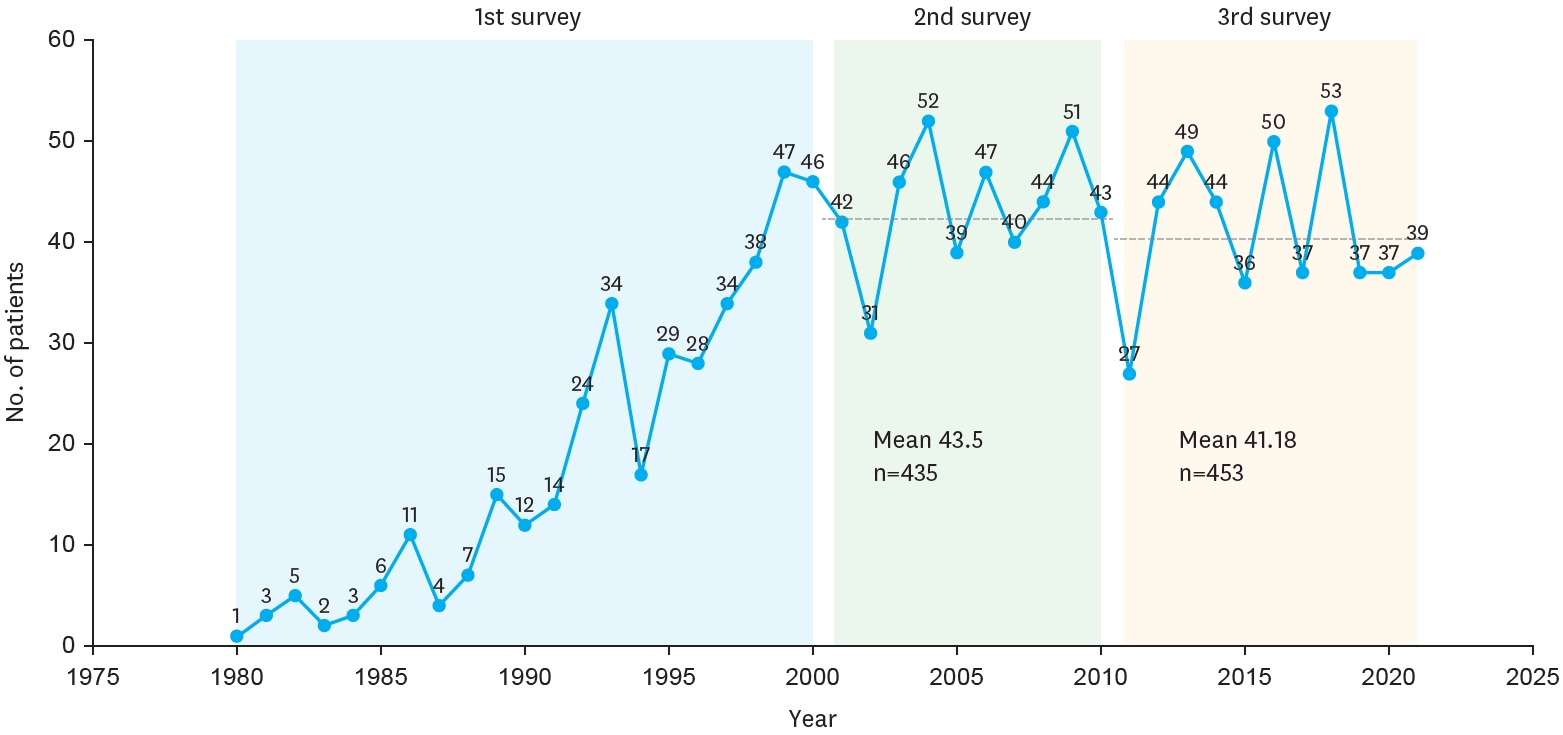
The Korean Association of Pediatric Surgeons (KAPS) performed the second nationwide survey on biliary atresia in 2011. It was a follow-up study to the first survey, which was performed in 2001 for the retrospective analysis of biliary atresia between 1980 and 2000. In the second survey, the authors reviewed and analyzed the clinical data of patients who were treated for biliary atresia by the members of KAPS from 2001 to 2010. A total of 459 patients were registered. Among them, 435 patients primarily underwent the Kasai operation. The mean age of patients who underwent the Kasai operation was 66.2±28.7 days, and 89.7% of those patients had type III biliary atresia. Only five patients (1.4%) had complications related to the Kasai operation. After the Kasai operation, 269 (61.8%) of the patients were re-admitted because of cholangitis (79.9%) and varices (20.4%). One hundred and fifty-nine (36.6%) of the patients who underwent the Kasai operation subsequently underwent liver transplantation. The most common cause of subsequent liver transplantation was persistent hyperbilirubinemia. The mean interval between the Kasai operation and liver transplantation was 1.1±1.3 years. Overall the 10-year survival rate after the Kasai operation was 92.9% and the 10-year native liver survival rate was 59.8%. We had 23 patients for primary liver transplantation without the Kasai operation. The mean age patients who underwent primary liver transplantation was 8.6±2.9 months. In summary, among the 458 Kasai-operation and liver-transplantation patients, 373 lived, 31 died, and 54 were unavailable for follow up. One-third of the patient who survived have had complications correlated with biliary atresia. In comparison with the first survey, this study showed a higher survival rate and a greater number of liver transplantation.
Citations

The purpose of this study is to analyse clinical impact of specific MRI findings in liver in patients of long-term survivors after Kasai portoenterostomy (KPE). Twenty-eight patients who were underwent KPE were followed up more than 5 years. Macro-regenerative nodule (MRN) and beaded-duct dilatation (BDD) were considered as important findings in liver MRI. The association between these findings in MRI and clinical indicator, serum bilirubin level and history of cholangitis were evaluated. Sixteen patients (57.1%) were shown MRN in liver MRI. There were 14 patients(50%) whose MRI showed BDD. Serum total and direct bilirubin were 3.6mg/dL and 1.8mg/dL respectively in positive MRN group whereas 1.4mg/dL and 0.7mg/dL in negative MRN group (
Biliary atresia (BA) is an infantile cholestatic disease of progressive obliterative cholangiopathy with varying degrees of damage to both extra and intrahepatic bile ducts due to unknown causes. The diagnostic studies should be done to diagnose or exclude BA without unnecessary delay. Kasai portoenterostomy is the first choice of treatment for bile drainage from microscopic bile ductules present in the portal fibrous mass. The medical management after Kasai portoenterostomy should be done carefully to maintain bile excretion and prevent and treat complications including cholangitis, hepatic fibrosis, portal hypertension and nutritional problem. The reported five years-survival rates after Kasai portoenterostomy range from 30 to 60%. About 20% of all patients undergoing Kasai portoenterostomy during infancy survive into adulthood with their native liver. Even if Kasai portoenterostomy remains as the first line of treatment in BA, liver transplantation serves as a good salvage treatment when portoenterostomy fails or liver function gradually deteriorates after initially successful establishment of bile flow. Overall 5-year survival rate in BA is about 90% in recent series.
To evaluate the long-term prognosis of biliary atresia after Kasai operation, a total of 14 patients (of the 41 patients operated upon from 1982 to 1997), who had been followed up for more than 10 years, were included in this retrospective study. Eleven out of 14 patients survived with their native livers, and their data analyzed for age at operation, clearing time of jaundice, histological outcome, postoperative complications, effectiveness after the application of an intussusception anti-reflex valve, and quality of life. Average age at surgery was 62.8 days. Serum bilirubin was normalized within three months in all patients. Six among the eleven long-term survivors had ascending cholangitis as one of the postoperative complications. The application of an intussusception anti-reflux valve did not show any statistical significance in long-term survival. Most of long-term survivors appeared to enjoy good quality of life. Kasai operation might not be the definitive treatment for biliary atresia; however, Kasai operation made it possible to achieve long-term survival for patients with biliary atresia when the patients were detected and treated as early as possible.
Biliary atresia (BA) is an uncommon neonatal surgical disease that has a fatal outcome if not properly treated. The survival rates of the patients with native liver after Kasai's operation in countries outside Japan are not so good. We reviewed the results of 22 cases of biliary atresia treated in Kosin University Hospital between October 1987 and March 2001. There were 13 males and 9 females aged from 21 to 106 days (mean 52 days). There were 3 cases of Type I (13.6%), and 3 of Type II (13.6%), and 16 Type III (72.7%). The operative methods were resection of the common bile duct remnant and cyst followed by Roux-en-Y hepaticojejunostomy in 3 cases for Type I BA; Kasai I in 15 cases, Kasai II in 1 case, and Ueda's operation in 3 cases for Types II and III BA. There was no death within the first 30 days after operation. We were able to follow 21 of the 22 patients (95.4%) for more than 5 years. The actual 5 year survival rate (YSR) was 40.9%. One Type I case received a living-related liver transplantation at 6 years of age because of the multiple intrahepatic stones and liver cirrhosis. Five YSR after biliostomy group (Kasai II and Ueda op.) was 75% (3/4) while that of Kasai I was 20% (3/15). One case had no bile duct in the resected fibrotic plaque on microscopic review and died 8 months after Kasai I operation, would have been a strong candidate for early liver transplantation. From the above result, our conclusions are as follows; (1) early liver transplantation should be considered for cases of no bile duct after pathologic examination of the resected specimen, (2) measures to prevent postoperative cholangitis and prevention of postoperative liver cirrhosis are needed, (3) liver transplantation program should be available for failed cases.
Biliary atresia (BA) is the result of fibrosing destructive inflammatory process affecting intrahepatic and extrahepatic bile ducts, which lead to cirrhosis and portal hypertension. Kasai portoenterostomy has been the standard operative procedure in biliary atresia. Recently, there has been remarkable increase in the survival rate in cases of BA. However, long-term survivors are not clearly evaluated in Korea. To define long-term prognosis factors of patients who underwent surgery for BA, a retrospective study was undertaken of 10 (37 %) patients surviving more than 10 years among 27 patients who underwent one of Kasai procedures between 1981 and 1995. Hepatomegaly was present in 4 and splenomegaly in 7 patients. Serum bilirubin was normalized at 1 year after operation. Aspartate aminotransferase (AST, GOT), Alanine aminotransferase(ALT, GPT) were normalized at 12 years and alkaline phosphatase(ALP) was normalized at 13.5 years. Cholangitis developed mainly within 5 years after operation so close follow up is needed. Life long follow-up is needed because of progressive deterioration of liver function even after 10 years.
To assess the clinical and nutritional status of long-term survivors of biliary atresia, history taking, medical record review, physical examination (height, weight, MAC, TSF), blood tests (LFT, prothrombin time, platelet count, prealbumin, calcium) and liver needle biopsy were performed in 12 patients in whom Kasai procedure were performed more than 10 years ago at Department of Pediatric Surgery in Seoul National University Hospital. None were below the 5th percentile in height and weight. TSF was above the 75th percentile in all patients and showed good subcutaneous fat deposition. MAC was above the 5th percentile in all patients. Serum prealbumin level was abnormal in 2 patients with abnormal liver function and revealed visceral protein malnutrition. Serum calcium level was decreased below normal range in 4 patients with abnormal liver function. One patient had mild ascites. Five patients had abnormal liver function and 7 patients showed clinical manifestation of portal hypertension. Liver needle biopsy was performed in 5 patients and no cirrhotic change was observed. Although some patients who have survived for more than 10 years after Kasai procedure developed protein malnutrition and vitamin deficiencies, growth and development and nutritional status were generally satisfactory. Five patients(42%) showed normal liver function and no portal hypertension. In conclusion, Kasai procedure is satisfactory as a primary treatment in biliary atresia but significant portion of long-term survivors had abnormal liver function and portal hypertension. Continuous and careful follow-up is necessary to determine when liver transplantation may be indicated.
Citations
 First
First Prev
Prev