

Skip to main navigation Skip to main content
  • KAPS
  • E-Submission

APS : Advances in Pediatric Surgery

OPEN ACCESS
ABOUT
BROWSE ARTICLES
EDITORIAL POLICY
FOR CONTRIBUTORS

Page Path

5
results for

"Portoenterostomy"

Article category

Keywords

Publication year

Authors

Funded articles

"Portoenterostomy"

Original Article

[English]
A Comparative Study of Three National Surveys on Biliary Atresia by the Korean Association of Pediatric Surgeons
Yeon Jun Jeong, Dayoung Ko, Hyunhee Kwon, Ki Hoon Kim, Dae Yeon Kim, Soo-Hong Kim, Wontae Kim, Hae-Young Kim, Hyun Young Kim, Seong Chul Kim, Younghyun Na, Jung-Man Namgoong, So Hyun Nam, Junbeom Park, Jinyoung Park, Tae-Jun Park, Jeong-Meen Seo, Ji-Young Sul, Joonhyuk Son, Hyun Beak Shin, Joohyun Sim, Soo Min Ahn, Hee Beom Yang, Jung-Tak Oh, Chaeyoun Oh, Joong Kee Youn, Sanghoon Lee, Ju Yeon Lee, Kyong Ihn, Hye Kyung Chang, Eunyoung Jung, Jae Hee Chung, Yu Jeong Cho, Yun Mee Choe, Soo Jin Na Choi, Seok Joo Han, In Geol Ho, Ji-Won Han
Adv Pediatr Surg 2025;31(2):47-58.   Published online July 16, 2025
DOI: https://doi.org/10.13029/aps.2025.31.2.47
Purpose
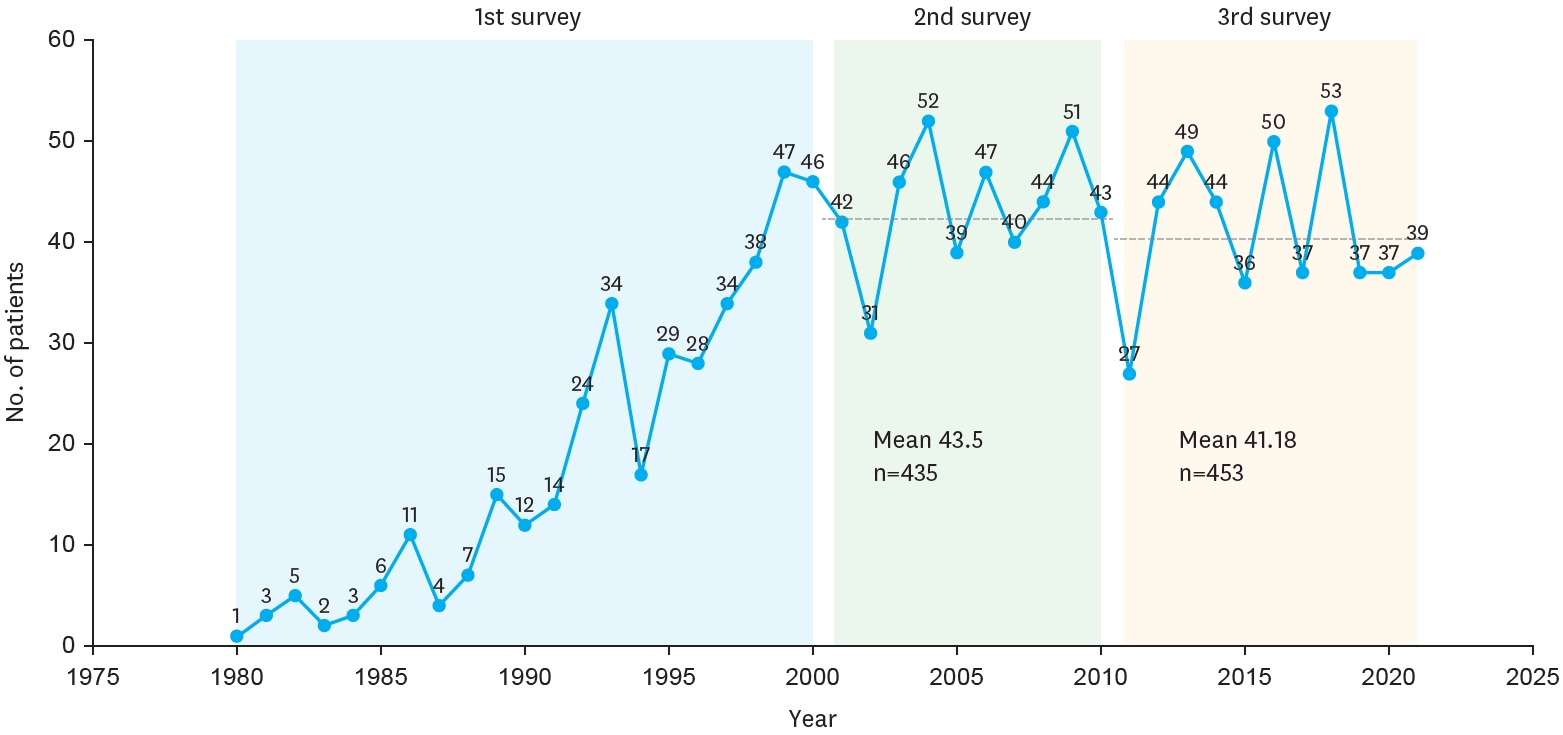
Biliary atresia (BA) is a rare but progressive cholangiopathy and the leading cause of pediatric liver transplantation worldwide. The Korean Association of Pediatric Surgeons (KAPS) has conducted three national surveys (2001, 2011, and 2023) to assess long-term trends in the diagnosis, treatment, and outcomes of BA. This study provides a comparative analysis of the 2nd and 3rd national surveys, with reference to selected findings from the 1st survey.
Methods
This study included 453 patients from the 3rd national survey (2011–2021) and 435 patients from the 2nd survey (2001–2010), all of whom underwent Kasai portoenterostomy. Data were collected via electronic case report forms from pediatric surgical centers nationwide. Comparisons were made regarding demographics, clinical features, diagnostic patterns, operative details, follow-up outcomes, and survival. Kaplan–Meier analysis was used to evaluate long-term survival.
Results
The mean number of BA patients per year remained stable between surveys (43.5 in the 2nd, 41.18 in the 3rd), though centralization of care increased, with 61.5% of cases managed by two major institutions in the 3rd survey. The median age at surgery decreased, and the use of preoperative imaging (especially magnetic resonance cholangiopancreatography) increased. The 10-year native liver survival rate declined from 59.8% to 53.7%, while overall 10-year survival improved slightly (92.9% to 93.2%). Postoperative complications, such as cholangitis and liver failure, persisted but were better categorized. The 3rd survey also reported improved mortality (4.9%) and reduced follow-up loss (11.5%) compared to the 2nd survey.
Conclusion
While overall survival after Kasai operation has remained high and even improved, native liver survival has slightly declined. The findings reflect earlier diagnosis, more consistent diagnostic imaging, and increasing centralization of care. These trends underscore the importance of long-term nationwide data collection in guiding future strategies for BA management in Korea.
  • 28 View
  • 4 Download

Review

[English]
Biliary Atresia
Seok Joo Han
J Korean Assoc Pediatr Surg 2011;17(1):1-14.   Published online June 30, 2011
DOI: https://doi.org/10.13029/jkaps.2011.17.1.1

Biliary atresia (BA) is an infantile cholestatic disease of progressive obliterative cholangiopathy with varying degrees of damage to both extra and intrahepatic bile ducts due to unknown causes. The diagnostic studies should be done to diagnose or exclude BA without unnecessary delay. Kasai portoenterostomy is the first choice of treatment for bile drainage from microscopic bile ductules present in the portal fibrous mass. The medical management after Kasai portoenterostomy should be done carefully to maintain bile excretion and prevent and treat complications including cholangitis, hepatic fibrosis, portal hypertension and nutritional problem. The reported five years-survival rates after Kasai portoenterostomy range from 30 to 60%. About 20% of all patients undergoing Kasai portoenterostomy during infancy survive into adulthood with their native liver. Even if Kasai portoenterostomy remains as the first line of treatment in BA, liver transplantation serves as a good salvage treatment when portoenterostomy fails or liver function gradually deteriorates after initially successful establishment of bile flow. Overall 5-year survival rate in BA is about 90% in recent series.

  • 2 View
  • 1 Download

Original Articles

[English]
Kasai Operation for Extrahepatic Biliary Atresia - Survival and Prognostic Factors
Chan Seok Yoon, Seok Joo Han, Young Nyun Park, Ki Sup Chung, Jung tak Oh, Seung Hoon Choi
J Korean Assoc Pediatr Surg 2006;12(2):202-212.   Published online December 31, 2006
DOI: https://doi.org/10.13029/jkaps.2006.12.2.202

The prognostic factors for extrahepatic biliary atresia (EHBA) after Kasai portoenterostomy include the patient's age at portoenterostomy (age), size of bile duct in theporta hepatis (size), clearance of jaundice after operation (clearance) and the surgeon's experience. The aim of this study is to examine the most significant prognostic factor of EHBA after Kasai portoenterostomy. This retrospective study was done in 51 cases of EHBA that received Kasai portoenterostomy by one pediatric surgeon. For the statistical analysis, Kaplan-Meier method, Logrank test and Cox regression test were used. A p value of less than 0.05 was considered to be significant. Fifteen patients were regarded as dead in this study, including nine cases of liver transplantation. There was no significant difference of survival to age. The age is also not a significant risk factor for survival in this study (Cox Regression test; p = 0.63). There was no significant difference in survival in relation to the size of bile duct. However, bile duct size was a significant risk factor for survival (Cox Regression test; p = 0.002). There was a significant difference in relation to survival and clearance (Kaplan-Meier method; p = 0.02). The clearing was also a significant risk factor for survival (Cox Regression test; p = 0.001). The clearance of jaundice is the most significant prognostic factor of EHBA after Kasai portoenterostomy.

  • 2 View
  • 0 Download
[English]
Hepatic Portojejunostomy for Biliary Atresia
In Koo Kim, Dae Yeon Kim, Seong Chul Kim
J Korean Assoc Pediatr Surg 1999;5(2):111-115.   Published online December 31, 1999
DOI: https://doi.org/10.13029/jkaps.1999.5.2.111

The results of hepatic portojejunostomy in 34 patients with biliary atresia operated upon by one surgeon between May 1989 and December 1997 were analyzed. Eleven (32.3 %) patients were 60 days or younger, 14 patient (41.2 %) were between 60 and 90 days, and 9 (26.5 %) were over 90 days of age. Jaundice cleared in 20 cases (58.8 %). Three patients died of liver insufficiency, 2 were anicteric but died from esophageal variceal bleeding. Three patients died as a result of sepsis, heart failure and left kidney agenesis. Five patients were lost to follow-up. The five-year survival rate was 73.8 %. Two patients over 90 days of age, survived more than 5 years. Survival rates were not significantly related to the age at operation. We conclude that hepatic portojejunostomy should be considered as a primary surgical modality for biliary atresia, even at age 90 days or more. Early detection of esophageal varices and sclerotherapy may be necessary. Liver transplantation is necessary if hepatic failure develops.

  • 1 View
  • 0 Download

Case Report

[English]
Surgically Treated Gallstone Ileus 22 Years After Kasai Portoenterostomy: A Case Report
Gang, Sujin , Youn, Joong Kee , Kim, Hyun-Young
Adv Pediatr Surg 2022;28(1):21-25.
DOI: https://doi.org/10.13029/aps.2022.28.1.21
Gallstone ileus occurs when there is a fistula between the gallbladder and the small intestine, by which the gallstone reaches the small bowel and thereby inducing bowel obstruction. This condition is very rare in the overall population, accounting for only 0.1–5%. It is also very rare in the pediatric population and in the patients who undergo Kasai operation as well. Worldwide, only two cases have been reported. Gallstone production may be facilitated under certain circumstances, and migrated stone induces ileus. Diagnosis is usually done by imaging studies such as abdominal ultrasonography and computed tomogram (CT). Surgical removal of stone is decisive treatment. The 22-year-old female patient with a history of Kasai operation at age of 1 month visited emergency department for abdominal pain. The most reasonable impression was the acute exacerbation of the chronic cholangitis, but it was improved soon after intravenous antibiotics treatment. At the same time, mechanical ileus was diagnosed and exacerbated during admission. CT was done to find out the cause. Small bowel obstruction by a round material was observed. By considering its clinical course and the imaging, the material was suspected to be gallstone. The patient underwent enterolithotomy under general anesthesia. She was fully recovered from gallstone ileus after stone removal. There has been no recurrence of ileus nor cholangitis. When a patient with a history of Kasai portoenterostomy complains mechanical ileus, the clinician need to allow for gallstone ileus referring patient’s history and medical condition which promotes to induce stone formation.
  • 3 View
  • 0 Download