Skip to main navigation Skip to main content
  • KAPS
  • E-Submission

APS : Advances in Pediatric Surgery

OPEN ACCESS
ABOUT
BROWSE ARTICLES
EDITORIAL POLICY
FOR CONTRIBUTORS
Original Article

Clinical Features of Varicose Vein in Pediatric Population

Journal of the Korean Association of Pediatric Surgeons 2016;22(2):29-32.
Published online: December 22, 2016

Division of Pediatric Surgery, Department of Surgery, Chonbuk National University Hospital, Chonbuk National University Medical School, Jeonju, Korea.

Correspondence: Yeon Jun Jeong, Division of Pediatric Surgery, Department of Surgery, Chonbuk National University Hospital, Chonbuk National University Medical School, 20 Geonji-ro, Deokjin-gu, Jeonju 54907, Korea. Tel: +82-63-250-1570, Fax: +82-63-271-6197, surgeon@jbnu.ac.kr
• Received: June 7, 2016   • Revised: October 18, 2016   • Accepted: October 21, 2016

Copyright © 2016 by the Korean Association of Pediatric Surgeons

This is an Open Access article distributed under the terms of the Creative Commons Attribution Non-Commercial License (https://creativecommons.org/licenses/by-nc/4.0) which permits unrestricted non-commercial use, distribution, and reproduction in any medium, provided the original work is properly cited.
  • 0 Views
  • 0 Download
prev next
  • Purpose
    Varicose veins requiring operative treatment have been more common recently, but there are not enough studies among children dermographics because most patients belong to the adult population. We concentrated on varicose vein of under 18 years old, and here intend to report cases of our clinical experiences.
  • Methods
    From January 2003 until December 2014, there were 6 children under 18 years old who required varicose vein management. Data was collected by the investigation of medical records retrospectively, including preoperative symptoms, diagnostic tools, treatment methods, results of treatment, and complications.
  • Results
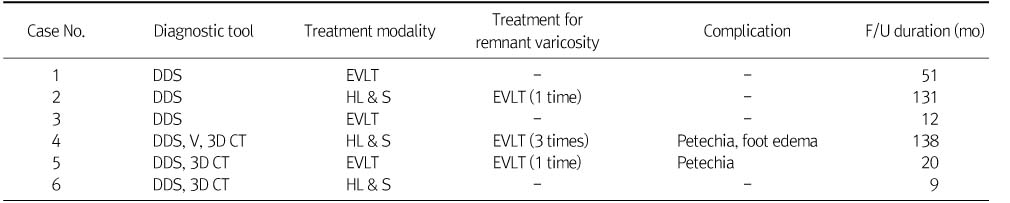
    The mean age was 11 years (range, 3-17 years), and gender ratio was 1:2 (2 male, 4 female). The involved legs were on the right in 3 cases, on the left in 2 cases, and on both in 1 case. The most common symptoms were venous bulging and tortuosity in 6 cases, and other symptoms were Klippel-Trenaunay-Weber syndrome in 2 cases, pain and fatigue in 1 case, port-wine stain in 1 case, and telangiectasia in 1 case. Duplex sonography was performed to confirm venous reflux in all cases. The additional venography was performed to check for anatomical variation in 1 case, and three-dimensional CT in 2 cases. Treatments were high ligation and stripping in 3 cases, and endovenous laser therapy in 3 cases. Additionally, remnant varicosities after first operations were treated by endovenous laser therapy in all cases. During the mean postoperative follow-up period of 60 months, complications included edema of the foot and petechia in 2 cases each, and were not severe.
  • Conclusion
    Operative treatments including high ligation and stripping, and endovenous laser therapy are very effective for the management of varicose vein in the pediatric population, with improvements in quality of life including relief of symptoms and management of the cosmetic aspect.

No potential conflict of interest relevant to this article was reported.

  • 1. Ra H, Kang J, Yun HM, Lee T, Ha J, Chung JK, et al. The pattern & change of venous reflux in primary varicose vein. J Korean Soc Vasc Surg 2005;21:140-146.
  • 2. Choi SS. Clinical analysis of varicose veins in the lower extremities: an analysis of 227 operative cases. Korean J Thorac Cardiovasc Surg 1999;32:1036-1041.
  • 3. Hur SJ, Park HC, Lee SH, Lee KH, Koh SH, Yoon C. A clinical analysis of 604 cases of varicose veins. J Korean Soc Vasc Surg 1999;15:94-100.
  • 4. Lee YJ, Park C, Kim JS, Kim HY, Yoo BH. Clinical analysis of primary varicose vein: review of 209 cases. Korean J Thorac Cardiovasc Surg 2001;34:909-916.
  • 5. Chang CY, Ryu DH, Jang LC. Vein ligation combined with endovenous laser treatment in Klippel-Trenaunay syndrome: a case report. J Korean Soc Vasc Surg 2005;21:151-155.
  • 6. Jacob AG, Driscoll DJ, Shaughnessy WJ, Stanson AW, Clay RP, Gloviczki P. Klippel-Trénaunay syndrome: spectrum and management. Mayo Clin Proc 1998;73:28-36.
  • 7. Oduber CE, Young-Afat DA, van der Wal AC, van Steensel MA, Hennekam RC, van der Horst CM. The persistent embryonic vein in Klippel-Trenaunay syndrome. Vasc Med 2013;18:185-191.
  • 8. Sermsathanasawadi N, Hongku K, Wongwanit C, Ruangsetakit C, Chinsakchai K, Mutirangura P. Endovenous radiofrequency thermal ablation and ultrasound-guided foam sclerotherapy in treatment of Klippel-Trenaunay syndrome. Ann Vasc Dis 2014;7:52-55.
  • 9. Servelle M. Klippel and Trénaunay's syndrome. 768 operated cases. Ann Surg 1985;201:365-373.
  • 10. Eklöf B, Rutherford RB, Bergan JJ, Carpentier PH, Gloviczki P, Kistner RL, et al. Revision of the CEAP classification for chronic venous disorders: consensus statement. J Vasc Surg 2004;40:1248-1252.
  • 11. Porter JM, Moneta GL. Reporting standards in venous disease: an update. International Consensus Committee on Chronic Venous Disease. J Vasc Surg 1995;21:635-645.
  • 12. Yang SJ, Park YS, Kim CS. Comparison of the operative methods for varicose veins in the lower extremities. J Korean Soc Vasc Surg 2007;23:168-173.
Fig. 1

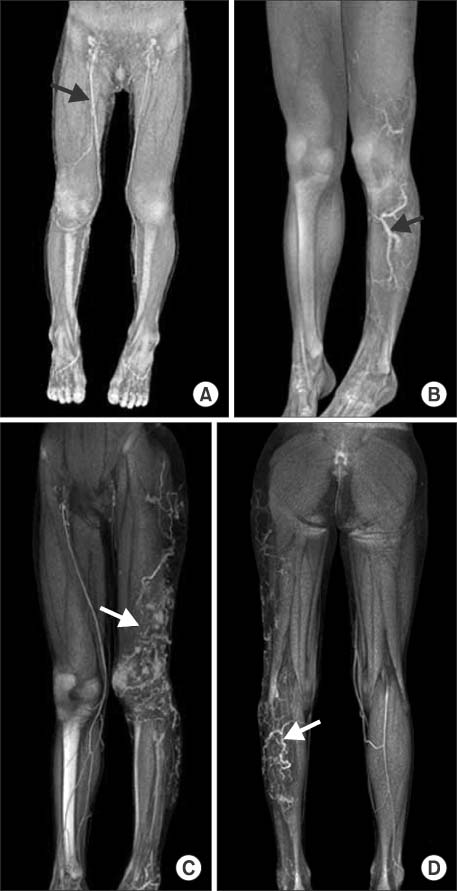
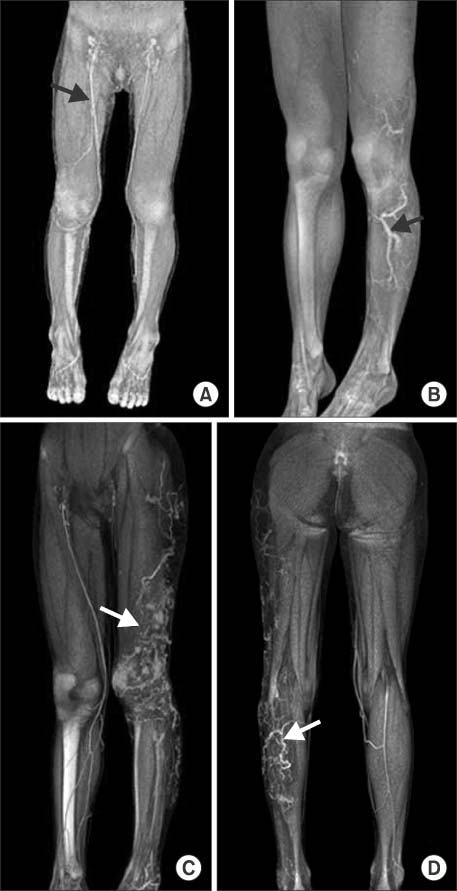
(A) A 3-year-old child has dilatation of the right great saphenous vein (arrow). (B) A 15-year-old child has enlargement of great and small saphenous vein (arrow). (C, D) A 7-year-old child has venous malformation of left lower leg (arrow). She has prominent venous dilatation of the thigh and knee portion (arrow).

jkaps-22-29-g001.jpg
Table 1

Patient’s Characteristics

KTS, Klippel-Trenaunay-Weber syndrome; Rt., right; Lt., left; GSV, great saphenous vein; SSV, small saphenous vein; PV, popliteal vein; CEAP, Clinical-Etiology-Anatomy-Pathology classification.

jkaps-22-29-i001.jpg
Table 2

Diagnostic Tool, Treatment Modality, and Clinical Outcomes

DDS, duplex Doppler scan; V, venography; 3D, three-dimensional; EVLT, endo-venous laser therapy; HL & S, high ligation and stripping; F/U, follow-up.

jkaps-22-29-i002.jpg

Download Citation

Download a citation file in RIS format that can be imported by all major citation management software, including EndNote, ProCite, RefWorks, and Reference Manager.

Format:

Include:

Clinical Features of Varicose Vein in Pediatric Population
J Korean Assoc Pediatr Surg. 2016;22(2):29-32.   Published online December 22, 2016
Download Citation

Download a citation file in RIS format that can be imported by all major citation management software, including EndNote, ProCite, RefWorks, and Reference Manager.

Format:
Include:
Clinical Features of Varicose Vein in Pediatric Population
J Korean Assoc Pediatr Surg. 2016;22(2):29-32.   Published online December 22, 2016
Close

Figure

  • 0
Clinical Features of Varicose Vein in Pediatric Population
Image
Fig. 1 (A) A 3-year-old child has dilatation of the right great saphenous vein (arrow). (B) A 15-year-old child has enlargement of great and small saphenous vein (arrow). (C, D) A 7-year-old child has venous malformation of left lower leg (arrow). She has prominent venous dilatation of the thigh and knee portion (arrow).
Clinical Features of Varicose Vein in Pediatric Population

Patient’s Characteristics

KTS, Klippel-Trenaunay-Weber syndrome; Rt., right; Lt., left; GSV, great saphenous vein; SSV, small saphenous vein; PV, popliteal vein; CEAP, Clinical-Etiology-Anatomy-Pathology classification.

Diagnostic Tool, Treatment Modality, and Clinical Outcomes

DDS, duplex Doppler scan; V, venography; 3D, three-dimensional; EVLT, endo-venous laser therapy; HL & S, high ligation and stripping; F/U, follow-up.

Table 1 Patient’s Characteristics

KTS, Klippel-Trenaunay-Weber syndrome; Rt., right; Lt., left; GSV, great saphenous vein; SSV, small saphenous vein; PV, popliteal vein; CEAP, Clinical-Etiology-Anatomy-Pathology classification.

Table 2 Diagnostic Tool, Treatment Modality, and Clinical Outcomes

DDS, duplex Doppler scan; V, venography; 3D, three-dimensional; EVLT, endo-venous laser therapy; HL & S, high ligation and stripping; F/U, follow-up.