Skip to main navigation Skip to main content
  • KAPS
  • E-Submission

APS : Advances in Pediatric Surgery

OPEN ACCESS
ABOUT
BROWSE ARTICLES
EDITORIAL POLICY
FOR CONTRIBUTORS
Original Article

Postoperative Monotherapy with Piperacillin-Tazobactam versus Multidrug Therapy with Cefotaxime and Metronidazole for Perforated Appendicitis in Children: A Case-Control Study

Journal of the Korean Association of Pediatric Surgeons 2015;21(2):28-31.
Published online: December 22, 2015

1Department of Surgery, Asan Medical Center, University of Ulsan College of Medicine, Seoul, Korea.

2Division of Pediatric Surgery, Department of Surgery, Asan Medical Center, University of Ulsan College of Medicine, Seoul, Korea.

Correspondence: Dae Yeon Kim, Division of Pediatric Surgery, Department of Surgery, Asan Medical Center, University of Ulsan College of Medicine, 88 Olympic-ro 43-gil, Songpa-gu, Seoul 05505, Korea. Tel: +82-2-3010-3961, Fax: +82-2-3010-6841, kimdy@amc.seoul.kr
• Received: October 2, 2015   • Revised: November 20, 2015   • Accepted: November 24, 2015

Copyright © 2015 by the Korean Association of Pediatric Surgeons

This is an Open Access article distributed under the terms of the Creative Commons Attribution Non-Commercial License (https://creativecommons.org/licenses/by-nc/4.0) which permits unrestricted non-commercial use, distribution, and reproduction in any medium, provided the original work is properly cited.

  • 0 Views
  • 0 Download
prev next
  • Purpose
    Recent data suggest that monotherapy with a broad-spectrum antibiotic may be as efficacious as, and potentially less costly than, standard multi-drug therapy. We compared mono-therapy with intravenous piperacillin-tazobactam (PT) with multi-drug therapy with cefotaxime and metronidazole (CM) in aspect of postoperative complications and hospital stay.
  • Methods
    We reviewed the hospital records and medical costs of the pediatric patients who were managed for perforated appendicitis between April 2013 and May 2014 retrospectively.
  • Results
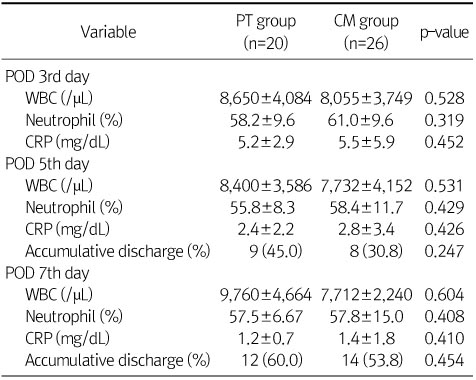
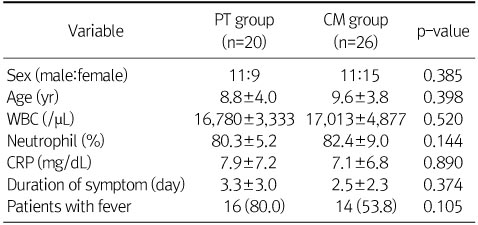
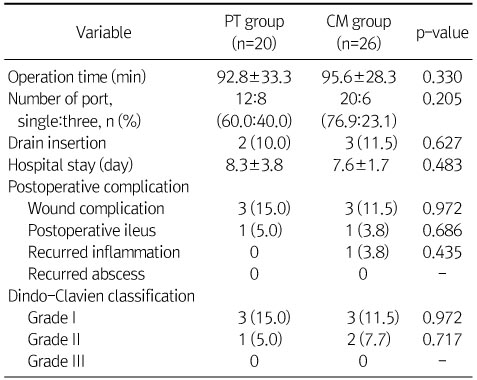
    Forty-six patients with laparoscopic appendectomy for perforated appendicitis were included in our study. PT group was 20 and CM group was 26 patients. On admission, there were no significance in sex distribution, duration of symptoms, leukocyte count, and CRP levels. At postoperative third, fifth, and seventh day of each regimen, PT group have no statistical difference with CM group in leukocyte count, percentage of neutrophil, and CRP. There was no difference in abscess formation rate, wound infections, and hospital stay between two groups. There was only one patient who was readmitted with elevation of CRP and leukocyte count in CM group.
  • Conclusion
    Daily dosing with the mono-therapy of PT offers as efficient as multi-drug therapy of CM. To evaluate the efficacy of broad-spectrum antibiotics monotherapy in perforated appendicitis children, the cohort included more patients should be needed.

No potential conflict of interest relevant to this article was reported.

The abstract of this article was presented at the 66th Annual Congress of the Korean Surgical Society, November 28, 2014.

  • 1. Williams RF, Interiano RB, Paton E, Eubanks JW, Huang EY, Langham MR, et al. Impact of a randomized clinical trial on children with perforated appendicitis. Surgery 2014;156:462-466.
  • 2. Zerem E, Imamović G, Ljuca F, Alidžanović J. What is the optimal treatment for appendiceal mass formed after acute perforated appendicitis. World J Gastroenterol 2012;18:1849-1850.
  • 3. Bauer T, Vennits B, Holm B, Hahn-Pedersen J, Lysen D, Galatius H, et al. Antibiotic prophylaxis in acute nonperforated appendicitis. Ann Surg 1989;209:307-311.
  • 4. Pieper R, Kager L, Näsman P. Acute appendicitis: a clinical study of 1018 cases of emergency appendectomy. Acta Chir Scand 1982;148:51-62.
  • 5. Browder W, Smith JW, Vivoda LM, Nichols RL. Nonperforative appendicitis: a continuing surgical dilemma. J Infect Dis 1989;159:1088-1094.
  • 6. Bates T, Touquet VL, Tutton MK, Mahmoud SE, Reuther JW. Prophylactic metronidazole in appendicectomy: a controlled trial. Br J Surg 1980;67:547-550.
  • 7. Hopkins JA, Lee JC, Wilson SE. Susceptibility of intra-abdominal isolates at operation: a predictor of postoperative infection. Am Surg 1993;59:791-796.
  • 8. Curran TJ, Muenchow SK. The treatment of complicated appendicitis in children using peritoneal drainage: results from a public hospital. J Pediatr Surg 1993;28:204-208.
  • 9. Gollin G, Abarbanell A, Moores D. Oral antibiotics in the management of perforated appendicitis in children. Am Surg 2002;68:1072-1074.
  • 10. Lund DP, Murphy EU. Management of perforated appendicitis in children: a decade of aggressive treatment. J Pediatr Surg 1994;29:1130-1134.
  • 11. Fishman SJ, Pelosi L, Klavon SL, O'Rourke EJ. Perforated appendicitis: prospective outcome analysis for 150 children. J Pediatr Surg 2000;35:923-926.
  • 12. Dindo D, Demartines N, Clavien PA. Classification of surgical complications: a new proposal with evaluation in a cohort of 6336 patients and results of a survey. Ann Surg 2004;240:205-213.
  • 13. Newman K, Ponsky T, Kittle K, Dyk L, Throop C, Gieseker K, et al. Appendicitis 2000: variability in practice, outcomes, and resource utilization at thirty pediatric hospitals. J Pediatr Surg 2003;38:372-379.
  • 14. Chen C, Botelho C, Cooper A, Hibberd P, Parsons SK. Current practice patterns in the treatment of perforated appendicitis in children. J Am Coll Surg 2003;196:212-221.
  • 15. Rice HE, Brown RL, Gollin G, Caty MG, Gilbert J, Skinner MA, et al. Results of a pilot trial comparing prolonged intravenous antibiotics with sequential intravenous/oral antibiotics for children with perforated appendicitis. Arch Surg 2001;136:1391-1395.
  • 16. Nadler EP, Reblock KK, Ford HR, Gaines BA. Monotherapy versus multi-drug therapy for the treatment of perforated appendicitis in children. Surg Infect (Larchmt) 2003;4:327-333.
Table 1
Perioperative Patients Characteristics and Laboratory Findings

Values are presented as ratio, mean±SD, or n (%).

PT, piperacillin-tazobactam; CM, cefotaxime and metronidazole.
jkaps-21-28-i001.jpg
Table 2
Perioperative and Postoperative Findings

Values are presented as mean±SD, ratio, or n (%).

PT, piperacillin-tazobactam; CM, cefotaxime and metronidazole.
jkaps-21-28-i002.jpg
Table 3
Inflammatory Index according to the Postoperative Day (POD)

Values are presented as mean±SD or n (%).

PT, piperacillin-tazobactam; CM, cefotaxime and metronidazole.

jkaps-21-28-i003.jpg
Table 4
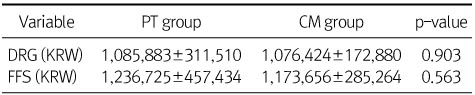
FFS vs. DRG

Values are presented as mean±SD.

FFS, fee for service; DRG, diagnosis related group; PT, piperacillin-tazobactam; CM, cefotaxime and metronidazole; KRW, Korean Won.

jkaps-21-28-i004.jpg

Download Citation

Download a citation file in RIS format that can be imported by all major citation management software, including EndNote, ProCite, RefWorks, and Reference Manager.

Format:

Include:

Postoperative Monotherapy with Piperacillin-Tazobactam versus Multidrug Therapy with Cefotaxime and Metronidazole for Perforated Appendicitis in Children: A Case-Control Study
J Korean Assoc Pediatr Surg. 2015;21(2):28-31.   Published online December 22, 2015
Download Citation

Download a citation file in RIS format that can be imported by all major citation management software, including EndNote, ProCite, RefWorks, and Reference Manager.

Format:
Include:
Postoperative Monotherapy with Piperacillin-Tazobactam versus Multidrug Therapy with Cefotaxime and Metronidazole for Perforated Appendicitis in Children: A Case-Control Study
J Korean Assoc Pediatr Surg. 2015;21(2):28-31.   Published online December 22, 2015
Close
Postoperative Monotherapy with Piperacillin-Tazobactam versus Multidrug Therapy with Cefotaxime and Metronidazole for Perforated Appendicitis in Children: A Case-Control Study

Perioperative Patients Characteristics and Laboratory Findings

Values are presented as ratio, mean±SD, or n (%).

PT, piperacillin-tazobactam; CM, cefotaxime and metronidazole.

Perioperative and Postoperative Findings

Values are presented as mean±SD, ratio, or n (%).

PT, piperacillin-tazobactam; CM, cefotaxime and metronidazole.

Inflammatory Index according to the Postoperative Day (POD)

Values are presented as mean±SD or n (%).

PT, piperacillin-tazobactam; CM, cefotaxime and metronidazole.

FFS vs. DRG

Values are presented as mean±SD.

FFS, fee for service; DRG, diagnosis related group; PT, piperacillin-tazobactam; CM, cefotaxime and metronidazole; KRW, Korean Won.

Table 1 Perioperative Patients Characteristics and Laboratory Findings

Values are presented as ratio, mean±SD, or n (%).

PT, piperacillin-tazobactam; CM, cefotaxime and metronidazole.

Table 2 Perioperative and Postoperative Findings

Values are presented as mean±SD, ratio, or n (%).

PT, piperacillin-tazobactam; CM, cefotaxime and metronidazole.

Table 3 Inflammatory Index according to the Postoperative Day (POD)

Values are presented as mean±SD or n (%).

PT, piperacillin-tazobactam; CM, cefotaxime and metronidazole.

Table 4 FFS vs. DRG

Values are presented as mean±SD.

FFS, fee for service; DRG, diagnosis related group; PT, piperacillin-tazobactam; CM, cefotaxime and metronidazole; KRW, Korean Won.