Skip to main navigation Skip to main content
  • KAPS
  • E-Submission

APS : Advances in Pediatric Surgery

OPEN ACCESS
ABOUT
BROWSE ARTICLES
EDITORIAL POLICY
FOR CONTRIBUTORS
Original Article

Santulli Enterostomy: A Considerable Method for Patients Who Require Proximal Enterostomy

Journal of the Korean Association of Pediatric Surgeons 2018;24(1):20-25.
Published online: June 30, 2018

Department of Pediatric Surgery, Severance Children's Hospital, Yonsei University College of Medicine, Seoul, Korea

Correspondence: Jung-Tak Oh, Department of Pediatric Surgery, Severance Children’s Hospital, Yonsei University College of Medicine, 50-1 Yonsei-ro, Seodaemun-gu, Seoul 03722, Korea. Tel: +82-2-2228-2124, Fax: +82-2-313-8289, E-mail: jtoh@yuhs.ac
• Received: May 9, 2018   • Revised: June 7, 2018   • Accepted: June 7, 2018

Copyright © 2018 Korean Association of Pediatric Surgeons

This is an Open Access article distributed under the terms of the Creative Commons Attribution Non-Commercial License (http://creativecommons.org/licenses/by-nc/4.0/) which permits unrestricted non-commercial use, distribution, and reproduction in any medium, provided the original work is properly cited.

  • 2 Views
  • 0 Download
prev next
  • Purpose
    Santulli enterostomy has been used for various surgical abdominal conditions that require temporary diversion of bowel during a neonatal period. The aim of this study was to report clinical outcomes of Santulli enterostomy and to evaluate its usefulness.
  • Methods
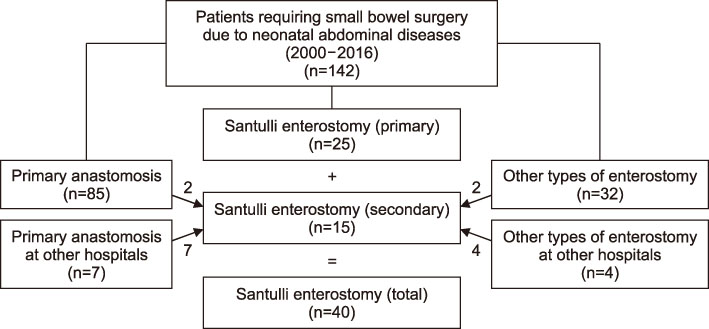
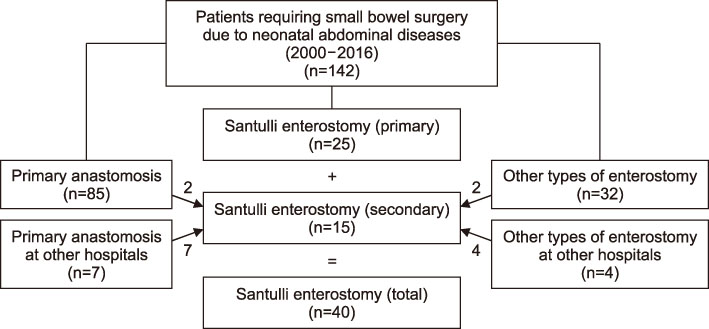
    Between January 2000 and December 2016, 40 neonates who underwent Santulli enterostomy were enrolled; Santulli enterostomies were performed for 25 patients without previous laparotomy (primary Santulli group) and 15 patients with previous laparotomy (secondary Santulli group).
  • Results
    Small bowel atresia is the first common indication of Santulli enterostomy (22/40, 55.0%), and luminal discrepancy between proximal and distal bowel was the most common determinant factor of Santulli enterostomy (17/40, 42.5%). The median age at surgery and mean birth weight were 2 days and 2,480 g respectively in the primary group, and 71 days, 2,340 g respectively in the secondary group. Operation time was significantly longer in the secondary group than the primary group (156±48 minutes vs. 224±95 minutes, p=0.019), and there was no difference in the time taken to initiation of oral feeding between the two groups. Santulli enterostomy closure was performed at median 65 days after Santulli enterostomy for primary group and 70 days for secondary group. Six complications (15.0%) were found after Santulli enterostomy, and nine complications (24.3%) after Santulli enterostomy closure (p=0.302). The incidence of complications was significantly higher in secondary group than in primary group (4.5% vs. 53.3%, p=0.001), and the reoperation rate was also significantly higher in the secondary group (4.5% vs. 46.7%, p=0.004).
  • Conclusion
    Santulli enterostomy could be applied as a temporary enterostomy in neonatal patients with various surgical abdominal diseases. Considering the high complication rate after secondary Santulli enterostomy closure, decision making on the timing of enterostomy closure should be done with caution.
Fig. 1.
Flowchart showing the study design including 40 patients enrolled in this study.
jkaps-2018-24-1-20f1.jpg
Table 1.
Demographic Data and Diseases Requiring Santulli Enterostomy
Table 1.
Variable Value (n=40)
Sex (male/female) 21/19
Gestational age (wk) 37 (24.3-40.9)
Birth weight (g) 2,430±1,040
 Birth weight<2,500 g 16 (40.0)
 Birth weight<1,000 g 5 (12.5)
 Primary Santulli 2,480±1,060a)
 Secondary Santulli 2,340±1,040a)
Median age at Santulli enterostomy (day) 6 (0-292)
 Primary Santulli 2 (0-103)b)
 Secondary Santulli 71 (0-292)b)
Diseases requiring Santulli enterostomy
 Small bowel atresia 22 (55.0)
 Intestinal pseudo-obstruction 6 (15.0)
 Meconium plug syndrome 4 (10.0)
 Necrotizing enterocolitis 3 (7.5)
 Intestinal obstruction due to other disease 2 (5.0)
 Focal intestinal perforation 1 (2.5)
 Midgut volvulus 1 (2.5)
 Hirschsprung’s disease 1 (2.5)

Values are presented as n only, median (range), mean±SD, or number (%).

a)Student t-test; p=0.694.

b)Mann-Whitney U test; p<0.001.

Table 2.
Intraoperative Determinant of Performing a Santulli Enterostomy
Table 2.
Variable Primary Santulli Secondary Santulli Value
Luminal discrepancy 14 3 17 (42.5)
Adhesion 1 2 3 (7.5)
Preoperative functional obstruction 0 3 3 (7.5)
Severe inflammation 7 1 8 (20.0)
Not reported 3 6 9 (22.5)
Total 25 15 40

Values are presented as n only or n (%).

Fisher’s exact test; p=0.003.

Table 3.
Operative Characteristics of Santulli Enterostomy
Table 3.
Variable Primary (n=25) Secondary (n=15) p-value
Operation time (min) 156±48 224±95 0.019b)
Time taken to reach full enteral feeding (day) (n=22/15)a) 13 (7-392) 17 (7-127) 0.213c)
Patients with complications 3 (12.0) 3 (20.0) 0.654d)
Complications requiring re-operation 1 (4.0) 1 (6.7) 1.000d)

Values are presented as mean±SD, median (range), or n (%).

a)Three patients were excluded from the primary group because they did not survive before they achieve full enteral feeding.

b)Student t-test.

c)Mann-Whitney U test.

d)Fisher’s exact test.

Table 4.
Operative Characteristics of Santulli Closure
Table 4.
Variable Primary (n=22)a) Secondary (n=15) p-value
Operation time (min) 82±55 109±71 0.203b)
Time taken to reach full enteral feeding after stoma closure (day) 7.5 (4-20) 8 (5-164) 0.210c)
Stomal duration (day) 65 (16-177) 70 (21-364) 0.249c)
Follow-up duration (mo) 16 (0-135) 24 (2-136) 0.595c)
Patients with complication 1 (4.5) 8 (53.3) 0.001d)
Complications requiring re-operation 1 (4.5) 7 (46.7) 0.004d)

Values are presented as mean±SD, median (range), or n (%).

a)Three patients were excluded from the primary group because they did not survive before enterostomy closure.

b)Student t-test.

c)Mann-Whitney U test.

d)Fisher’s exact test.

Table 5.
Overall Complications Following Santulli Enterostomy and Santulli Closure
Table 5.
Details of complication Primary Secondary Re-operation
Santulli enterostomy
 Wound infection 2 1 -
 Stoma bleeding - 1 -
 Parastomal evisceration - 1 1
 Obstruction 1 - 1
Santulli closure
 Wound infection - 2 1
 Obstruction - 4 4
 Wound evisceration 1 2 3
Total 4 11 10
  • 1. van Zoonen AG, Schurink M, Bos AF, Heineman E, Hulscher JB. Ostomy creation in neonates with acute abdominal disease: friend or foe? Eur J Pediatr Surg 2012;22:295-299.
  • 2. Santulli TV, Blanc WA. Congenital atresia of the intestine: pathogenesis and treatment. Ann Surg 1961;154:939-948.
  • 3. Sapin E, Carricaburu E, De Boissieu D, Goutail-Flaud MF, Benammar S, Helardot PG. Conservative intestinal surgery to avoid short-bowel syndrome in multiple intestinal atresias and necrotizing enterocolitis: 6 cases treated by multiple anastomoses and Santulli-type enterostomy. Eur J Pediatr Surg 1999;9:24-28.
  • 4. Yeung F, Tam YH, Wong YS, Tsui SY, Wong HY, Pang KK, et al. Early reoperations after primary repair of Jejunoileal atresia in newborns. J Neonatal Surg 2016;5:42.
  • 5. Rees CM, Eaton S, Khoo AK, Kiely EM. Members of NET Trial Group. Pierro A. Peritoneal drainage does not stabilize extremely low birth weight infants with perforated bowel: data from the NET Trial. J Pediatr Surg 2010;45:324-328 discussion 328–9.
  • 6. Vanamo K, Rintala R, Lindahl H. The Santulli enterostomy in necrotising enterocolitis. Pediatr Surg Int 2004;20:692-694.
  • 7. Zani A, Lauriti G, Li Q, Pierro A. The timing of stoma closure in infants with necrotizing enterocolitis: a systematic review and meta-analysis. Eur J Pediatr Surg 2017;27:7-11.
  • 8. Ahlgren LS. Apple peel jejunal atresia. J Pediatr Surg 1987;22:451-453.
  • 9. Tepetes K, Liakou P, Balogiannis I. The use of the Santulli enterostomy. World J Surg 2007;31:1343-1344.
  • 10. Steinau G, Ruhl KM, Hörnchen H, Schumpelick V. Enterostomy complications in infancy and childhood. Langenbecks Arch Surg 2001;386:346-349.
  • 11. Lee J, Kang MJ, Kim HS, Shin SH, Kim HY, Kim EK, et al. Enterostomy closure timing for minimizing postoperative complications in premature infants. Pediatr Neonatol 2014;55:363-368.
  • 12. Struijs MC, Sloots CE, Hop WC, Tibboel D, Wijnen RM. The timing of ostomy closure in infants with necrotizing enterocolitis: a systematic review. Pediatr Surg Int 2012;28:667-672.
  • 13. Waldhausen JH, Sawin RS. Improved long-term outcome for patients with jejunoileal apple peel atresia. J Pediatr Surg 1997;32:1307-1309.
  • 14. Wit J, Sellin S, Degenhardt P, Scholz M, Mau H. Is the Bishop-Koop anastomosis in treatment of neonatal ileus still current? Chirurg 2000;71:307-310.
  • 15. Gause CD, Hayashi M, Haney C, Rhee D, Karim O, Weir BW, et al. Mucous fistula refeeding decreases parenteral nutrition exposure in postsurgical premature neonates. J Pediatr Surg 2016;51:1759-1765.
  • 16. Aguayo P, Fraser JD, Sharp S, St Peter SD, Ostlie DJ. Stomal complications in the newborn with necrotizing enterocolitis. J Surg Res 2009;157:275-278.

Download Citation

Download a citation file in RIS format that can be imported by all major citation management software, including EndNote, ProCite, RefWorks, and Reference Manager.

Format:

Include:

Santulli Enterostomy: A Considerable Method for Patients Who Require Proximal Enterostomy
J Korean Assoc Pediatr Surg. 2018;24(1):20-25.   Published online June 30, 2018
Download Citation

Download a citation file in RIS format that can be imported by all major citation management software, including EndNote, ProCite, RefWorks, and Reference Manager.

Format:
Include:
Santulli Enterostomy: A Considerable Method for Patients Who Require Proximal Enterostomy
J Korean Assoc Pediatr Surg. 2018;24(1):20-25.   Published online June 30, 2018
Close

Figure

  • 0
Santulli Enterostomy: A Considerable Method for Patients Who Require Proximal Enterostomy
Image
Fig. 1. Flowchart showing the study design including 40 patients enrolled in this study.
Santulli Enterostomy: A Considerable Method for Patients Who Require Proximal Enterostomy
Variable Value (n=40)
Sex (male/female) 21/19
Gestational age (wk) 37 (24.3-40.9)
Birth weight (g) 2,430±1,040
 Birth weight<2,500 g 16 (40.0)
 Birth weight<1,000 g 5 (12.5)
 Primary Santulli 2,480±1,060a)
 Secondary Santulli 2,340±1,040a)
Median age at Santulli enterostomy (day) 6 (0-292)
 Primary Santulli 2 (0-103)b)
 Secondary Santulli 71 (0-292)b)
Diseases requiring Santulli enterostomy
 Small bowel atresia 22 (55.0)
 Intestinal pseudo-obstruction 6 (15.0)
 Meconium plug syndrome 4 (10.0)
 Necrotizing enterocolitis 3 (7.5)
 Intestinal obstruction due to other disease 2 (5.0)
 Focal intestinal perforation 1 (2.5)
 Midgut volvulus 1 (2.5)
 Hirschsprung’s disease 1 (2.5)
Variable Primary Santulli Secondary Santulli Value
Luminal discrepancy 14 3 17 (42.5)
Adhesion 1 2 3 (7.5)
Preoperative functional obstruction 0 3 3 (7.5)
Severe inflammation 7 1 8 (20.0)
Not reported 3 6 9 (22.5)
Total 25 15 40
Variable Primary (n=25) Secondary (n=15) p-value
Operation time (min) 156±48 224±95 0.019b)
Time taken to reach full enteral feeding (day) (n=22/15)a) 13 (7-392) 17 (7-127) 0.213c)
Patients with complications 3 (12.0) 3 (20.0) 0.654d)
Complications requiring re-operation 1 (4.0) 1 (6.7) 1.000d)
Variable Primary (n=22)a) Secondary (n=15) p-value
Operation time (min) 82±55 109±71 0.203b)
Time taken to reach full enteral feeding after stoma closure (day) 7.5 (4-20) 8 (5-164) 0.210c)
Stomal duration (day) 65 (16-177) 70 (21-364) 0.249c)
Follow-up duration (mo) 16 (0-135) 24 (2-136) 0.595c)
Patients with complication 1 (4.5) 8 (53.3) 0.001d)
Complications requiring re-operation 1 (4.5) 7 (46.7) 0.004d)
Details of complication Primary Secondary Re-operation
Santulli enterostomy
 Wound infection 2 1 -
 Stoma bleeding - 1 -
 Parastomal evisceration - 1 1
 Obstruction 1 - 1
Santulli closure
 Wound infection - 2 1
 Obstruction - 4 4
 Wound evisceration 1 2 3
Total 4 11 10
Table 1. Demographic Data and Diseases Requiring Santulli Enterostomy

Values are presented as n only, median (range), mean±SD, or number (%).

Student t-test; p=0.694.

Mann-Whitney U test; p<0.001.

Table 2. Intraoperative Determinant of Performing a Santulli Enterostomy

Values are presented as n only or n (%).

Fisher’s exact test; p=0.003.

Table 3. Operative Characteristics of Santulli Enterostomy

Values are presented as mean±SD, median (range), or n (%).

Three patients were excluded from the primary group because they did not survive before they achieve full enteral feeding.

Student t-test.

Mann-Whitney U test.

Fisher’s exact test.

Table 4. Operative Characteristics of Santulli Closure

Values are presented as mean±SD, median (range), or n (%).

Three patients were excluded from the primary group because they did not survive before enterostomy closure.

Student t-test.

Mann-Whitney U test.

Fisher’s exact test.

Table 5. Overall Complications Following Santulli Enterostomy and Santulli Closure