

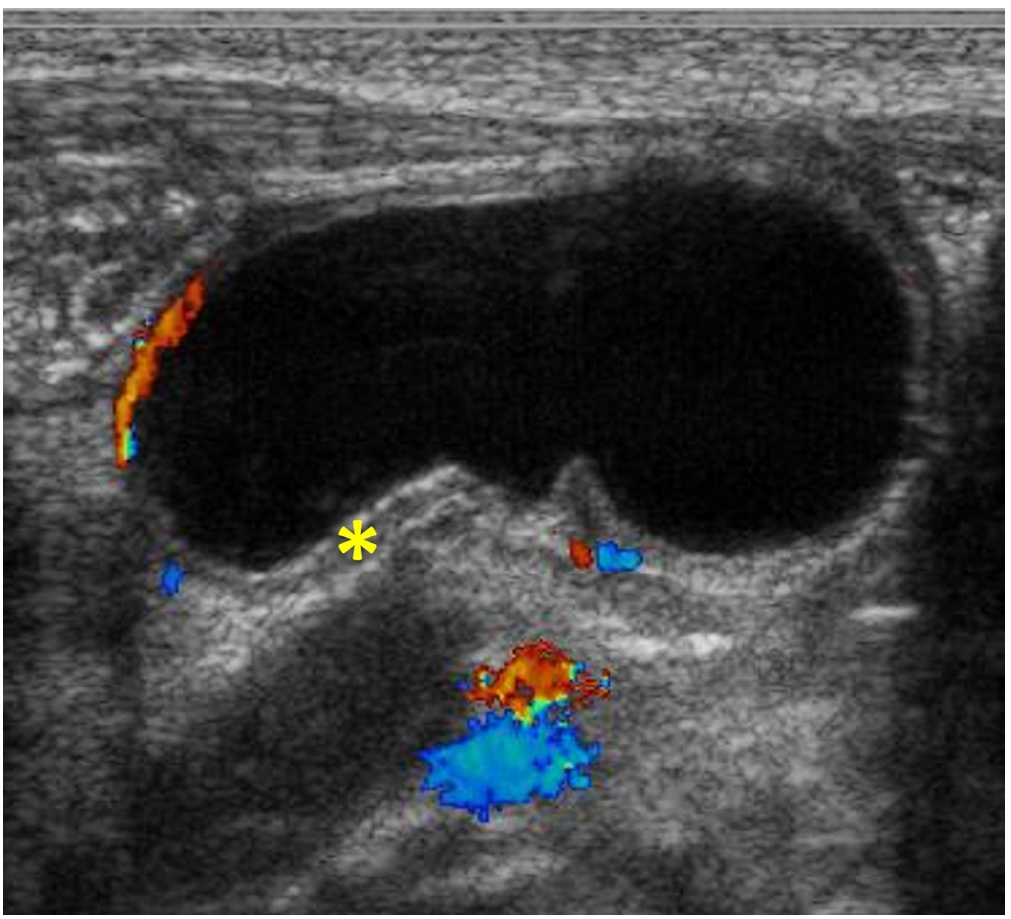
Preoperative ultrasonography (USG) in pediatric inguinal hernia has controversy. In this study, we analyzed the cases of pediatric inguinal hernia with/without preoperative USG and discussed whether USG is necessary.
We reviewed medical records of 1,441 patients who underwent inguinal hernia repair in Seoul National University Children's Hospital between January 2011 and August 2016 retrospectively.
Male were 69.3% and age at operation was 37.8±36.5 months old. There were 150 patients (10.4%) performed USG preoperatively. The department ordered to perform USG included department of surgery (n=71), emergency medicine (n=42), pediatrics (n=26), urology (n=10) and outside hospital (n=1). The reasons of performing USG included evaluation for hernia laterality (n=82), incarceration (n=28), testis (n=15), request of parents (n=14), scrotal mass (n=6) and incidentally found during evaluation for another disease (n=5). Excepting 5 cases of incidental finding, of 145 cases with USG, 12 (8.3%) cases changed the surgical plan; change to bilateral repair from unilateral repair (n=5), emergency operation due to incarceration (n=4) which include 1 salpingo-oophorectomy, 1 open abdomen surgery and 2 hernia repair after reduction of ovary, change to co-operation of orchiopexy (n=2) and change to laparoscopic surgery from open surgery due to herniation of both ovaries into one inguinal canal (n=1). In group without USG (n=1,291), 5 patients (0.4%) had unexpected problems during operation; 2 co-operation of orchiopexy because of transverse testicular ectopia (n=1) and right undescended testis (n=1), 2 hypertrophy of major labia and 1 retroperitoneal lymphangioma at inguinal area misdiagnosed as inguinal hernia.
It was difficult to interpret the meaning of preoperative USG because not all patients had performed it. In this study, 10.4% of patients performed USG and 8.3% of them changed surgical plan. About 0.4% of patients without preoperative USG would have benefited from it for surgery if they had performed it. Since the percentage is too low, it is unreasonable to conclude that USG has diagnostic utility in inguinal hernia in this study.
The use of CT as a diagnostic tool in pediatric acute appendicitis is increasing because of its high sensitivity and specificity. However, due to both the serious concerns about radiation of CT and the convenience and reasonable cost of ultrasound (US) examination, US has value on the initial diagnosis of acute appendicitis despite of the lower sensitivity in children. The purpose of this study was to examine the factors that affect the rate of false negative diagnosis of the ultrasound from the patients who received laparoscopic appendectomy.
The pediatric appendectomy cases from 2002 to 2013 in Yeouido St. Mary's Hospital have been reviewed through the medical records. We included patients who underwent an initial screening by ultrasound examination.
Among 181 patients, 156 patients were the sono-positive group and 25 patients were sono-negative group. There is no significant difference in ages, genders, physical examination findings and white blood cell count between the two groups. But, the degree of inflammation of appendicitis (simple, 58.3% vs. 32.0%; complicated, 41.7% vs. 68.0%) and the appendix position (antececal, 85.0% vs. 12.0%; retrocecal, 13.7% vs. 44.0%; pelvic, 1.3% vs. 44.0%) were significantly different between the two groups (sono-positive group vs. sono-negative group; p<0.05).
The position of the appendix may act as a factor that causes an error in the diagnostic ultrasound, especially, in the retrocecal type and the pelvic type with the higher risk of necrosis or perforation.
Citations

Diagnosis of acute appendicitis in children is sometimes difficult. The aim of this study is to validate a clinical scoring system and ultrasonography for the early diagnosis and treatment of appendicitis in childhood. This is a prospective study on 59 children admitted with abdominal pain at St. Mary's Hospital, the Catholic University of Korea from July 2002 to August 2003. We applied Madan Samuel's Pediatric Appendicitis Score (PAS) based on preoperative history, physical examination, laboratory finding and ultrasonography. This study was designed as follows: patients with score 5 or less were observed regardless of the positive ultrasonographic finding, patients with score 6 and 7 were decided according to the ultrasonogram and patients above score 8 were operated in spite of negative ultrasonographic finding. The patients were divided into two groups, appendicitis (group A) and non-appendicitis groups (group B). Group A consisted of 36 cases and Group B, 23 cases. Mean score of group A was 8.75 and group B was 6.13 (p<0.001). Comparing the diagnostic methods in acute appendicitis by surveying sensitivity, specificity, positive predictive value, negative predictive value, and accuracy, PAS gave 1.0000, 0.3043, 0.6923, 1.0000, and 0.7288, and ultrasonography gave 0.7778, 0.9130, 0.9333, 0.7241, and 0.8300 while the combined test gave 1.0000, 0.8696, 0.9231, 1.0000, and 0.9490, respectively. Negative laparotomy rate was 3 %. In conclusion, the combination of PAS and ultrasonography is a more accurate diagnostic tool than either PAS or ultrasonography.
Citations
Inguinal hernia is the most frequent problem requiring surgery in children. Moreover, subsequent contralateral occurrence after repair of the symptomatic unilateral inguinal hernia(UIH) is not rare. This study is to evaluate the diagnostic value of inguinal ultrasonography (IUS) for potential bilateral inguinal hernia(BIH). A prospective study was performed for preschool children less than 6 years of age who were diagnosed as UIH from July 1999 to December 2000. We selected 58 cases with potential BIH, based on the past history, such as prematurity, ventriculo-peritoneal shunt, family history of BIH, hernia on the left side (LIH), age below 2, female, and contralateral positive silk glove sign on the physical examination. Screening with IUS and bilateral surgical exploration were applied on these cases. Forty-seven cases were males (81.0%) and 11 cases were females(19.0%). Thirty-four were infants. Symptomatic right inguinal hernia (RIH) were 28 (48.3%), and LIH were 30 cases (51.7%). Six cases had no evidence of contralateral patent process vaginalis (PPV) by IUS but showed contralateral PPV by operation, Two cases were suspicious to contralateral PPV under IUS, but operative findings were negative. Fifty cases showed contralateral PPV by IUS as well as operation. The detection rate of contralateral PPV under IUS was 86.2%. The preoperative IUS may reduce contralateral exploration.
Between March 1999 and January 2000, 82 boys with the diagnosis of inguinal hernias (12 bilateral and 70 unilateral hernias), underwent Ultrasound (US) examination of both sides of the groin, a total of 164 inguinal imaging prior to surgery. The patients ages ranged from 3 days to 12 years with a mean of 32.6 months. Ninty four examinations were on the clinically symptomatic side and 70 were on the asymptomatic side. The US criteria for the diagnosis of an inguinal hernia were as follows: 1) visceral hernia, the presence of bowel loops, or omentum in the inguinal canal, 2) communicating hydrocele, the presence of fluid in the processus vaginalis, 3) widening of patent processus vaginalis at the level of nternal inguinal ring. The width of patent processus vaginalis at the level of internal inguinal ring over 4 mm is onsidered an occult hernia. Among the 94 symptomatic groins, US findings showed 31 (33 %) visceral hernias, 18 (19 %) communicating hydroceles, and 38 (41 %) widening of the internal inguinal ring, and 7 (7 %) groins without abnormalities. In 70 asymptomatic groins, there were 4 (6 %) visceral hernias, 5 (7 %) communicating hydroceles, 11 (16 %) widening of the internal inguinal ring, and 50 (70 %) groins without abnormalities. Among the 70 asymptomatic groins there were US abnormalities in 20 (28 %). One hundred and seven groins with positive US findings were surgically explored. Among 107 operated sites, the operative findings were compatible with the US diagnosis in 104, a sensitivity for US of 97.2 %. In patients with US findings of widening of internal inguinal ring (>4 mm), there was patent processus vaginalis in 36 out of 38 symptomatic groins and 10 of 11 asymptomatic groins. The sensitivity of US to the operative findings in widening of internal inguinal ring was 93.8 %. For visceral hernia and communicating hydrocele, the sensitivity of positive US findings was 100 %. Ultrasonography for inguinal hernias appears to be a rapid, reliable, and noninvasive screening diagnostic tool with high positive specificity. Therefore, we recommend the use of US as a routine diagnostic tool in pediatric patients with inguinal hernias and hydroceles.
Citations
During a 6-year period, from January1990 to December 1995, 101 neonates with congenital anomalies were admitted to the division of Pediatric Surgery of Y oungdong Severance Hospital. All of them had prenatal screening more than once with ultrasound. Fifty eight of them had prenatally detectable anomalies by ultrasonography. However abnormalities were prenatally detected in 24 neonates( 41 %). The detection rate was 70% in patientws who had the prenatal screening at our hospital, whereas, the rate was 24% when it was performed at other medical facilities. Duodenal and jejunoileal atresia showed the highest detection rate(86%) followed by abdominal mass. Esophageal atresia was suggested by maternal polyhydramnios in 3 patients(25%). Only one patient with diaphragmatic hernia ( 1.75%) was prenatally detected and none with gastroschisis. The mean interval from birth to operation was 32 hours in the prenatally detected patients and 50 hours in the nondetected. The complication rate and the mortality after emergency operation were 20% and 7% in the detected group, and 58% and 23% in the nondetected, respectively. The average period of the hospitalization was 20 days in the detected group and 39 days in the nondetected. We conclude that the prenatal detection of anomalies is necessary to ensure adequate care for the mothers and the babies with congenital anomalies. This includes early transfer, timing of optimal delivery and operation.
 First
First Prev
Prev