

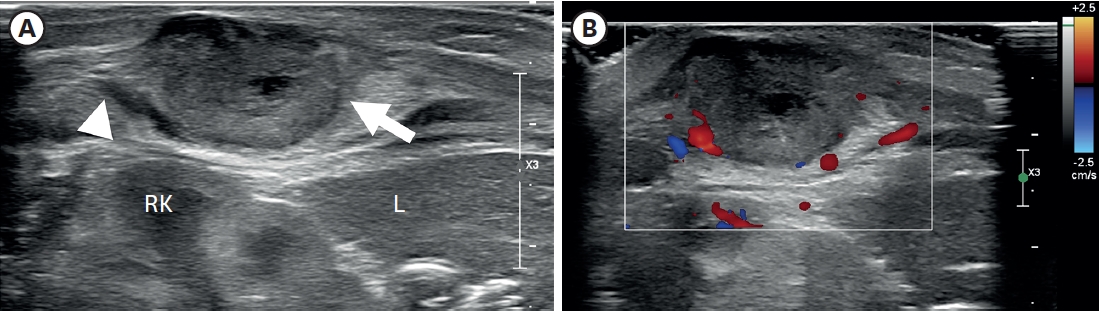
Thyroid cancer is a rare disease in pediatric population, but its incidence rate is increasing. The aim of this report is to present a single institution experience of pediatric thyroid cancer and to identify clinical features, predisposing factors, and postoperative course of pediatric thyroid cancer.
We retrospectively reviewed 35 pediatric patients who underwent operation due to thyroid cancer at Seoul National University Children's Hospital between May 1997 and January 2017. The median follow-up period was 70 months (range, 5–238 months).
The mean age at operation was 12.0±5.91 years and 27 patients were female. The underlying conditions in patients included history of chemoradiotherapy for previous other malignancies (n=4), hypothyroidism (n=3), history of chemotherapy (n=2), family history of thyroid cancer (n=1) and history of radiation therapy (n=1). The initial symptoms were palpable neck mass (n=21) and incidental findings (n=11). Total thyroidectomy (n=30) or unilateral lobectomy (n=5) were performed. There were 15 postoperative complications including transient hypocalcemia in 14 patients and Horner's syndrome in 1 patient. The most common pathologic cell type was papillary thyroid cancer (n=29). Extrathyroid extension and lymph node invasion were found in 25 patients and 27 patients, respectively. Thirteen patients showed multifocality. During follow-up period, 5 patients underwent additional operation because of tumor recurrence in lymph nodes. Lung metastasis was detected in 3 patients at the time of diagnosis and in 3 patients during follow-up period. The mortality rate was zero and mean disease-free survival was 83.7±47.9 months.
Pediatric thyroid cancer has lower mortality rate and recurrence rate as seen in this study despite the advanced stage at diagnosis. A thorough follow-up of patients with an underlying condition such as history of chemoradiotherapy and understanding new pediatric guideline can be helpful to maximize patients' survival and prognosis.
Soft tissue hemangioendothelioma (STHE) is a rare vascular tumor, which has a similar prognosis to borderline malignancy. The disease is poorly understood in pediatric cases because of its low incidence; therefore, we investigated treatment strategies for STHE in children.
We retrospectively analyzed 8 patients with STHE, who were pathologically confirmed between January 1995 and June 2015. The median duration of follow-up was 72 months.
Five were male and the median age at the time of surgery was 1.2 years. Six patients presented with a palpable mass, and 2 patients experienced facial paralysis. The median tumor size was 4.0 cm. The following tumor locations were observed head (2 patients), neck (2 patients), chest wall (1 patient), sacrococcyx (1 patient), upper limb (1 patient), and lower limb (1 patient). The patients underwent either microscopic complete resection (R0) (3 patients), macroscopic complete resection (R1) (2 patients), or macroscopic incomplete resection (R2) (3 patients). After histopathological examination, 6 patients were diagnosed with kaposiform hemangioendothelioma (HE), one with retiform HE, and one with epithelioid HE. Postoperative sequelae occurred as gait disturbance, hearing impairment, and vocal cord palsy. Tumor recurrence or regrowth occurred in 4 patients. These patients underwent reoperation and IFN therapy; however, in the patient with epithelioid HE, metastasis to the scalp occurred after these therapies. The patient with the head tumor who underwent R2 resection, underwent resection three more times, but died 11 months after the first surgery.
When treating STHE in children, R0 resection should be first considered, but recurrence and metastasis should be monitored depending on the size, pathology, and location of the lesion. When major sequelae are expected, function-preserving surgery could be considered, depending on tumor location, size, and nearby organs.
Abdominal actinomycosis is a rare and chronic progressive disease, especially in children. Clinically, it has non-specific symptoms and diagnostic findings as well as low prevalence, making it very difficult to diagnose prior to intraoperative pathological confirmation. For this reason, abdominal actinomycosis is commonly misdiagnosed as appendicitis. After the histopathological diagnosis of abdominal actinomycosis is made, patients should be administered an appropriate antibiotic such as penicillin. Here we describe a case of appendiceal actinomycosis in an 18-year-old girl who was initially diagnosed with acute appendicitis.
Citations

Nodular hidradenoma was diagnosed in a 29-month-old girl on her axilla. Hidradenoma, sometimes designated as acrospiroma, is a benign sweat gland neoplasm, which mostly occurs in adults. Very few cases of hidradenoma have been documented in children in their first decade of life. This case demonstrates that when a child develops a skin nodule, nodular hidradenoma can be a diagnostic option.
Citations
Pancreatic tumors in children are relatively rare, and their prognosis differs from that in adults. The purpose of this study is to examine the clinical characteristics, treatment, and prognosis for children with pancreatic tumors. We retrospectively reviewed the medical records of children under 15 years of age with pancreatic tumors who were treated surgically at Asan Medical Center between January 1992 and November 2009. There were 16 patients, fourteen of whom were pathologically diagnosed with solid pseudopapillary tumor. The other two patients were diagnosed with pancreatoblastoma and acinar cell carcinoma, respectively. Six patients of the 16 patients (38%) were male, and there was a male-to-female ratio of 1:1.6. The initial presentations were upper abdominal pain in eight patients (50%), palpable abdominal mass in three, and vomiting in one. Four patients were diagnosed incidentally. Six patients' tumors were located in the pancreatic head, six in the pancreatic body, and four in the pancreatic tail, respectively. The surgical procedures performed included distal pancreatectomy (n=7, 44%), median segmentectomy (n=3), enucleation (n=3), pancreaticoduodenectomy (n=2), and pylorus-preserving pancreaticoduodenectomy (n=1). Three patients underwent laparoscopic surgery. The median tumor size was 6.5cm (1.8~20 cm). Early surgical complications included pancreatic fistula (n=4), bile leakage (n=1), and delayed gastric emptying (n=1). A late complication in one patient was diabetes. The median follow-up period was five years and four months, and all patients survived without recurrence. While pancreatic tumors in adults have a poor prognosis, pancreatic tumors of childhood are usually curative with complete resection and thus have a favorable prognosis.
Extraosseous Ewing's sarcoma is a rare primary malignant soft tissue tumor which is histologically identical to Ewing's sarcoma. This tumor tends to involve the soft tissue of the lower extremity and paravertebral region of adolescents and young adults but particularly rare in infants. We recently experienced a case of extraosseous Ewing's sarcoma which presented in the left arm of 4 months infant.
Four children with solid and papillary epithelial neoplasm of the pancreas are reported. Three were girls. Mean age at operation was 12 years and 7 months (10-13 years). Clinical presentation included nausea, vomiting, and apalpable mass. One had hemoperitoneum due to tumor rupture. In two cases, tumors were in the body of the pancreas, and one the body and tail, and in one,the tail. Mean diameter of the tumors was 10.8 cm (8-15cm). Surgical procedures were distal pancreatectomy and splenectomy in 2 cases, distal pancreatectomy in one, and subtotal pancreatectomy and splenectomy in one. Mean follow-up period was 61 months (6-121 months). Three patients are still alive without any recurrence. However, in the one case of ruptured tumor, portal vein thrombosis and liver metastasis developed after subtotal pancreatectomy and splenectomy during the course of postoperative adjuvant chemotherapy.
Solid and papillary epithelial neoplasm (SPEN) of the pancreas is a rare tumor with low malignant potentiality that usually occurs in young females. Preoperative evaluation, especially radiologic tests, including ultrasonography and CT scan, is helpful in the diagnosis. These studies demonstrate a well-demarcated large mass with solid and cystic portions, frequently in the tail or body of the pancreas. Complete resection is usually curative, however local invasion and/or metastasis may occur. The authors report a case of a solid and papillary epithelial neoplasm of the pancreatic body in a 14-year old child at St. Benedict Hospital and review the literature.
Thymolipoma is a rare benign mediastinal tumor, composed of mature fatty and thymic tissues. A 9-year-old boy was referred with a one-month history of neck swelling. Preoperative computed tomography scan and fine needle aspiration biopsy suggested thymolipoma. Despite it being rare, thymolipoma should be considered in the differential diagnosis of mediastinal tumors. Characteristics of its clinical feature and radiological findings that can differentiated it from other mediastinal tumors are discussed with a review of the literatures.
Citations
Beckwith-Wiedemann syndrome presents with multisystemic patterns of congenital anomalies and macrosomia. This syndrome was independently described by Beckwith in 1963 and by Wiedemann in 1964. There is wide spectrum of clinical manifestations, including prenatal or postnatal overgrowth, neonatal hypoglycemia, macroglossia, visceromegaly, omphalocele, hemihypertrophy and a predisposition for embryonal tumors, most frequently Wilms' tumor. We managed a case of Beckwith-Wiedemann syndrome with left adrenal cortical neoplasm of undetermined malignancy.
Citations
Solid and papillary cystic neoplasm of pancreas is an uncommon low grade malignant tumor found predominantly in young female in their second or third decade of life, and amenable cure by surgical treatment. The authors report two cases of solid and papillary neoplasm of pancreas pathologically verified at Kyung Hee university hospital. The first case was 11-years old male patient and the other case was 12-years old male patient. Symptoms of two patients were abdominal discomfort, nausea and vomiting and abdominal pain in the female patient. CT finding of solid and papillary neoplasm of pancreas depict a well-demarcated mass with solid and cystic necrosis component. In female patient, large hematoma was shown. Gross findings of tumor revealed apparent encapsulation, cystic degeneration and hemorrhagic necrosis. Microscopically the tumors were characterized by distinctive solid and papillary patterns of cellular arrangement without local invasion. All patients were discharged and follow up without any problem.
Although intraperitoneal teratomas are rare, teratomas of the greater omentuma are seldom reported. A single case of omental teratoma with torsion in a 26-month-old girl is reported. The patient presented with abdominal pain and a palpable mass. Ultrasonography and CT of the abdomen showed a large cystic mass with a non homgenious solid component composed of fat and calcification. The lesion was surgically excised. Pathology revealed a mature omental teratoma. The hospital course was uneventful.
Adrenal cortical tumors are rare in adults and children. Most are malignant and functional. The principal clinical features are virilization, Cushing's syndrome, hyperaldosteronism and feminization. Recently, we treated a case of virilizing adrenal cortical tumor in a 26 month-old boy. The diagnosis was made by hormone assay, abdominal CT and tissue pathology. Right adrenalectomy was successful performed. Pathologic examination revealed an adrenal cortical adenoma with vascular invasion.
Six children with solid and papillary epithelial neoplasm of the pancreas were studied retrospectively. There were 2 boys and 4 girls. The mean age at operation was 11 years(range; 8-13years). Three patients had incidental abdominal mass, in two patients the mass was non-tender, in one patient the mass was tender. The minimum size of tumor was 6.5 × 6.0 cm and the maximum was 10.5 × 8.0 cm. Five tumors were located in the head of the pancreas, and the other one in the tail. Local invasion or metastasis was not noticed. Tumors were removed completely by performing the following operations: 3 pylorous preserving pancreaticoduodenectomy, 2 Whipple's operation and 1 distal pancreatectomy. There was no mortality. The histologic findings were characteristic. There were no recurrences during a follow-up of 0.5 to 12 years (mean; 5.0 years).
Precocious puberty is difficult to define because of the marked variation in the age at which puberty begins normally, onset of puberty before 8 years of age in girls and 9 years in boys may be considered precocious. The etiology of precocious puberty in boys is usually idiopathic, but can result from adrenal and testicular tumors. The hepatoblastoma that produces hCG is a very rare functioning tumor known to cause precocious puberty in boys. Recently, author experienced one case of virilizing adrenal cortical adenoma in 22 month-old boy, one case of adrenal cortical carcinoma in 28 month-old boy, and one case of virilizing hCG-producing hepatoblastoma in 7 year-old boy and reviewed literatures.
Two cases with papillary cystic neoplasm of the pancreas are reviewed and discussed. Up to recently, the tumors have been misclassified as nonfunctioning islet cell tumor or carcinoma, acinar cell carcinoma, papillary cystadenocarcinoma, or pancreatoblastoma. It frequently has been managed with aggressive surgery such as pancreatoduodenectomy. The tumors are well encapsulated and the cut surfaces are characteristically solid and hemorrhagic. Ultrasonography and CT scan are the most useful tools for the diagnosis. The neoplasms usually behave like a very low grade malignancy, so complete removal is the treatment of choice for the tumor arising anywhere in the pancreas. We have a boy and a girl who have papillary cystic neoplasm. The boy was 12 years old and the girl was 14 years old. Both underwent distal panereatectomy and the progress were uneventfuL We have a boy and a girl who have papillary cystic neoplasm. The boy was 12 years old and the girl was 14 years old. Both underwent distal pancreatectomy and the progress were uneventful.
Citations
Citations
 First
First Prev
Prev