Skip to main navigation Skip to main content
  • KAPS
  • E-Submission

APS : Advances in Pediatric Surgery

OPEN ACCESS
ABOUT
BROWSE ARTICLES
EDITORIAL POLICY
FOR CONTRIBUTORS
Review Article

Neonate Congenital Bochdalek Hernia: A National Survey of Its Members by Korean Association of Pediatric Surgeons

Journal of the Korean Association of Pediatric Surgeons 2016;22(1):6-9.
Published online: June 30, 2016

Korean Association of Pediatric Surgeons, Korea.

Correspondence: Dae Yeon Kim, Division of Pediatric Surgery, Department of Surgery, Asan Medical Center, University of Ulsan College of Medicine, 88 Olympic-ro 43-gil, Songpa-gu, Seoul 05505, Korea. Tel: +82-2-3010-3961, Fax: +82-2-3010-6841, kimdy@amc.seoul.kr
• Received: May 31, 2016   • Accepted: May 31, 2016

Copyright © 2016 by the Korean Association of Pediatric Surgeons

This is an Open Access article distributed under the terms of the Creative Commons Attribution Non-Commercial License (https://creativecommons.org/licenses/by-nc/4.0) which permits unrestricted non-commercial use, distribution, and reproduction in any medium, provided the original work is properly cited.
  • 1 Views
  • 0 Download
prev next
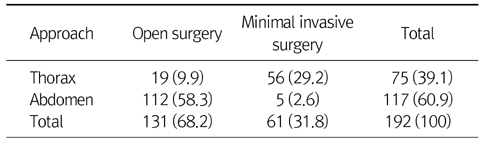
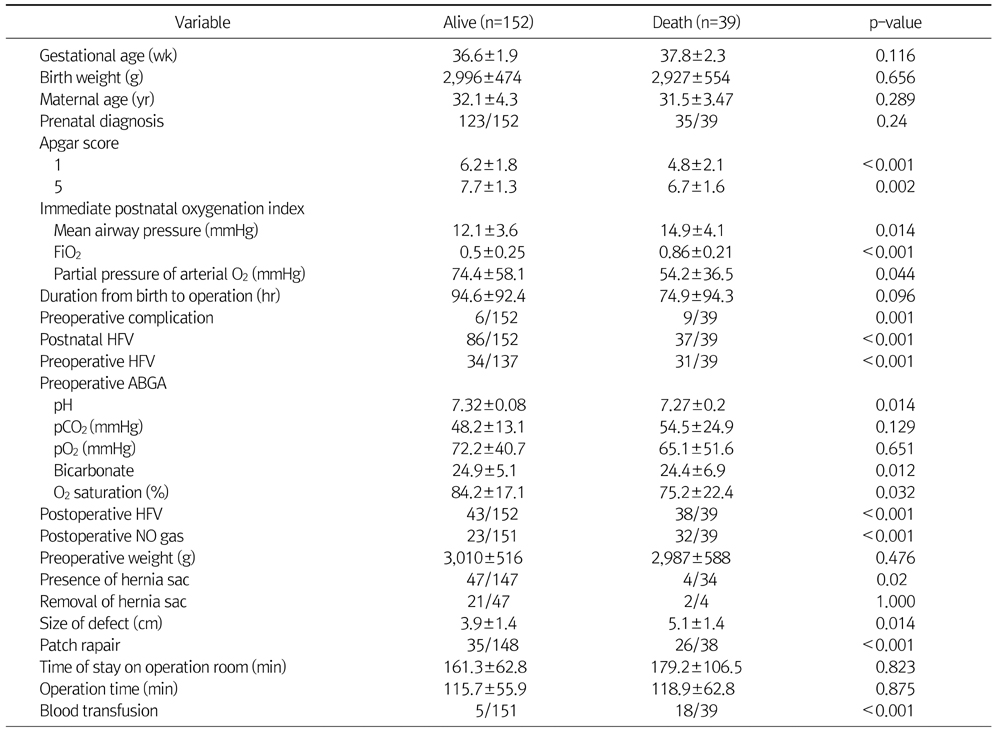
  • This is a survey on congenital posterolateral diaphragmatic hernia, conducted by Korean Association of Pediatric Surgeons (KAPS). A registration form for each patient during the 5-year period between 2010 and 2014 and a questionnaire were sent to each member. Twenty-six members in 16 institutions returned completed forms. Total patients were 219. Prenatal diagnoses were done in 181 cases (82.6%). Preoperative mortality was 11.4%. Minimal invasive surgery was done in 61 cases (31.8%). Risk factors related with death were Apgar score, oxygenation index, preoperative pH and bicarbonate, O2 saturation, the presence of hernia sac, and the size of defect. The neonatal survival and 1-year survival of total patients were 77.6% and 75.3%.

No potential conflict of interest relevant to this article was reported.

  • 1. Kim JC, Kim DY, Kim SY, Kim SC, Kim IK, Kim JE, et al. Congenital posterolateral diaphragmatic hernia in Korea: a survey by the Korean Association of Pediatric Surgeons. J Korean Assoc Pediatr Surg 2006;12:53-69.
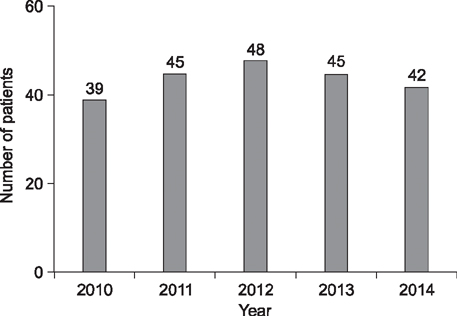
Fig. 1

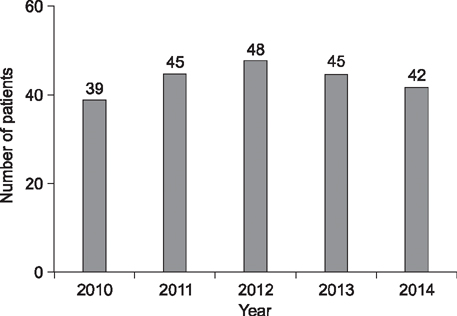
Number of patients by year.

jkaps-22-6-g001.jpg
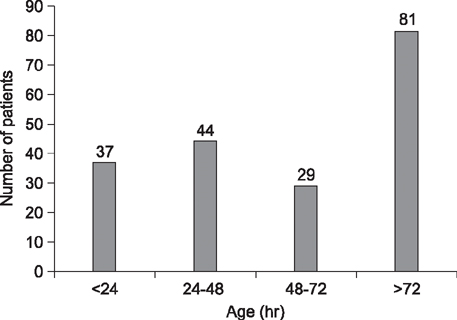
Fig. 2

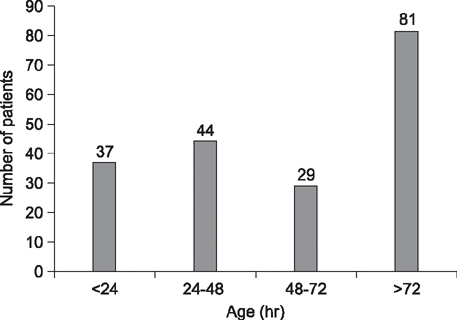
Number of patients by operation age.

jkaps-22-6-g002.jpg
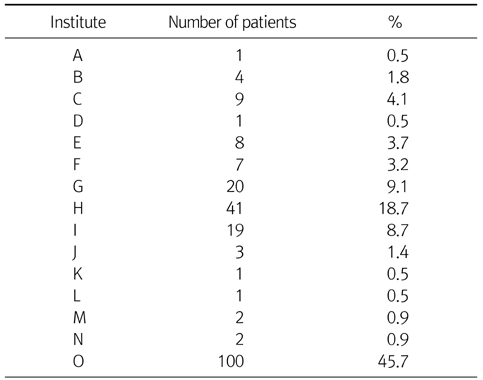
Table 1

Number of Patients by Each Institute (n=219)

The sum of the percentages does not equal 100% because of rounding.

jkaps-22-6-i001.jpg
Table 2

Surgical Approach

Values are presented as n (%)

jkaps-22-6-i002.jpg
Table 3

Risk Analysis: Perioperative Findings

Values are presented as mean±SD or n only (number of patients/total number of patients).

HFV, high frequency ventilation; ABGA, arterial blood gas analysis; NO, nitric oxide.

jkaps-22-6-i003.jpg

Download Citation

Download a citation file in RIS format that can be imported by all major citation management software, including EndNote, ProCite, RefWorks, and Reference Manager.

Format:

Include:

Neonate Congenital Bochdalek Hernia: A National Survey of Its Members by Korean Association of Pediatric Surgeons
J Korean Assoc Pediatr Surg. 2016;22(1):6-9.   Published online June 30, 2016
Download Citation

Download a citation file in RIS format that can be imported by all major citation management software, including EndNote, ProCite, RefWorks, and Reference Manager.

Format:
Include:
Neonate Congenital Bochdalek Hernia: A National Survey of Its Members by Korean Association of Pediatric Surgeons
J Korean Assoc Pediatr Surg. 2016;22(1):6-9.   Published online June 30, 2016
Close

Figure

  • 0
  • 1
Neonate Congenital Bochdalek Hernia: A National Survey of Its Members by Korean Association of Pediatric Surgeons
Image Image
Fig. 1 Number of patients by year.
Fig. 2 Number of patients by operation age.
Neonate Congenital Bochdalek Hernia: A National Survey of Its Members by Korean Association of Pediatric Surgeons

Number of Patients by Each Institute (n=219)

The sum of the percentages does not equal 100% because of rounding.

Surgical Approach

Values are presented as n (%)

Risk Analysis: Perioperative Findings

Values are presented as mean±SD or n only (number of patients/total number of patients).

HFV, high frequency ventilation; ABGA, arterial blood gas analysis; NO, nitric oxide.

Table 1 Number of Patients by Each Institute (n=219)

The sum of the percentages does not equal 100% because of rounding.

Table 2 Surgical Approach

Values are presented as n (%)

Table 3 Risk Analysis: Perioperative Findings

Values are presented as mean±SD or n only (number of patients/total number of patients).

HFV, high frequency ventilation; ABGA, arterial blood gas analysis; NO, nitric oxide.