


Purpose
The Korean Association of Pediatric Surgeons (KAPS) has conducted annual national surveys, each year addressing a different topic regarding pediatric surgical diseases, and the data of these surveys are discussed at each respective annual spring meeting of KAPS.
Methods
In 2002 and 2017, KAPS conducted two national surveys for choledochal cysts. The authors reviewed the data from the national surveys and analyzed the differences or changes in demographic characteristics, clinical findings, diagnostic methods, treatment, and outcomes of pediatric patients with choledochal cysts who had been treated by KAPS members.
Results
A total of 348 and 241 patients with choledochal cysts were enrolled in the first and second national surveys, respectively. The male-to-female ratio was 1:3.4 and 1:2.7 in the first and second national surveys, respectively. In both national surveys, abdominal pain was the most common clinical symptom. The most common type of choledochal cyst was type I in 71.3% and 73.9% of patients in the first and second national surveys, respectively. In the first national survey, all 348 patients underwent open surgery. However, in the second national survey of 241 patients, open, laparoscopic, and robotic surgeries were performed in 102 (42.3%), 75 (31.1%), and 56 (23.2%) patients, respectively. Cyst excision with Roux-en-Y hepaticojejunostomy was performed in 339 (98.8%) of 343 patients in the first national survey and 240 (99.6%) of 241 patients in the second national survey.
Conclusion
These national surveys provide current status, general information, and comprehensive treatment and outcomes for pediatric patients with choledochal cysts in Korea. This study could provide significant knowledge and reference for pediatric surgeons seeking to better understand choledochal cysts and treatment options for this disease.
 ,1,2
Dae Yeon Kim,2
Seong Chul Kim,2
Hyun-Young Kim,2
So Hyun Nam,2
Jeong-Meen Seo,2
Jung-Tak Oh,2
Myung-Duk Lee,2
Suk-Koo Lee,2
Soo Min Ahn,2
Hye Kyung Chang,2
Sung Eun Jung,2
Yeon Jun Jeong,2
Eunyoung Jung,2
Jae Hee Chung,2
Yong Hoon Cho,2
Soon Ok Choi,2
Seung Hoon Choi,2
Yun Mee Choe,2
Seok Joo Han,2
Jeong Hong,2
and Nam-Hyuk Lee2,3
,1,2
Dae Yeon Kim,2
Seong Chul Kim,2
Hyun-Young Kim,2
So Hyun Nam,2
Jeong-Meen Seo,2
Jung-Tak Oh,2
Myung-Duk Lee,2
Suk-Koo Lee,2
Soo Min Ahn,2
Hye Kyung Chang,2
Sung Eun Jung,2
Yeon Jun Jeong,2
Eunyoung Jung,2
Jae Hee Chung,2
Yong Hoon Cho,2
Soon Ok Choi,2
Seung Hoon Choi,2
Yun Mee Choe,2
Seok Joo Han,2
Jeong Hong,2
and Nam-Hyuk Lee2,3
The Korean Association of Pediatric Surgeons (KAPS) has conducted annual national surveys, each year addressing a different topic regarding pediatric surgical diseases, and the data of these surveys are discussed at each respective annual spring meeting of KAPS.
In 2002 and 2017, KAPS conducted two national surveys for choledochal cysts. The authors reviewed the data from the national surveys and analyzed the differences or changes in demographic characteristics, clinical findings, diagnostic methods, treatment, and outcomes of pediatric patients with choledochal cysts who had been treated by KAPS members.
A total of 348 and 241 patients with choledochal cysts were enrolled in the first and second national surveys, respectively. The male-to-female ratio was 1:3.4 and 1:2.7 in the first and second national surveys, respectively. In both national surveys, abdominal pain was the most common clinical symptom. The most common type of choledochal cyst was type I in 71.3% and 73.9% of patients in the first and second national surveys, respectively. In the first national survey, all 348 patients underwent open surgery. However, in the second national survey of 241 patients, open, laparoscopic, and robotic surgeries were performed in 102 (42.3%), 75 (31.1%), and 56 (23.2%) patients, respectively. Cyst excision with Roux-en-Y hepaticojejunostomy was performed in 339 (98.8%) of 343 patients in the first national survey and 240 (99.6%) of 241 patients in the second national survey.
These national surveys provide current status, general information, and comprehensive treatment and outcomes for pediatric patients with choledochal cysts in Korea. This study could provide significant knowledge and reference for pediatric surgeons seeking to better understand choledochal cysts and treatment options for this disease.
Choledochal cysts are a rare congenital anomaly affecting the biliary tract. It is characterized by various degrees of congenital abnormal extrahepatic and/or intrahepatic biliary tract dilatation [1]. This dilatation can cause several symptoms, including abdominal pain, jaundice, and recurrent infections. Choledochal cysts are typically diagnosed in childhood but can also be identified in adults. There are several classification systems for choledochal cysts, of which the Todani classification system is the most frequently used [2]. This classification system is useful for guiding treatment decisions and predicting outcomes. To remove the cyst and reconstruct the bile ducts to prevent complications, including recurrent cholangitis, pancreatitis, perforation of the cyst, or even malignant degeneration, choledochal cysts are frequently treated with surgical intervention. Since 1991, the Korean Association of Pediatric Surgeons (KAPS) has conducted annual national surveys, each year addressing a different topic regarding pediatric surgical diseases, and the data of these surveys are discussed at the annual spring meeting of KAPS. Therefore, in 2002 and 2017, KAPS conducted two national surveys to its members regarding choledochal cysts; subsequently, the data of these surveys were discussed at the 18th and 33rd annual spring meeting of KAPS, which were held in Jeonbuk National University on June 21–22, 2002 and Sol Beach Hotel and Resort, Samcheok, on June 15–16, 2017.
The first national survey of KAPS for choledochal cysts in 2002 was conducted for 5 years, from 1997 to 2001, on 39 KAPS members working in 32 pediatric surgical centers in Korea; in 2003, the results of this survey were subsequently published in the Journal of the Korean Association of Pediatric Surgeons [1]. Afterward, a second national survey of KAPS was conducted to identify any differences or changes in demographic characteristics, clinical findings, diagnostic methods, treatment, and outcomes of pediatric patients with choledochal cysts. The second national survey in 2017 was conducted for 3 years, from 2013 to 2015. Before the survey, we made the case registration form, which included data regarding age, gender, clinical presentation, preoperative diagnostic work-up, type of choledochal cyst, treatment, and outcomes. The case registration form was sent to KAPS members and was completed in 16 pediatric surgical centers, with a total of 241 patients. The Todani classification system was used at the second national survey to classify the type of choledochal cyst. Comparing the data of the two national surveys was challenging since the case registration form used in the first and second national surveys were different; however, the results of these surveys were simply compared without statistical verification. The study protocol was approved by the Institutional Review Board (IRB) of Kyungpook National University Hospital (IRB No. 2023-09-025).
A total of 348 patients were enrolled in the first national survey, which included 59, 63, 73, 74, and 79 patients in 1997, 1998, 1999, 2000, and 2001, respectively. A total of 241 patients were enrolled in the second national survey, which included 89, 81, and 71 patients in 2013, 2014, and 2015, respectively (Fig. 1).
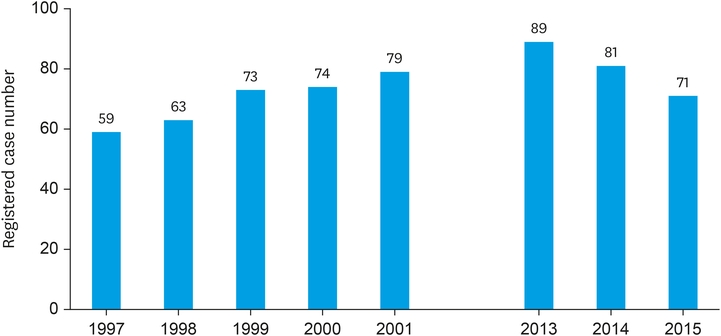
Fig. 1
Registered case number by year.
In the first national survey, there were 79 males and 269 females, with a male-to-female ratio of 1:3.4. In the second national survey, there were 65 males and 176 females, with a male-to-female ratio of 1:2.7. Age at diagnosis varied from 1 day to 180 months (mean, 49.0±44.4 months) in the first national survey and from 1 day to 16.5 years (mean, 24 months) in the second national survey. Regarding the distribution by age, in the second national survey, 109 (45.2%) patients were the most prevalent between the ages of 1 and 5, and this was similar to the first national survey, with 171 (49.1%) patients occurring most frequently between the ages of 1 and 5 (Table 1). The national geographic distribution of patients with choledochal cysts was investigated on the basis of their place of birth in the first national survey and the hospital where they were operated in the second national survey. Characteristically, in the second national survey, several choledochal cysts (n=196, 81.3%) were operated at hospitals located in Seoul (Table 2).
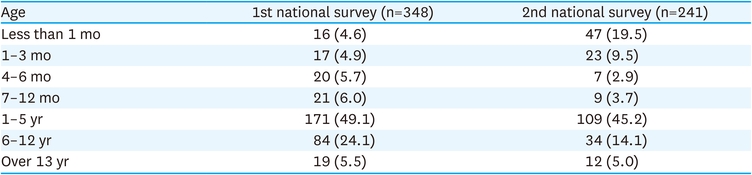
Table 1
Age distribution
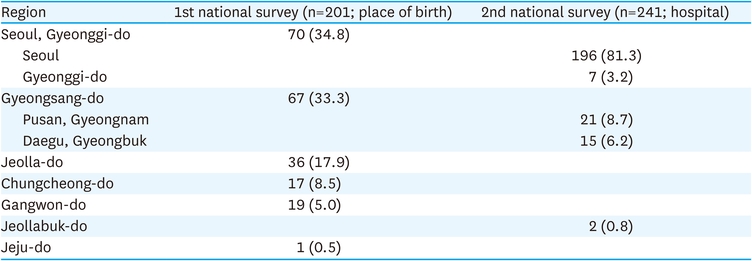
Table 2
National geographic distribution of patients
Regarding the clinical presentation of choledochal cysts, abdominal pain was the most common symptom with 222 (63.8%) patients, followed by nausea/vomiting and jaundice in 123 (35.3%) and 101 (29.1%) patients, respectively, in the first national survey. Similarly, in the second national survey, abdominal pain was the most common symptom with 131 (54.4%) patients, followed by nausea/vomiting in 74 (30.7%) patients (Table 3).
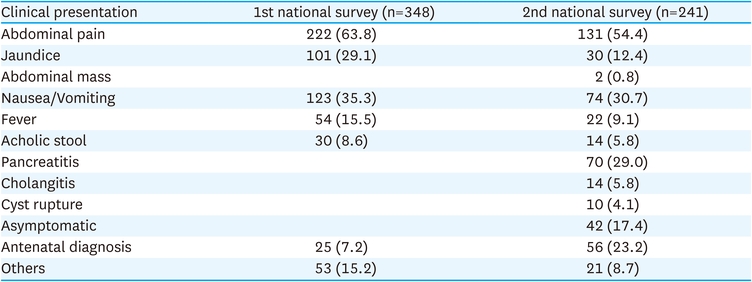
Table 3
Clinical presentation
The most common type of choledochal cyst was type I in 238 (71.3%) and 176 (73.9%) patients in the first and second national surveys, respectively (Table 4). Regarding the presence or absence of a preoperative biliary stone, 297 (84.9%) and 173 (71.8%) patients did not have a biliary stone in the first and second national surveys, respectively. When preoperative biliary stones were present, they were most frequently located in the common bile duct in both the first and second national surveys (Table 5).
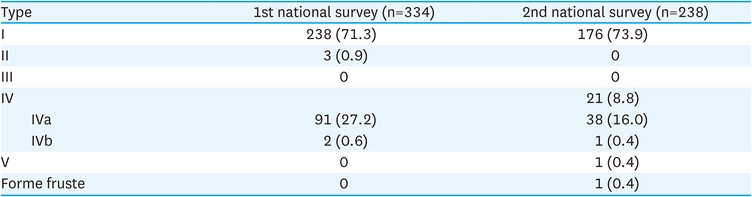
Table 4
Anatomical classification by the Todani classification
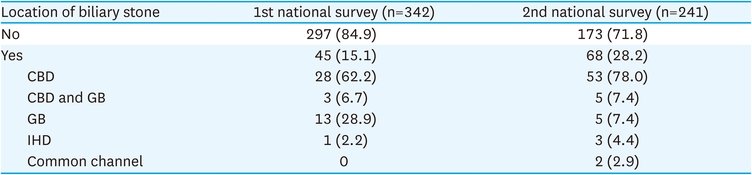
Table 5
Preoperative biliary stones
For the preoperative liver fibrosis of patients with choledochal cysts, in the first national survey, 102 (74.5%) and 31 (22.6%) patients were grades 0 and 1, respectively. In the second national survey, 69 (63.3%) and 19 (17.4%) patients were grades 0 and 1, respectively (Table 6).
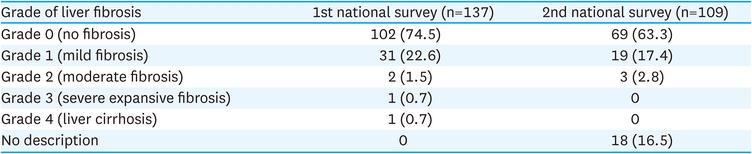
Table 6
Ohkuma’s classification of liver fibrosis
In the first national survey, regarding the presence or absence of APBDU, it was confirmed in 176 (51.5%) patients. Additionally, 92 (52.3%), 51 (29.0%), and 26 (14.8%) patients did not have APBDU, had biliary duct to pancreatic duct type, and had pancreatic duct to biliary duct type, respectively. In the second national survey, it was confirmed in 138 (57.3%) patients. Moreover, 35 (25.4%), 41 (29.7%), and 49 (35.5%) patients did not have APBDU, had biliary duct to pancreatic duct type, and had pancreatic duct to biliary duct type, respectively (Table 7).
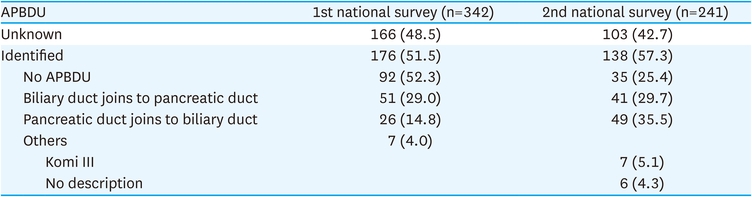
Table 7
APBDU
Twenty-six (46.6%) patients underwent surgery within 28 days of birth, 14 (25%) after 3 months of birth, and 12 (21.4%) within 1–2 months after birth (Table 8).

Table 8
Time of operation in 56 cases of prenatal-diagnosed choledochal cysts in the second national survey
In the first national survey, KAPS members were asked about preoperative diagnostic methods, and ultrasonography (97%) and computed tomography (70%) were performed most frequently. In the second national survey of 241 patients, ultrasonography and magnetic resonance cholangiopancreatography were performed in 213 (88.4%) and 195 (80.9%) patients, respectively (Table 9). Furthermore, in the second national survey, 212 (88.0%), 15 (51.7%), and 6 (20.7%) patients did not undergo a preoperative procedure, underwent endoscopic sphincterotomy, and underwent percutaneous transhepatic biliary drainage, respectively (Table 10).
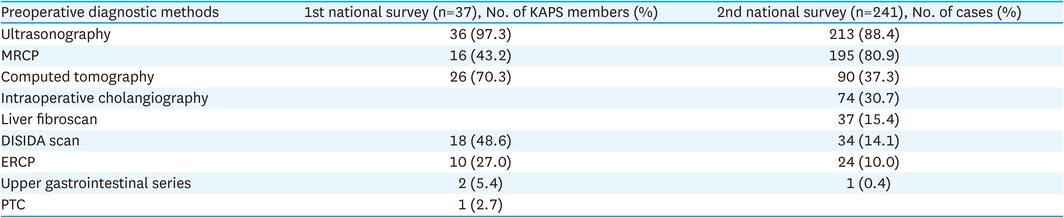
Table 9
Preoperative diagnostic work-up methods
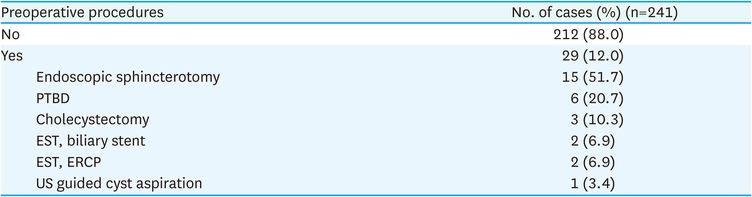
Table 10
Preoperative procedures of 2nd national survey
In the first national survey, all 348 patients underwent open surgery. However, in the second national survey of 241 patients, open, laparoscopic, and robotic surgeries were performed in 102 (42.3%), 75 (31.1%), and 56 (23.2%) patients, respectively (Table 11). Cyst excision with Roux-en-Y hepaticojejunostomy was performed in 339 (98.8%) of 343 patients in the first national survey and 240 (99.6%) of 241 patients in the second national survey (Table 12).

Table 11
Mode of surgery
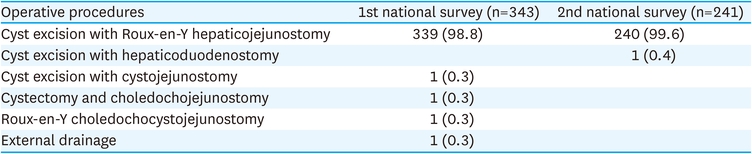
Table 12
Operative procedures
In the first national survey, a total of 36 early and 23 late complications developed following open surgery. In the second national survey, a total of thirteen complications developed following open surgery, including three, two, two, and two cases of wound infection, cholangitis, pancreatitis, and abscess or fluid collection, respectively. Following laparoscopic surgery, a total of fourteen complications developed, including three, three, two, and two cases of anastomotic leakage, cholangitis, wound infection, and bleeding, respectively. Following robotic surgery, a total of four complications developed, including two, one, and one case of wound infection, bowel perforation, and ileus, respectively (Table 13).
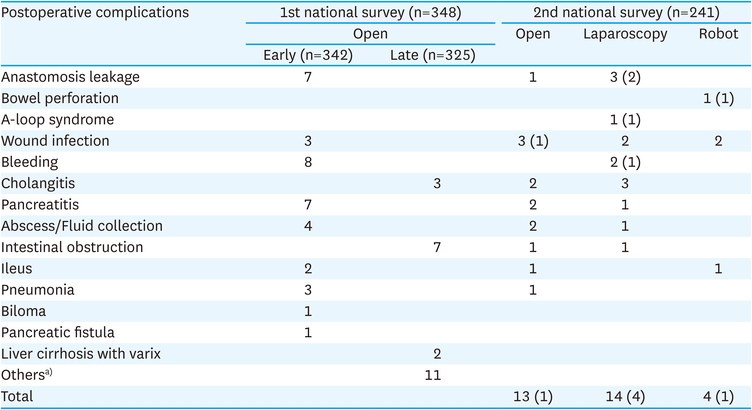
Table 13
Postoperative complications
The mean operation time was 242.9±86.5, 292.8±94.9, and 403.8±82.6 minutes for open, laparoscopic, and robotic surgeries, respectively. The mean length of admission was 12.6±6.8, 10.7±7.0, and 11.5±3.8 days for open, laparoscopic, and robotic surgeries, respectively. Postoperative complications developed in 12.7%, 18.7%, and 7.1% of patients in open, laparoscopic, and robotic surgeries, respectively. Reoperation was performed in 1.0%, 5.3%, and 1.8% of patients in open, laparoscopic, and robotic surgeries, respectively. No mortality cases were noted in all surgeries (Table 14).

Table 14
Comparison between open, laparoscopic, and robotic surgeries in the second national survey
The first national survey of KAPS for choledochal cysts in 2002 was conducted for 5 years, from 1997 to 2001, and the second national survey in 2017 was conducted for 3 years, from 2013 to 2015. Fifteen years had elapsed between the first and second national surveys for choledochal cysts, and the data of the two national surveys were simply compared. No significant changes or differences in demographic and clinical characteristics, including age, gender, clinical presentation, type of choledochal cyst, and diagnostic methods of choledochal cyst, were observed.
Recently, with the development of prenatal ultrasonography screening, the prenatal diagnosis of patients with choledochal cysts is increasing [3]. In the case of the authors, 7.2% of patients were diagnosed through prenatal examination in the first national survey, whereas 23.2% of patients were diagnosed through prenatal examination in the second national survey.
The first experience with laparoscopic surgery for a choledochal cyst in a 6-year-old girl was reported by Farello et al. [4] in 1995. Woo et al. [5] published the first robot-assisted laparoscopic resection for a 5-year-old girl with a type I choledochal cyst . Subsequently, in several pediatric surgical centers worldwide, the surgical treatment of choledochal cysts has been shifting from an open procedure to a laparoscopic or robot-assisted procedure. This trend was confirmed through the change of surgical methods in the first and second national surveys. All surgeries were performed using open surgery in the first national survey, whereas in the second national survey, open, laparoscopic, and robotic surgeries were performed in 42.3%, 31.1%, and 23.2% of patients, respectively. With the advent of pediatric minimally invasive surgery, several studies on the safety and feasibility of laparoscopic or robot-assisted procedures for the treatment of choledochal cysts have been reported [6, 7, 8, 9, 10, 11]. Koga et al. [6] reported that robotic hepaticojejunostomy anastomosis would be superior to laparoscopic hepaticojejunostomy anastomosis in children undergoing choledochal cyst excision. Xie et al. [7] reported that robot-assisted procedures for pediatric choledochal cysts had similar surgical effects as open procedures and had lower technical requirements. Moreover, they showed that compared with robot-assisted and open procedures, laparoscopic procedures were the most technique-demanding approaches . In a systematic review and meta-analysis by Yin et al. [10], laparoscopic and robotic-assisted cyst excision with Roux-en-Y hepaticojejunostomy had comparable postoperative outcomes .
Unfortunately, this study was a simple comparison of data without any statistical validation between two national surveys for choledochal cysts. Additionally, long-term follow-up data were lacking. However, these national surveys provide current status, general information, and comprehensive treatment and outcomes for pediatric patients with choledochal cysts in Korea. Therefore, we anticipate that it could provide significant knowledge and reference for pediatric surgeons seeking to better understand choledochal cysts and treatment options for this disease. In the next third national survey, it would be better to statistically analyze and compare the outcomes according to open, laparoscopic, and robot-assisted procedures as treatment options for choledochal cysts.
Conflict of Interest:No potential conflict of interest relevant to this article was reported.



